










Mahanadi Coalfields Receivables Rose 73.30%, Customers Unnamed
Key highlights
- Mahanadi Coalfields reported Rs 3,743.68 crore of net trade receivables at March 31, 2026, up 73.30% from Rs 2,160.29 crore at March 31, 2024.
- Mahanadi Coalfields’ trade receivable days increased from 22 in Fiscal 2024 to 41 in Fiscal 2026.
- Net trade receivables were Rs 3,767.78 crore at September 30, 2026, 0.64% above the March 31, 2026 balance.
- The disclosed receivables table does not name customers or substantiate a two-utility, nearly two-thirds concentration claim.
powered by IRIS
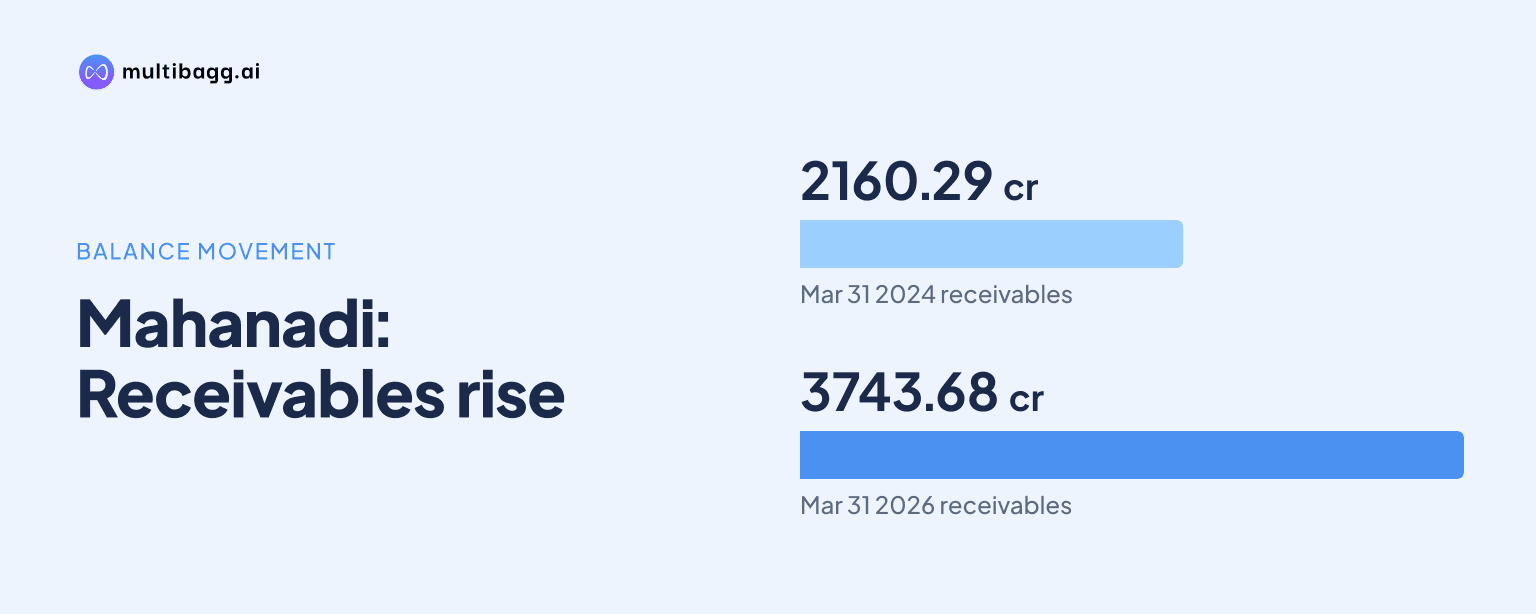
Mahanadi Coalfields Limited reported Rs 3,743.68 crore of net trade receivables at March 31, 2026, up 73.30% from Rs 2,160.29 crore at March 31, 2024, while the supplied disclosure does not identify two Andhra Pradesh utilities or substantiate a nearly two-thirds concentration. Revenue from operations fell 3.43% between Fiscal 2024 and Fiscal 2026.
What does Mahanadi Coalfields’ receivables disclosure establish?
Mahanadi Coalfields establishes that net trade receivables rose sharply between March 31, 2024 and March 31, 2026. The balance increased from Rs 2,160.29 crore at March 31, 2024 to Rs 2,676.05 crore at March 31, 2025 and Rs 3,743.68 crore at March 31, 2026. The company specifically reports the two-year increase as 73.30%.
Mahanadi Coalfields also reported a further increase in the six months ended September 30, 2026. Net trade receivables were Rs 3,767.78 crore at September 30, 2026, up Rs 24.10 crore, or 0.64%, from March 31, 2026. The table classifies the full net balance as unsecured considered good, meaning no collateral-backed receivables were reported for any of the five presented dates.
Why did Mahanadi Coalfields’ receivables rise while revenue declined?
Mahanadi Coalfields’ disclosed figures show receivables growing as annual revenue declined. Revenue from operations decreased from Rs 31,643.45 crore in Fiscal 2024 to Rs 30,549.59 crore in Fiscal 2026, a 3.43% decline, while net trade receivables rose by Rs 1,583.39 crore over the same dates. The disclosure does not attribute this divergence to a particular customer, billing mechanism, payment dispute or collection delay.
Mahanadi Coalfields’ trade receivable days rose from 22 days in Fiscal 2024 to 41 days in Fiscal 2026. Trade receivable days measure the receivables balance relative to revenue and provide an indication of the time represented by outstanding dues. The 19-day increase indicates that the Fiscal 2026 year-end receivables balance was larger relative to revenue than it was in Fiscal 2024.
The interim comparison shows some movement in the other direction on this measure, although the balance remained elevated. Trade receivable days were 36 days for the six months ended September 30, 2026, compared with 39 days in the corresponding 2025 period and 41 days in Fiscal 2026. Net receivables at September 30, 2026 were nevertheless Rs 480.08 crore above the Rs 3,287.70 crore reported at September 30, 2025.
Do two Andhra Pradesh utilities account for nearly two-thirds of Mahanadi Coalfields’ receivables?
The disclosed receivables information does not establish that two Andhra Pradesh state utilities account for nearly two-thirds of Mahanadi Coalfields’ receivables. At September 30, 2026, the table provides only credit-quality categories: Rs 3,767.78 crore was unsecured considered good and Rs 62.06 crore was credit impaired before allowance. It does not name customers, states, ownership categories or customer-level balances.
A concentration finding requires the combined dues from identified customers and a stated total-receivables denominator. Mahanadi Coalfields reports a Rs 3,767.78 crore net receivables balance at September 30, 2026, but provides no schedule that links any part of that amount to Andhra Pradesh utilities. The available classification therefore cannot establish whether two customers represent nearly two-thirds, or any other stated share, of the balance.
Mahanadi Coalfields does disclose concentration among contractors, but that is a separate measure. Its top 10 contractors accounted for 63.61% of contractual expenses in the six months ended September 30, 2026, versus 56.38% in the corresponding 2025 period. That statistic concerns payments to service providers and cannot be used to infer concentration among coal customers that owe trade receivables.
Got a follow-up? Ask IRIS
What does Mahanadi Coalfields’ expected-credit-loss allowance show?
Mahanadi Coalfields reported an expected credit loss allowance of Rs 62.06 crore at September 30, 2026, equal to the Rs 62.06 crore classified as credit impaired. Expected credit loss is an accounting allowance for estimated non-collection of receivables. Gross trade receivables were Rs 3,829.84 crore at September 30, 2026 before deduction of the allowance.
The reported allowance does not apply to the Rs 3,767.78 crore described as unsecured considered good at September 30, 2026. This follows directly from the table’s classification, where the allowance matches the credit-impaired category and reduces gross receivables to the unsecured-considered-good balance. The disclosure does not identify the customers in either category, so it cannot show whether a specific utility’s dues carry an allowance.
Mahanadi Coalfields’ allowance was Rs 105.94 crore at March 31, 2024, Rs 43.65 crore at March 31, 2025 and March 31, 2026, and Rs 62.06 crore at September 30, 2026. The company reported no bad debts written off in Fiscal 2024, Fiscal 2025, Fiscal 2026 or either six-month period ended September 30. No write-off figure, however, does not provide a customer-specific assessment of future collections.
How should Mahanadi Coalfields’ receivables trend be assessed from the disclosed data?
Mahanadi Coalfields identifies counterparty credit risk because customers may delay or fail to make payments in the normal course of business. At September 30, 2026, the company had Rs 3,767.78 crore of net receivables and 36 trade receivable days, with no disclosed bad-debt write-offs. Its stated risk is that inability to collect dues in time, or at all, could affect its financial condition, results of operations and cash flows.
The Fiscal 2025-to-Fiscal 2026 comparison makes the changing relationship between revenue and receivables clear. Fiscal 2026 receivables of Rs 3,743.68 crore were Rs 1,067.63 crore above Fiscal 2025, while Fiscal 2026 revenue of Rs 30,549.59 crore was Rs 803.43 crore below Fiscal 2025 revenue of Rs 31,353.02 crore. This combination coincided with trade receivable days rising from 28 to 41 days.
Mahanadi Coalfields has not disclosed a customer-level collection target, ageing schedule or payment timetable in the information provided. Sustained improvement would require collections to reduce outstanding dues relative to revenue, while the accounting allowance would need to continue reflecting changes in the credit quality of receivables. Customer names and balances would also be required to measure any dependency on individual state utilities.
Conclusion
Mahanadi Coalfields’ reported receivables increased 73.30% to Rs 3,743.68 crore between March 31, 2024 and March 31, 2026 despite a 3.43% decline in revenue, and trade receivable days increased from 22 to 41. The September 30, 2026 balance of Rs 3,767.78 crore remained entirely classified as unsecured considered good after the Rs 62.06 crore allowance for credit-impaired receivables.
The unresolved matter is customer concentration: the disclosure does not identify any Andhra Pradesh utility, provide customer-level ageing, or map the expected-credit-loss allowance to individual debtors. Subsequent financial statements will show whether collections reduce the 36 trade receivable days reported for the six months ended September 30, 2026 and whether the allowance changes from Rs 62.06 crore.