










Mahanadi Coalfields has no independent directors, seeks SEBI relief
Key highlights
- Mahanadi Coalfields disclosed zero independent directors on a six-member board.
- Mahanadi Coalfields said at least six independent directors, including one woman, were required under its stated Regulation 17(1) position.
- Mahanadi Coalfields filed its wider SEBI governance-exemption request on August 31, 2026.
- The request covered four board committees, two committee mandates and an independent-director committee for price-band approval.
powered by IRIS
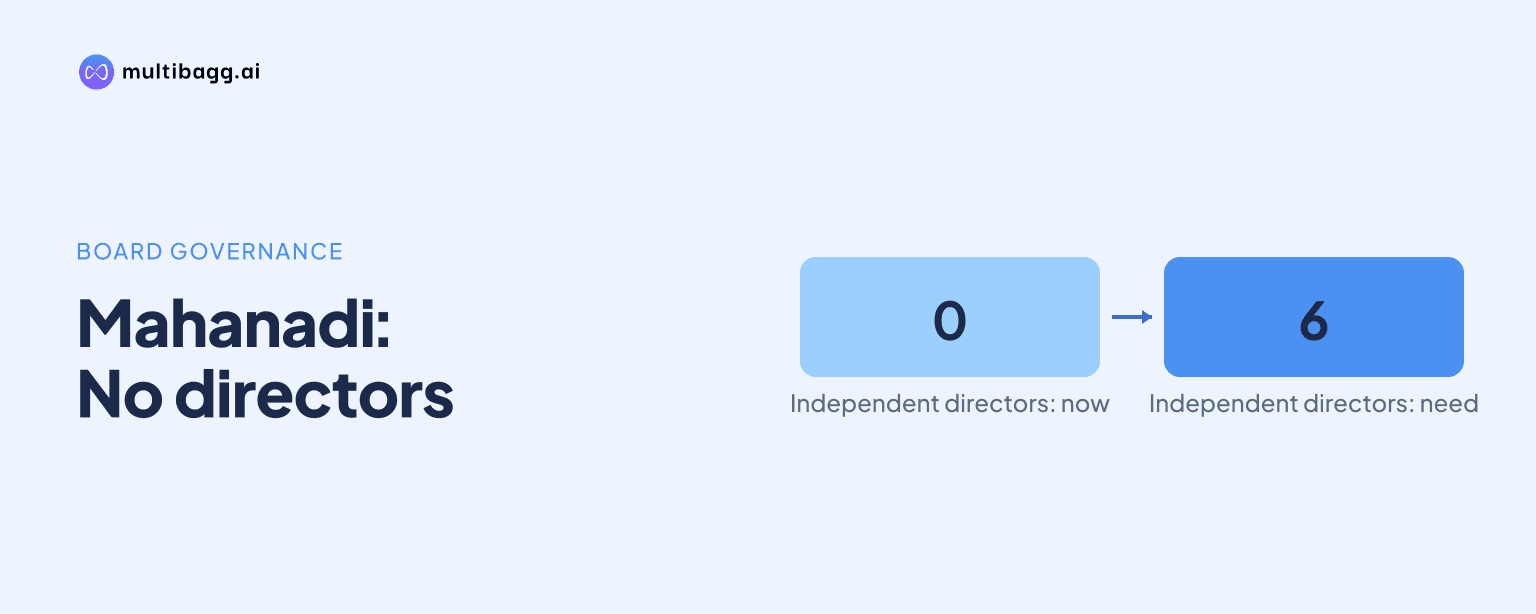
Mahanadi Coalfields Limited disclosed that it had zero independent directors on a six-member board as of the Red Herring Prospectus date, although it said Regulation 17(1) required at least six, including one woman independent director. Mahanadi Coalfields filed for Securities and Exchange Board of India exemptions on August 31, 2026 covering board and committee governance requirements.
Why has Mahanadi Coalfields sought SEBI exemptions?
Mahanadi Coalfields sought exemptions because its board and board committees did not comply with requirements under the SEBI Listing Regulations, the Companies Act and the Department of Public Enterprises corporate-governance guidelines for central public sector enterprises. The company disclosed six directors: four executive directors and two non-executive directors. None was an independent director at the prospectus date.
Mahanadi Coalfields stated that its executive chairman triggers the requirement under Regulation 17(1) of Chapter IV of the SEBI Listing Regulations to have at least six independent directors, including one woman independent director. The disclosed shortfall was therefore six independent directors, measured against an actual board count of zero. The company also stated that it was not compliant with the SEBI Listing Regulations to that extent.
Mahanadi Coalfields filed its August 31, 2026 letter under Regulation 300(1) of the SEBI Issue of Capital and Disclosure Requirements Regulations and Regulation 102(1) of the SEBI Listing Obligations and Disclosure Requirements Regulations. The request concerns governance treatment connected with the proposed offer, rather than a disclosed appointment plan for independent directors.
What SEBI exemptions has Mahanadi Coalfields requested?
Mahanadi Coalfields requested exemption in four governance areas: board composition, board-committee composition, the terms of reference of two committees and a committee of independent directors for price-band approval. The first request covered requirements for at least half the board to comprise independent directors and for at least one woman director. The company’s separate Regulation 17(1) disclosure specifies that, given its executive chairman, at least six independent directors including one woman independent director are required.
The committee-composition request covers the Audit Committee, Nomination and Remuneration Committee, Stakeholders’ Relationship Committee and Risk Management Committee. Mahanadi Coalfields also sought relief on the terms of reference of the Audit Committee and Nomination and Remuneration Committee. These are separate matters because the disclosure identifies both who must sit on committees and what authority or functions particular committees must have.
The fourth request concerns constituting a committee of independent directors to approve the price band. Mahanadi Coalfields had no independent director as of the prospectus date, making the proposed committee unavailable under its disclosed board composition. The company said it may face penalties for non-compliance with the SEBI Listing Regulations, Companies Act and SEBI Issue of Capital and Disclosure Requirements Regulations, but did not quantify a possible penalty.
Mahanadi Coalfields separately sought an exemption under Regulation 33(1)(a), read with Regulation 2(o), of the SEBI Issue of Capital and Disclosure Requirements Regulations for employee reservation in the proposed offer. That exemption was granted solely to include permanent employees of wholly owned and listed subsidiaries of Coal India Limited within the definition of employee. The disclosure does not say that SEBI had granted the broader August 31, 2026 governance-exemption request.
How does government control affect Mahanadi Coalfields’ board governance?
Mahanadi Coalfields attributes the governance constraints to its position as a Government of India-controlled government company. Its directors are appointed by the President of India acting through the Ministry of Coal, and the President acting through the ministry also approves appointment terms and remuneration. The company said this arrangement is set out in its articles of association.
This mechanism limits the direct role of the Nomination and Remuneration Committee. Mahanadi Coalfields said the committee cannot directly approve director appointments or remuneration, as those matters are approved through the President of India acting via the Ministry of Coal. Under the existing structure, the committee can only note or take those matters on record.
The statutory-auditor process has a comparable statutory limitation. Section 139(5) of the Companies Act provides that the Comptroller and Auditor General of India appoints the statutory auditor of a government company, provided the auditor is duly qualified. Mahanadi Coalfields said its Audit Committee cannot directly appoint the statutory auditor and can only note or take the Comptroller and Auditor General appointment on record.
Mahanadi Coalfields said it would remain a government company after completion of the offer. Consequently, the Ministry of Coal’s role in director appointments and the Comptroller and Auditor General’s statutory-auditor role would remain relevant after the offer. The requested exemptions address the resulting difference between its government-company mechanisms and specified listed-company governance requirements.
Got a follow-up? Ask IRIS
What governance risks does the Mahanadi Coalfields non-compliance create?
Mahanadi Coalfields said non-compliance could lead to penalties under the SEBI Listing Regulations, the Companies Act and the SEBI Issue of Capital and Disclosure Requirements Regulations. The company stated that such penalties could adversely affect its reputation, business operations, financial condition and results of operations. Its prospectus disclosure does not provide a rupee estimate, a penalty notice or a pending enforcement action for the board-composition shortfall.
The issue extends beyond the numerical absence of six independent directors. Mahanadi Coalfields requested exemptions relating to the composition of four committees, namely the Audit Committee, Nomination and Remuneration Committee, Stakeholders’ Relationship Committee and Risk Management Committee. It also requested relief from terms-of-reference requirements for the Audit Committee and Nomination and Remuneration Committee.
The woman-director requirement is specifically included in the company’s August 31, 2026 exemption request and in its Regulation 17(1) discussion of the independent-director requirement. Mahanadi Coalfields did not disclose the appointment of a woman independent director, any candidate, or a timetable for filling the independent-director positions. The prospectus therefore identifies a continuing compliance gap rather than a completed remediation.
The governance structure should be distinguished from Mahanadi Coalfields’ employee-reservation request involving Coal India Limited subsidiaries. The granted employee exemption applies only to defining eligible employees for reservation in the proposed offer. It does not alter the disclosed six-member board composition, the Ministry of Coal appointment process or the Comptroller and Auditor General’s auditor-appointment role.
What should readers watch after Mahanadi Coalfields’ SEBI filing?
Readers should watch for SEBI’s decision on the August 31, 2026 letter filed under Regulation 300(1) of the SEBI Issue of Capital and Disclosure Requirements Regulations and Regulation 102(1) of the SEBI Listing Obligations and Disclosure Requirements Regulations. Mahanadi Coalfields disclosed the filing and its scope, but did not disclose an approval date, rejection, conditions attached to relief or a scheduled decision date for the wider governance requests.
Readers should also watch whether Mahanadi Coalfields changes its board composition after the offer while remaining a government company. Any resolution would need to operate alongside the stated appointment authority of the President of India through the Ministry of Coal. For audit oversight, Section 139(5) would continue to place statutory-auditor appointment with the Comptroller and Auditor General of India.
Conclusion
Mahanadi Coalfields disclosed a defined listing-governance gap: its six-member board had four executive directors, two non-executive directors and zero independent directors, although it said at least six independent directors including one woman independent director were required. Its exemption request consequently reaches board composition, four board committees, two committee mandates and the independent-director committee required for price-band approval.
The next disclosed matter to watch is SEBI’s outcome on the August 31, 2026 governance-exemption filing. Mahanadi Coalfields has disclosed that its separate employee-reservation exemption was granted, but has not disclosed a result for the wider governance request or a schedule to appoint independent directors while it continues as a government company.