










Mahanadi Coalfields Does Not Disclose Underground Mine Losses
Key highlights
- Mahanadi Coalfields does not provide mine-level underground profitability or per-tonne loss data in the supplied extract.
- Fiscal 2026 materials consumption was Rs 1,070.35 crore, equal to 3.50% of revenue from operations.
- Fiscal 2026 employee benefit expense was Rs 4,719.17 crore, equal to 15.45% of revenue from operations.
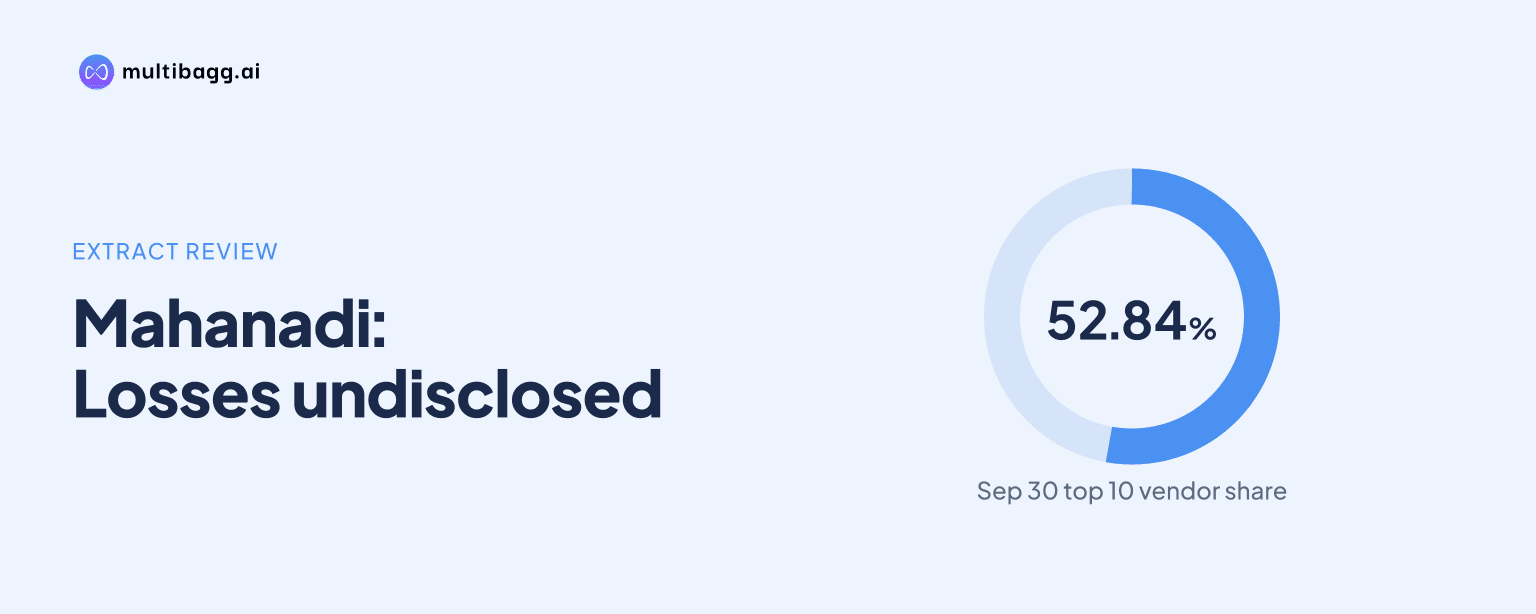
- Top 10 materials vendors accounted for 52.84% of materials consumed in the six months ended September 30, 2026.
powered by IRIS
Mahanadi Coalfields Limited does not disclose the names, per-tonne losses, continuation decision or outsourcing plan for three underground mines in the supplied extract through September 30, 2026. The extract instead reports group-level Fiscal 2026 materials consumption of Rs 1,070.35 crore and employee benefit expense of Rs 4,719.17 crore, with no mine-level profitability data.
Does Mahanadi Coalfields disclose underground mine losses?
No, Mahanadi Coalfields does not identify three underground mines or disclose their production, revenue, cost per tonne, realised price per tonne or losses in the supplied pages. The extract addresses environmental approvals, employees, wage agreements, coal quality, materials, equipment and cash flow, but it does not distinguish underground mining from open-cast mining.
The claimed comparison requires comparable mine-level measures: revenue or realisation per tonne and operating cost per tonne. Mahanadi Coalfields provides neither by mine, mining method or coal grade for Fiscal 2024, Fiscal 2025, Fiscal 2026 or the six months ended September 30, 2026. The supplied disclosure therefore cannot establish that any underground mine earned less per tonne than it cost to operate.
Mahanadi Coalfields does report that a substantial portion of audited coal resources and reserves was in G10 to G14 non-coking grades as of April 1, 2026. Gross Calorific Value, or GCV, measures coal heat content, and higher-GCV grades attract higher notified prices under India’s non-coking coal pricing framework. That is a company-wide realisation factor, not evidence of losses at specified underground mines.
What operating costs does Mahanadi Coalfields report?
Mahanadi Coalfields reports group-level materials and employee costs, rather than costs allocated to underground mines. Fiscal 2026 cost of materials consumed was Rs 1,070.35 crore, equal to 3.50% of revenue from operations, while employee benefit expense was Rs 4,719.17 crore, equal to 15.45% of revenue from operations.
The disclosed comparison shows materials spending declined while employee expense increased in Fiscal 2026. Materials consumption fell from Rs 1,101.21 crore in Fiscal 2025, whereas employee benefit expense rose from Rs 4,327.02 crore. The source does not allocate either movement to particular mines, so neither can be used to calculate underground mine economics.
For the six months ended September 30, 2026, materials consumed were Rs 530.39 crore, against Rs 480.56 crore in the corresponding 2025 period. Explosives cost Rs 251.47 crore and oil and lubricants cost Rs 203.35 crore in the September 2026 half-year. These inputs affect mining costs generally, but the extract provides no allocation by mine or operating method.
Could outsourcing lower Mahanadi Coalfields’ underground mining costs?
The supplied extract does not disclose an outsourcing plan for underground mines, so it does not support a conclusion that outsourcing would lower Mahanadi Coalfields’ underground mining costs. It states that 27,113 contract labourers were engaged through outsourcing agencies as of September 30, 2026, but does not identify their mines, contract values, work scope or savings relative to direct employment.
The distinction matters because outsourcing can cover labour, equipment, mine development or full mine operation, each with different cost and production effects. Mahanadi Coalfields says contracts were awarded through a tendering process and that contract labour supported mining operations under the Contract Labour (Regulation and Abolition) Act, 1970. It gives no target cost per tonne, timetable or proposed change to a named mine’s operating model.
Mahanadi Coalfields had 20,526 permanent employees as of September 30, 2026, of whom 18,752 were non-executives covered by the National Coal Wage Agreement, or NCWA. NCWA-XI expired on June 30, 2026, and NCWA-XII negotiations were ongoing, with the settlement to apply retrospectively from July 1, 2026. NCWA-XI increased wages by 19% from NCWA-X, while the actual NCWA-XII increase could differ from the estimate reflected in the September 2026 half-year expense.
Got a follow-up? Ask IRIS
Which dependencies could change Mahanadi Coalfields’ mining costs?
Mahanadi Coalfields depends on explosives, oil and lubricants, heavy earth-moving machinery spares and other consumable stores, while its top 10 materials vendors represented 52.84% of materials consumed in the six months ended September 30, 2026. That concentration was above 48.32% in the corresponding 2025 half-year and 42.46% in Fiscal 2026, making supply continuity relevant to costs across the company.
In Fiscal 2026, explosives cost Rs 520.34 crore, oil and lubricants cost Rs 332.03 crore, and heavy earth-moving machinery, or HEMM, spares cost Rs 123.05 crore. Mahanadi Coalfields identifies commodity prices, fuel prices, demand, transport costs, duties, taxes, trade restrictions and environmental conditions as possible drivers of materials costs. It reported no disruption involving its top 10 materials vendors in the September 2026 or September 2025 half-years, or in the preceding three fiscal years.
Equipment is another group-wide dependency, with property, plant and equipment of Rs 18,308.10 crore as of September 30, 2026, representing 31.72% of total assets. This compared with Rs 16,506.19 crore, or 31.07% of total assets, a year earlier. Mahanadi Coalfields reported no equipment failure or downtime that adversely affected operations in the September 2026 half-year or the preceding three fiscal years, but future wear, obsolescence or failure could raise maintenance costs and reduce production efficiency.
How do approvals and coal quality affect Mahanadi Coalfields’ economics?
Environmental approvals and lower-GCV coal may affect Mahanadi Coalfields’ production growth, compliance costs and average realisations, but they do not demonstrate underground mine losses. Its mines are entirely in Odisha’s Talcher and Ib Valley coalfields, and the Ib Valley industrial cluster had a Comprehensive Environmental Pollution Index score of 66.35 from 2018 monitoring, classifying it as a Severely Polluted Area.
The Ministry of Environment, Forest and Climate Change allowed consideration of environmental-clearance proposals in severely polluted areas from July 5, 2022, subject to additional safeguards. Mahanadi Coalfields says this may result in additional appraisal requirements, stricter conditions, delayed clearances or higher compliance costs for Ib Valley mines. The source does not quantify those costs by mine or per tonne.
Mahanadi Coalfields also states that its beneficiation facility historically produced washed coal with ash content of 33% to 34% on an air-dried basis. Together with the G10 to G14 resource and reserve concentration reported as of April 1, 2026, this may limit average realisations compared with producers holding more higher-GCV coal. The disclosure remains a company-level quality and pricing risk rather than a calculation of profitability at an underground operation.
Conclusion
The supplied extract supports an assessment of Mahanadi Coalfields’ group-wide cost and operating dependencies, not the claim that it will retain three underground mines that lose more per tonne than they earn. Fiscal 2026 materials consumption of Rs 1,070.35 crore, employee benefit expense of Rs 4,719.17 crore and G10 to G14 coal-grade concentration do not provide mine-level revenue, output or cost comparisons.
The disclosed matters to watch are the final NCWA-XII settlement, which is intended to apply retrospectively from July 1, 2026, and environmental-clearance progress for Balabhadra OCP, Balaram OCP and Bharatpur. A future disclosure separating production, realisation, operating cost and outsourcing arrangements by mine would be necessary to test the alleged underground-loss position and any proposed remedy.