










MCL sourced 82% of fiscal 2026 coal output through contractors
Key highlights
- MCL produced 218.31 million tonnes of coal in fiscal 2026, of which 82% came through contractual and MDO arrangements.
- Contractors removed 287.9 million cubic metres and MDOs removed 25.1 million cubic metres of MCL overburden in fiscal 2026.
- MDO coal production rose from 7.2 million tonnes in fiscal 2024 to 22.4 million tonnes in fiscal 2026.
- MCL’s opencast mines produced 217.99 million tonnes, while underground mines produced 0.46 million tonnes in fiscal 2026.
powered by IRIS
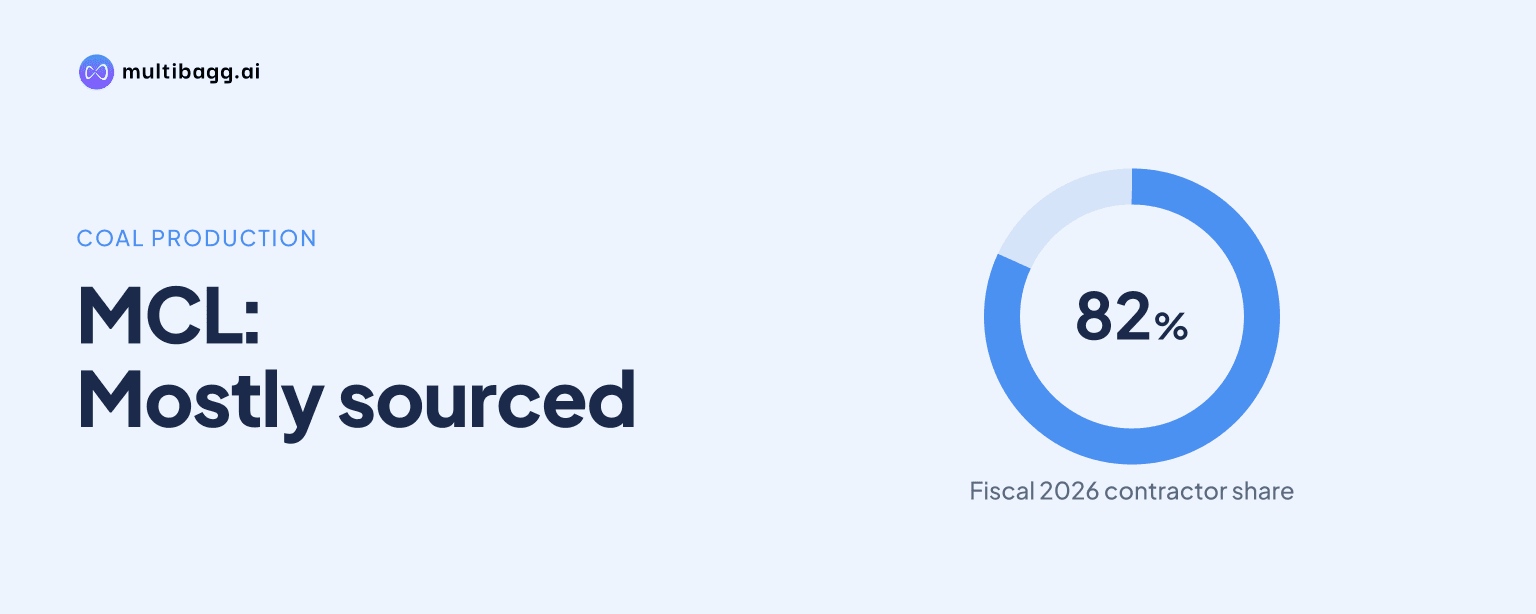
Mahanadi Coalfields Limited sourced 82% of its 218.31 million tonnes of coal production in fiscal 2026 through contractual miners and Mine Developer and Operator arrangements, while departmental production accounted for 18%. The externally executed model was more pronounced in overburden removal, where contractors and mine developers handled 96% of 327.22 million cubic metres.
How did MCL source 82% of fiscal 2026 coal output externally?
MCL produced 157.1 million tonnes through contractual arrangements and 22.4 million tonnes through Mine Developer and Operator, or MDO, arrangements in fiscal 2026. An MDO is a long-term contractor that develops and operates a mine under the applicable arrangement. Together, these channels represented 82% of MCL’s reported 218.31 million tonnes of output, compared with 38.9 million tonnes, or 18%, produced departmentally.
The operating model shifted chiefly through growth in MDO production rather than a rise in conventional contractual output. MDO production increased from 7.2 million tonnes, or 4% of output, in fiscal 2024 to 18.5 million tonnes, or 8%, in fiscal 2025 and 22.4 million tonnes, or 10%, in fiscal 2026. Contractual production declined from 161.9 million tonnes in fiscal 2024 to 157.1 million tonnes in fiscal 2026, and its share fell from 79% to 72%.
Departmental production was comparatively stable as a proportion of total output, reporting 37.0 million tonnes in fiscal 2024, 40.6 million tonnes in fiscal 2025 and 38.9 million tonnes in fiscal 2026. MCL’s underground production was entirely departmental, but it represented only 0.46 million tonnes in fiscal 2026, while opencast mines produced 217.99 million tonnes. That opencast concentration explains why external operating arrangements largely determine MCL’s total coal output.
Why is MCL’s overburden removal more outsourced than coal production?
MCL sourced 96% of fiscal 2026 overburden removal externally, consisting of 287.9 million cubic metres handled by contractors and 25.1 million cubic metres by MDOs. Overburden, or OB, is the rock and soil removed to expose coal seams before extraction. Departmental teams removed 14.3 million cubic metres, equal to 4% of the fiscal 2026 total of 327.22 million cubic metres.
The external share of OB work remained high across all three reported years, although its composition changed. Contractual operators handled 90% in both fiscal 2024 and fiscal 2025 before their share reduced to 88% in fiscal 2026. MDOs increased their contribution from 9.1 million cubic metres, or 3%, in fiscal 2024 to 25.1 million cubic metres, or 8%, in fiscal 2026, while departmental removal fell from 18.3 million cubic metres to 14.3 million cubic metres.
This work is material to future mining capacity because MCL’s overall stripping ratio was 1.50 cubic metres per tonne in both fiscal 2025 and fiscal 2026, up from 1.17 cubic metres per tonne in fiscal 2021. The stripping ratio measures the volume of OB removed for each tonne of coal produced. MCL’s total OB removal rose from 173.15 million cubic metres in fiscal 2021 to 327.22 million cubic metres in fiscal 2026, even as coal production eased from 225.17 million tonnes in fiscal 2025 to 218.31 million tonnes.
Got a follow-up? Ask IRIS
What changed in MCL’s production mix and mine activity?
MCL’s total coal production rose from 148.01 million tonnes in fiscal 2021 to 218.31 million tonnes in fiscal 2026, a 47% increase, but fiscal 2026 output was 6.86 million tonnes below the fiscal 2025 record of 225.17 million tonnes. MCL’s output remained almost entirely opencast, with 217.99 million tonnes in fiscal 2026 against underground production of 0.46 million tonnes.
MCL’s two coalfields provided a relatively balanced production base in fiscal 2026, with Talcher contributing 53% and Ib Valley contributing 47%. MCL operated 17 mines, including 14 opencast and three underground mines, across 12 operational mining areas. The source identifies Talcher projects including Jagannath, Bhubaneswari, Lingraj and Kanha, while Ib Valley includes Lakhanpur, Kulda, Jagannath and Sialma.
Coal quality was concentrated in three non-coking grades. G12, G13 and G14 coal together accounted for 202.8 million tonnes, or nearly 93%, of fiscal 2026 production; G12 supplied 82.45 million tonnes, G14 supplied 65.54 million tonnes and G13 supplied 54.89 million tonnes. Sustaining volume therefore depends on continued extraction, OB removal, equipment deployment and demand for these power-sector-oriented grades.
What does MCL’s external mining dependence mean for operations?
MCL’s dependence on contractors and MDOs is concentrated in the opencast activities that account for virtually all output and nearly all OB removal. MCL had 20,602 employees as at April 1, 2026, down from 21,902 in fiscal 2021, while overall output per manshift increased from 27.15 tonnes to 30.34 tonnes over the same period. Output per manshift, or OMS, measures coal output per worker shift.
Mechanisation is another condition supporting MCL’s operating model. MCL had 563 heavy earth-moving machinery vehicles as at March 31, 2026, including dumpers, dozers, shovels, drills and surface miners. MCL produced 99.4% of fiscal 2026 coal using surface miners, a blast-free technology, and deployed 22 owned surface miners during the year; the source also reports approximately 74 owned and contracted surface miners as at September 30, 2026.
The operating model must also be matched by logistics capacity. MCL’s first-mile connectivity capacity reached 96 million tonnes per annum in fiscal 2026, and first-mile connectivity dispatch increased to 48.54 million tonnes from 12.54 million tonnes in fiscal 2024. Total coal dispatch reached a record 210.74 million tonnes in fiscal 2026, with rail accounting for 65%, road 31% and merry-go-round rail systems 4%.
Conclusion
MCL’s fiscal 2026 figures show that its opencast mining model was principally executed through external operators: contractual miners and MDOs accounted for 82% of coal output and 96% of OB removal. This dependence is consequential because opencast mines delivered 217.99 million tonnes of MCL’s 218.31 million tonnes of fiscal 2026 coal production, while departmental underground mining supplied 0.46 million tonnes.
What to watch next is whether MDO production continues to increase beyond 22.4 million tonnes and whether OB removal remains sufficient to expose future seams at the fiscal 2026 stripping ratio of 1.50 cubic metres per tonne. MCL disclosed plans for additional exploration and infill drilling to convert coal inventory into higher-confidence resources and reserves; the outcome depends on exploration results, approvals, production levels and demand for non-coking coal.