










MCL’s 9.84 billion-tonne JORC reserves differ from ISP base
Key highlights
- MCL reported 9,840.31 MT of audited JORC Coal Reserves at April 1, 2026.
- MCL’s ISP Net Geological Resource was 40,336.39 MT, about 4.1 times its JORC reserve total.
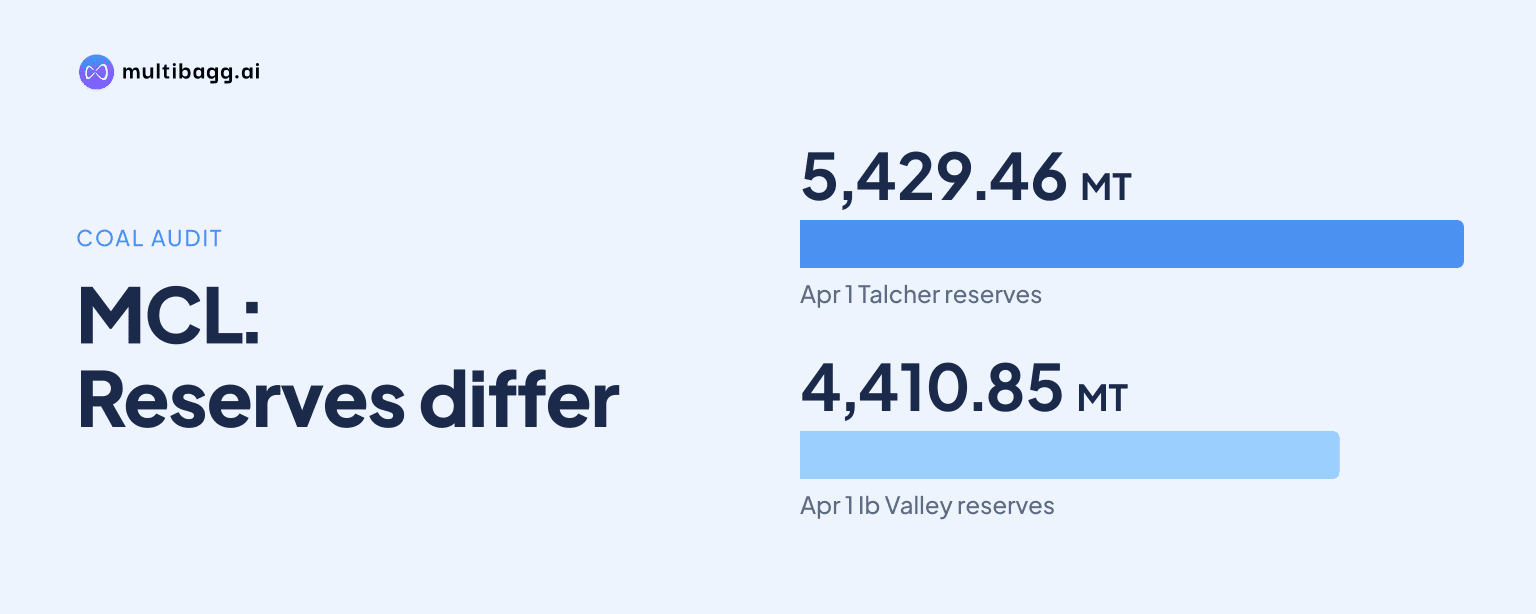
- Talcher held 5,429.46 MT of JORC reserves, compared with 4,410.85 MT in Ib Valley.
- Contractual and outsourcing operations produced 157.08 MT, or 71.96%, of MCL’s Fiscal 2026 output.
powered by IRIS
Mahanadi Coalfields Limited had 9.84 billion tonnes of audited JORC coal reserves at April 1, 2026, compared with a 40.34-billion-tonne inventory under ISP Guidelines. MCL’s JORC reserve is coal assessed as economically mineable after technical and economic testing, while the ISP Net Geological Resource is a broader in-situ geological inventory without those constraints.
What are MCL’s audited JORC coal reserves?
MCL reported 9,840.31 million tonnes (MT) of audited Joint Ore Reserves Committee (JORC) Coal Reserves at April 1, 2026, comprising 9,837.74 MT of Proved Reserves and 2.57 MT of Probable Reserves. A Coal Reserve is the economically mineable part of a Measured or Indicated Coal Resource, adjusted for dilution and expected mining losses after technical and economic assessments.
MCL’s JORC Coal Resource totalled 10,517.01 MT at the same date, including 10,512.60 MT of Measured Resource and 4.41 MT of Indicated Resource, with no Inferred Resource. The reserve total was 93.6% of the JORC resource total, but the figures cannot be added because the reported Measured and Indicated Resources include material converted into reserves where appropriate.
MCL’s reserve classification is overwhelmingly Proved: 99.97% of its JORC reserve total was Proved and 0.03% was Probable. Proved Reserves are derived from Measured Resources after detailed assessment, while Probable Reserves can arise from Indicated Resources or from Measured Resources where Modifying Factors require further confirmation.
Why is MCL’s ISP resource base not directly comparable?
MCL’s 40,336.39 MT ISP Net Geological Resource is not directly comparable with its 9,840.31 MT JORC reserve because the ISP measure is an in-situ inventory and the JORC figure is an economically mineable reserve. Under the ISP Guidelines, Net Geological Resource is estimated from available geological evidence without applying technical mineability, economic viability or other Modifying Factors.
The ISP geological inventory was about 4.1 times MCL’s JORC reserve total at April 1, 2026. Under JORC, a Coal Resource must demonstrate reasonable prospects for eventual economic extraction, assessed using preliminary assumptions about mining parameters, mining method, processing, infrastructure and operational conditions. Material that does not meet that threshold is excluded from the JORC resource estimate even if it has been identified by drilling or sampling.
MCL’s 12,535 MT ISP Mineable Reserve also exceeds its 9,840.31 MT JORC reserve, but that does not represent an additional 2,694.69 MT of equivalent reserve. The ISP process applies its own progression from geological estimation through mine design, surface constraints, coal quality, geo-mining conditions, market demand and environmental and social factors, before deriving Mineable and then Extractable Reserve estimates.
ISP confidence categories are based on borehole influence distances. Measured Resources cover up to 200 metres from an observation point, Indicated Resources generally range from beyond 200 metres to 1,000 metres, and Inferred Resources extend beyond 1,000 metres to 2,000 metres. These geological confidence categories do not themselves establish commercial extraction, operating approvals or final recoverability.
Got a follow-up? Ask IRIS
Where are MCL’s JORC reserves and ISP resources located?
MCL’s JORC reserves were split between the Talcher and Ib Valley coalfields in Odisha at April 1, 2026. Talcher contained 5,429.46 MT, or 55.18%, of the 9,840.31 MT JORC reserve total, including 5,426.89 MT of Proved and 2.57 MT of Probable Reserves. Ib Valley held 4,410.85 MT, all classified as Proved Reserves.
The resource distribution was similar but not identical. Talcher had 5,857.68 MT of JORC Coal Resources, consisting of 5,853.27 MT Measured and 4.41 MT Indicated, while Ib Valley had 4,659.33 MT, all Measured. Neither coalfield reported JORC Inferred Resources, meaning the disclosed JORC resource base was confined to Measured and Indicated categories.
The ISP inventory was more evenly divided between the two coalfields. Ib Valley, described in the ISP table as Ib Valley (Ib River), held 21,549 MT of Net Geological Resource and 5,699 MT of Mineable Reserve, while Talcher held 18,787 MT and 6,836 MT, respectively. By depth, 31,954.15 MT of MCL’s 40,336.39 MT ISP resource lay up to 300 metres, while 8,382.24 MT lay beyond 300 metres.
What could change MCL’s mineable coal volumes?
MCL’s future reserve and mineable volumes depend on Modifying Factors including mining recovery, dilution, mine design, infrastructure, coal quality, market demand, environmental conditions and approvals. For opencast projects, MCL states that 90% mining recovery is generally considered for Mineable Reserve estimation before seam-wise mining losses are applied to calculate Extractable Reserves.
Underground recoverability can vary materially by method and depth. MCL states that longwall mining can recover 60% to 70% of reserves, while mechanised bord-and-pillar mining at depths below 300 metres can recover less than the 40% to 50% stated for shallower mines. Development-only extraction can recover below 15% to 20% where large pillars remain unworked for geo-mining or socio-technical reasons.
Approvals are also required before potential coal volumes can support production. MCL had environmental clearances for aggregate capacity of 340.81 million tonnes per annum at September 30, 2026, up from 330.81 million tonnes per annum at March 31, 2026. The Ib Valley industrial cluster had a 2018 Comprehensive Environmental Pollution Index score of 66.35 and was classified as severely polluted, potentially bringing additional appraisal requirements and conditions for clearances.
MCL’s production execution also has a substantial contractual component. Contractual and outsourcing arrangements produced 157.08 MT, or 71.96%, of MCL’s 218.31 MT output in Fiscal 2026, compared with 73.73% in Fiscal 2025. The mine developer and operator model contributed 22.36 MT, or 10.24%, while departmental production contributed 38.87 MT, or 17.80%.
Conclusion
MCL’s 9.84 billion tonnes of audited JORC reserves are its disclosed estimate of coal that was economically mineable under stated technical, commercial and regulatory assumptions at April 1, 2026. The 40.34-billion-tonne ISP figure is a broader geological inventory, while the 12.54-billion-tonne ISP Mineable Reserve is derived under a separate framework and cannot be treated as directly equivalent to JORC reserves.
The next disclosed conversion tests are proposed approvals for Balabhadra OCP Stage II at 10 million tonnes per annum, Balaram OCP Stage II at 15 million tonnes per annum, and Bharatpur at 20 million tonnes per annum. Progress on environmental and forest clearances, especially in the Ib Valley cluster, and recovery outcomes in opencast and underground mines will affect how much of MCL’s resource base can support future extraction.