










Mahanadi Coalfields Limited carries Rs 16,773 crore provision
Key highlights
- MCL reported a Rs 16,773.08 crore stripping activity provision at 30 September 2026.
- The Rs 16,773.08 crore provision equalled 75.3% of MCL’s Rs 22,269.05 crore equity attributable to owners.
- MCL reversed Rs 489.70 crore of stripping activity provision in the year ended 31 March 2026.
- MCL’s stripping activity assets had a Rs 2,092.72 crore net carrying amount at 30 September 2026.
powered by IRIS
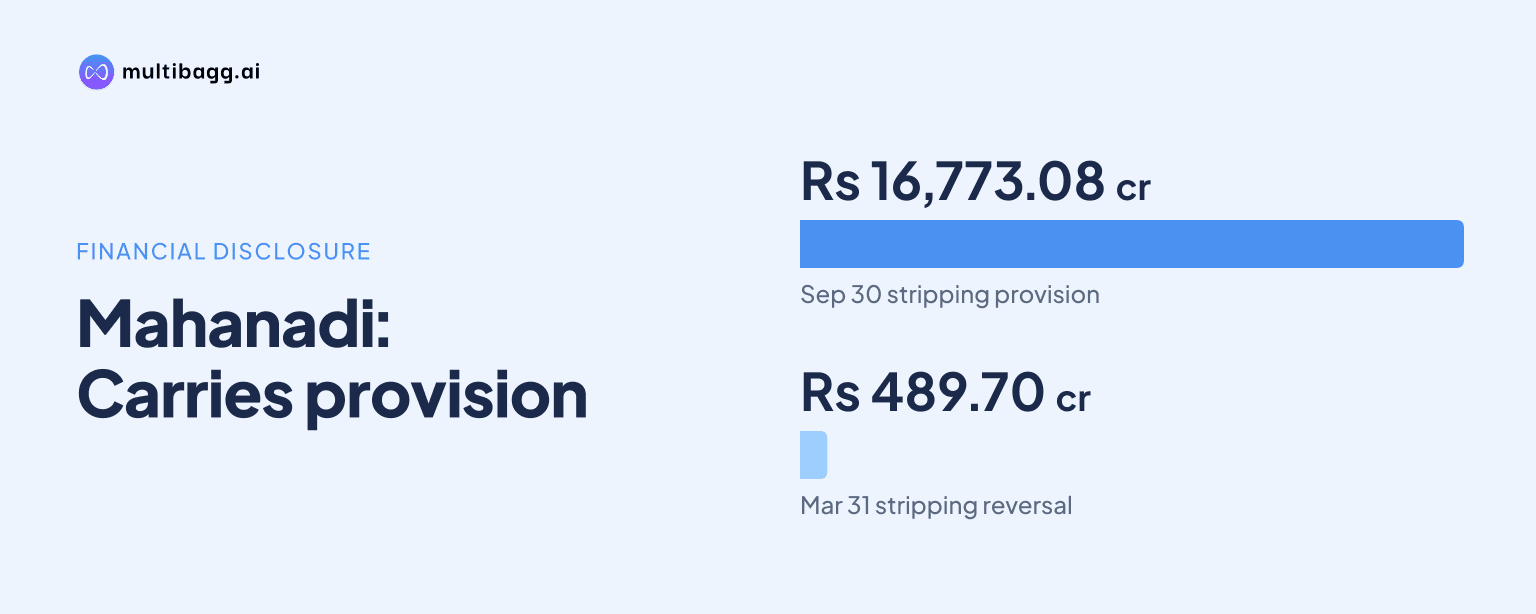
Mahanadi Coalfields Limited carried a Rs 16,773.08 crore stripping activity provision at 30 September 2026, under a mine-specific ratio-variance method that MCL says leaves the requirements of Ind AS 37. The balance equalled 75.3% of Rs 22,269.05 crore equity attributable to owners, while provision reversals are recognised as other operating revenue.
What is MCL’s Rs 16,773 crore stripping activity provision?
MCL’s stripping activity provision was a Rs 16,773.08 crore non-current provision at 30 September 2026, created or reversed by comparing actual overburden removal with the standard stripping ratio at each mine. Overburden is the soil and rock lying above a coal seam, and stripping is its removal to provide access to coal in an opencast mine.
MCL separates this provision from stripping activity assets in property, plant and equipment. Its stripping activity assets had a net carrying amount of Rs 2,092.72 crore at 30 September 2026, compared with the Rs 16,773.08 crore provision. Production-phase stripping costs are allocated between coal inventory and a stripping asset using a standard strip ratio, while the ratio-variance provision reflects the legacy policy described in Note 9.1.2.
MCL recognises a production-phase stripping asset only in mines with rated capacity of at least one million tonnes per annum. The policy does not apply to Mine Developer and Operator arrangements structured as revenue-sharing arrangements, limiting the asset-based treatment to qualifying MCL-operated mines rather than every opencast mining arrangement.
How does MCL’s stripping ratio-variance method work?
MCL compares each mine’s current overburden-to-coal ratio with its average, or standard, stripping ratio to determine whether to recognise or reverse the stripping activity provision. The standard ratio is the expected total overburden volume over the mine life divided by expected total coal extraction, so the calculation is mine-specific rather than based on one group-wide benchmark.
When actual overburden removal exceeds expected removal under a mine-specific approved plan, MCL systematically reverses the provision. The reversal is made at the rate at which the provision was originally recognised for that mine. This means that both physical extraction relative to the plan and the original mine-level recognition rate affect the accounting amount reported in a period.
MCL says changes in geo-mining conditions can affect the standard stripping ratio and that changes to the ratio are accounted for separately. The policy therefore depends on the continuing relevance of mine plans, expected lifetime extraction and geological assumptions, all of which are disclosed as factors in the mining accounting framework.
Why does MCL say its stripping provision departs from Ind AS 37?
MCL states that its systematic reversal policy for stripping activity provisions leaves the requirements of Ind AS 37, which is the Indian Accounting Standard covering provisions, contingent liabilities and contingent assets. Ind AS 37 otherwise provides that a provision is recognised where a present legal or constructive obligation arises from a past event, an outflow of economic benefits is probable and the amount can be estimated reliably.
MCL says the approach is nevertheless consistent with Ind AS 1, Presentation of Financial Statements, in view of the nature of its mining business and the objectives in the Conceptual Framework for Financial Reporting. It presents the balance as a non-current provision rather than in other equity, and records systematic reversals in other operating revenue with a consequent effect on net profit.
The company says the method was followed consistently by Coal India Limited since inception and has been substantiated and validated by multiple authoritative bodies and forums, including income-tax authorities. MCL also says that, where no specific Ind AS applies, management considers similar standards, the Framework, recent International Accounting Standards Board pronouncements and accepted industry practice, provided these do not conflict with Indian Accounting Standards.
Got a follow-up? Ask IRIS
How large is MCL’s stripping provision relative to equity and provisions?
MCL’s Rs 16,773.08 crore stripping activity provision represented 91.5% of Rs 18,326.72 crore total non-current provisions at 30 September 2026. The remaining non-current provisions comprised Rs 1,396.01 crore for site restoration and mine closure, and Rs 157.63 crore for employee benefits.
The Rs 16,773.08 crore balance equalled 75.3% of MCL’s Rs 22,269.05 crore equity attributable to owners at 30 September 2026. That owners’ equity consisted of Rs 1,323.67 crore paid-up share capital and Rs 20,945.38 crore other equity; the consolidated balance sheet also reported Rs 177.31 crore of non-controlling interests.
The provision declined in each of the three full financial years shown, from Rs 17,902.97 crore at 31 March 2024 to Rs 16,844.96 crore at 31 March 2026. It declined further by Rs 71.88 crore during the six months ended 30 September 2026, demonstrating that the balance changes through reversals rather than remaining fixed.
How do MCL’s stripping provision reversals affect revenue and profit?
MCL recognises a stripping provision reversal under other operating revenue when actual overburden extraction exceeds the expected volume in the relevant mine-specific plan. Because MCL states that this revenue recognition has a consequent impact on net profit, movements in stripping performance and mine-plan expectations can affect reported operating revenue and profit without representing a new coal sale.
For the year ended 31 March 2026, MCL reversed Rs 489.70 crore, compared with Rs 568.31 crore in the year ended 31 March 2025. The reversal was therefore Rs 78.61 crore lower year on year. For the six months ended 30 September 2026, the reversal was Rs 71.88 crore, reducing the opening Rs 16,844.96 crore provision to Rs 16,773.08 crore.
A reversal is an accounting release of a previously recognised provision, not a disclosed cash receipt. Its continuation requires the specified mine condition: actual overburden extraction must exceed the volume expected under the mine-specific plan, and MCL must continue to apply the systematic reversal policy at the original provision-recognition rate.
Conclusion
MCL’s Rs 16,773.08 crore stripping activity provision is a dominant balance-sheet item, accounting for 91.5% of non-current provisions and equalling 75.3% of equity attributable to owners at 30 September 2026. Its materiality arises not only from its size but also from its treatment: systematic mine-specific reversals are reported as other operating revenue and affect net profit.
The next issue to watch is whether MCL continues to apply a policy that it says departs from Ind AS 37, alongside the pace of reversals driven by actual overburden extraction versus mine plans. MCL says mining accounting policy may evolve with accounting literature and that any development would be accounted for prospectively under Ind AS 8, making future disclosures on policy treatment and ratio changes consequential.