










MCL Surface Miners Underpinned Lowest FY26 Production Cost
Key highlights
- MCL produced 99.37% of total coal output through surface miners in FY26, up from 97.84% in FY25.
- MCL’s opencast mines accounted for 99.85% of FY26 production, while 79.22% of coal resources lay within 300 metres of the surface.
- MCL recorded the lowest production cost per tonne among Coal India subsidiaries in FY26, according to CRISIL.
- MCL’s FY26 output per manshift was 30.34 tonnes, or 2.4 times Coal India’s consolidated level.
powered by IRIS
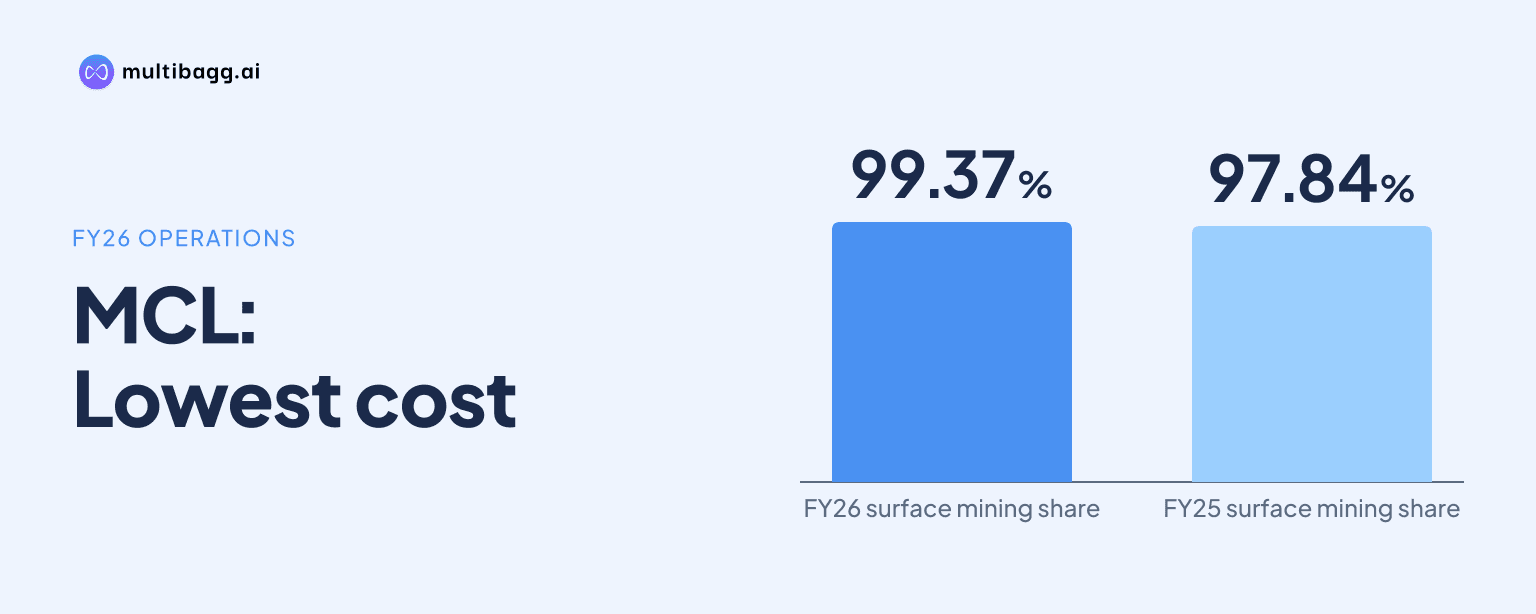
Mahanadi Coalfields Limited produced 99.37% of its coal with surface miners in Fiscal 2026, underpinning the lowest production cost per tonne among Coal India Limited subsidiaries. MCL’s FY26 cost position reflected 99.85% opencast output, 79.22% of coal resources at zero to 300 metres depth, and advance removal of overburden.
How did MCL surface miners underpin its lowest FY26 production cost?
MCL’s surface-miner-led opencast model underpinned its lowest production cost per tonne among Coal India subsidiaries in Fiscal 2026. Surface miners accounted for 99.37% of MCL’s total coal production and opencast mines accounted for 99.85%, leaving underground mines with 0.15% of output. MCL operated 17 mines in FY26, comprising 14 opencast mines and three underground mines.
A surface miner cuts and loads coal without conventional drilling and blasting. MCL says the technology reduces dust, noise and ground vibration relative to conventional methods, enables selective mining to separate coal from partings, and produces coal below 100 millimetres in size, reducing subsequent crushing needs. The operating model depends on coal seams being suitable for continuous surface-miner deployment.
MCL’s use of surface miners rose over the FY16-FY26 period rather than being a one-year change. The share increased from 91.14% in FY16 to 99.37% in FY26, although it declined marginally to 97.84% in FY25 before the FY26 increase. This 8.23-percentage-point change shows the extent to which MCL’s production method shifted towards mechanised surface mining.
MCL deployed 74 surface miners as at September 30, 2026, comprising 22 owned and 52 contracted machines. As at March 31, 2026, MCL owned 22 of Coal India’s 47 surface miners, or 46.81% of the group fleet, the largest owned surface-miner fleet among Coal India subsidiaries. The mix of owned and contracted equipment supports the scale of the surface-mining system, but equipment availability remains necessary for it to operate as intended.
Why do shallow coal seams affect MCL’s production cost?
Shallow, thick and continuous coal seams enable MCL’s opencast mining and favourable stripping ratios. About 79.22% of MCL’s coal resources under Indian Standard Procedure guidelines lay at depths of zero to 300 metres as at April 1, 2026. A stripping ratio measures the overburden, or rock and soil above coal seams, removed to access coal, making seam depth relevant to the material movement required before extraction.
MCL removed 327.22 million cubic metres of overburden in FY26, following a record 337.39 million cubic metres in FY25. The company conducts advance overburden removal, stripping rock before related coal is mined, to maintain exposed coal for subsequent production. MCL says this sequencing eliminates delays between stripping and extraction and improves use of heavy earth-moving machinery.
The Talcher and Ib Valley coalfields in Odisha provide the geological setting for this model. MCL reported FY26 annual coal production of 218.31 million tonnes, the level used in its disclosed reserve-life calculation. Its lowest-cost ranking therefore arose from accessible geology, stripping conditions and mechanisation, rather than production volume alone.
Resource scale and mine economics are separate measures. MCL reported about 40.34 billion tonnes of coal resources under Indian Standard Procedure guidelines as at April 1, 2026, while audited reserves under the Joint Ore Reserves Committee Code stood at 9,840.31 million tonnes. MCL’s disclosed reserve life was around 45 years at FY26 production levels, while future conversion of resources to reserves depends on exploration, recovery rates, approvals and production levels.
Got a follow-up? Ask IRIS
How productive was MCL’s mechanised mining in FY26?
MCL reported output per manshift of 30.34 tonnes in FY26, 2.4 times Coal India’s consolidated output per manshift. Output per manshift, or OMS, measures tonnes produced for each worker shift. MCL’s FY26 OMS also exceeded the 16.47 tonnes reported for South Eastern Coalfields Limited in the disclosed peer comparison.
The disclosed productivity comparison is consistent with MCL’s predominantly opencast and surface-miner-led production mix. Surface miners perform cutting and loading without drilling and blasting, while advance overburden removal maintains coal exposure for later output. This relationship would be affected by changes in seam conditions, equipment utilisation, overburden preparation or the share of underground production.
MCL’s scale provides the volume on which its mechanised model operates. MCL produced 218.31 million tonnes in FY26 and accounted for 28.4% of Coal India’s consolidated production of 768.19 million tonnes. Coal India accounted for 73.8% of domestic coal production in FY26, and MCL was its largest producing subsidiary.
How does rail evacuation support MCL’s mining model?
MCL’s rail-led evacuation system supports its mine operations by moving coal beyond the pithead through rail infrastructure. Rail carried 137.56 million tonnes, or 65.28%, of MCL’s total dispatch of 210.74 million tonnes in FY26. The rail share increased from 58.70% of total dispatch in FY24, when total dispatch was 199.02 million tonnes.
First-mile connectivity, or FMC, is infrastructure that moves coal from mines to the rail network. Rail’s share of MCL’s FMC dispatch rose from 91.27% in FY24 to 96.86% in FY26, when FMC dispatch totalled 48.54 million tonnes. MCL also reported rail connectivity through South Eastern Railway, South East Central Railway and East Coast Railway, alongside dedicated coal corridors.
Ports provide an additional route for MCL coal. MCL dispatched 45.36 million tonnes through ports in FY26, of which Paradip handled 38.88 million tonnes, or 85.71%. Paradip dispatch represented 18.45% of MCL’s total FY26 dispatch, close to 18.57% in FY24, indicating that its contribution to the total dispatch mix was broadly stable.
Power-generation customers received 155.75 million tonnes, or 73.91%, of MCL’s FY26 dispatch, while captive power plants received 31.62 million tonnes, or 15.00%. Long-term Fuel Supply Agreements, or FSAs, accounted for 82.12% of FY26 sale-of-products revenue. Continued dispatch volumes consequently depend on demand from power and captive-power customers and performance under these agreements.
Conclusion
MCL’s lowest FY26 production cost per tonne among Coal India subsidiaries was tied to a defined operating configuration: 99.37% surface-miner production, 99.85% opencast production and 79.22% of coal resources within 300 metres of the surface. Its 30.34-tonne OMS, 327.22 million cubic metres of overburden removal and rising rail share show the interaction between mine geology, mechanisation and evacuation.
What to watch next is whether MCL sustains this configuration as it develops the Talcher and Ib Valley coalfields. The company’s disclosed mine-life estimates depend on exploration success, resource-to-reserve conversion, recovery rates, mining and environmental approvals, production levels and non-coking coal demand; the Ib Valley Washery, commissioned on April 15, 2024, had 10 million tonnes per annum of operational capacity as at September 30, 2026.