










Jain Irrigation Converts Q2 EBITDA Into Rs 206 Crore Cash
Key highlights
- Jain Irrigation said Rs 206 crore of stated Rs 208 crore Q2 FY27 EBITDA converted into cash.
- Jain Irrigation's working-capital cycle declined to 179 days from 205 days at end-September a year earlier.
- Jain Irrigation said it paid Rs 230 crore of NCD repayments during the period.
- Jain Irrigation reported about Rs 3,100 crore of H1 FY27 revenue and Rs 372 crore of EBITDA.
powered by IRIS
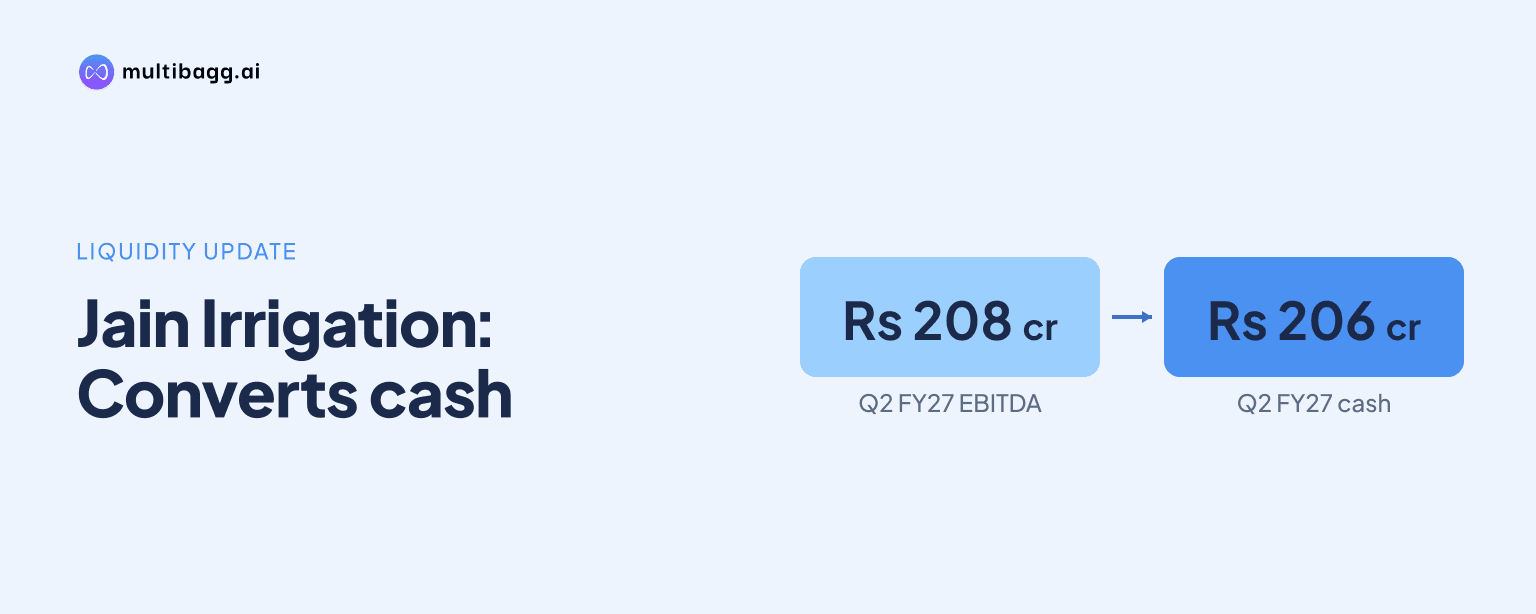
In Q2 FY27, Jain Irrigation Systems Limited converted Rs 206 crore of stated Rs 208 crore earnings before interest, tax, depreciation and amortisation into cash, helping it pay Rs 230 crore of non-convertible debentures as its working-capital cycle reached 179 days, down from 205 days at end-September a year earlier.
Know Jain Irrigation Systems inside out
Results, valuation, peers and who's buying, in one view.
How did Jain Irrigation convert EBITDA into cash?
Jain Irrigation said it converted Rs 206 crore into cash from Rs 208 crore of quarterly earnings before interest, tax, depreciation and amortisation, or EBITDA, in Q2 FY27. Management said the cash generation supported payment of Rs 230 crore of non-convertible debenture, or NCD, repayments that fell due during the period. The call did not provide a cash-flow statement split across operating, investing and financing activities.
The opening remarks cited Q2 FY27 EBITDA of Rs 207 crore, while the cash-conversion discussion used Rs 208 crore. Both figures were described by management as higher than the comparable prior-year period, but the transcript did not reconcile the Rs 1 crore difference. Jain Irrigation reported adjusted profit after tax of about Rs 40 crore for the quarter after adjusting for the NCD wind-down in the profit and loss account.
Cash generation was particularly relevant because management called FY27 a significant year for repayments. It said one part of the NCD obligation had been paid, while the second part is due in March. Management said it did not anticipate an issue in meeting that obligation, citing improved cash flow and lower receivables rather than giving a formal liquidity forecast.
Why did Jain Irrigation's working-capital cycle fall to 179 days?
Jain Irrigation said its working-capital cycle fell to 179 days because receivables reduced, while inventory and accounts payable supplied the remaining improvement. At end-September of the prior year, the cycle was 205 days, making the reported reduction 26 days. Management described the year-on-year improvement as almost 25 days.
Within Q2 FY27, the cycle declined by four days from 183 days to 179 days. Jain Irrigation attributed 15 days of the year-on-year reduction to days sales outstanding, or DSO, a measure of the time taken to collect receivables. The balance was shared between inventory improvement and accounts payable, though management did not give a separate number of days for either item.
Management also said collections improved in project business, including receivables linked to state governments and solar projects, where reductions had previously been difficult. It expects most legacy receivables to be collected over the next few quarters. That is management’s expectation, rather than a reported collection outcome, and it underpins its plan to create liquidity for repayments and growth in the next fiscal year.
Which businesses supported Jain Irrigation's Q2 performance?
Jain Irrigation reported Q2 FY27 revenue close to Rs 1,576 crore, up more than 10% year on year, and EBITDA of about Rs 207 crore. Its EBITDA margin was about 13.2%, compared with 13.9% a year earlier. Hi-Tech MI micro-irrigation maintained an 18.8% margin, while food was around 12% and plastics around 9%.
Agro-processing generated about Rs 560 crore of revenue in Q2 FY27 and grew 8.4%, while plastics, including domestic and overseas operations, grew about 17%. Jain Irrigation said domestic retail revenue grew about 18% and its combined retail businesses grew around 12%. Domestic revenue growth was about 10% after a planned reduction in project business.
The second quarter also followed a weaker first quarter. Jain Irrigation reported H1 FY27 revenue of about Rs 3,100 crore, around 4% above the prior year, with EBITDA of Rs 372 crore and a 12.1% margin. Adjusted H1 profit after tax was about Rs 43 crore, while management said overseas business revenue had declined by about 24% to 25% in Q1 FY27.
Got a follow-up? Ask IRIS
What could affect Jain Irrigation's cash progress in H2 FY27?
Jain Irrigation said deficient monsoon conditions could affect cash generation because 80% to 85% of its business is in western and southern India. Management said kharif crops had already been affected and rabi could also be hit, particularly where authorities reserve water for drinking instead of agriculture. In such areas, demand for irrigation equipment and pipes could decline if water is unavailable.
Management also cited higher polymer prices and uncertain polymer availability as pressures alongside the monsoon deficit. It said it would work with dealers and farmers in areas with adequate water, seek higher exports and direct capacity toward available demand. These are management actions rather than forecasts for revenue, EBITDA or operating cash flow.
The piping business showed the uneven demand pattern. Jain Irrigation said domestic agricultural piping was weak in Q1 FY27 and revenue-neutral in Q2 FY27, unlike competitors with larger exposure to urban plumbing, drainage and commercial-building markets. Management nevertheless expects full-year pipe revenue growth of 8% to 10%, if conditions develop as expected, supported by applications outside agriculture.
What is Jain Irrigation targeting after FY27?
Jain Irrigation is targeting further working-capital reduction over about the next 12 months, and management expects its balance sheet to look better in FY28. It said higher capacity utilisation, lower working-capital days and collection of legacy receivables should improve net margins. These are management expectations and not formal financial guidance.
Management identified large-diameter infrastructure pipes, solar water pumps, food products, beverages and overseas plastics as demand areas. It said food subsidiaries and overseas plastic-sheet operations performed well in Q2 FY27. Those businesses may partly offset pressure on agricultural drip and pipe demand, although management remained cautious about western and southern geographies.
Conclusion
Jain Irrigation’s Q2 FY27 performance linked operating improvement with liquidity management: revenue was close to Rs 1,576 crore, EBITDA was about Rs 207 crore, and receivable-led working-capital discipline supported NCD payments. The 179-day cycle matters because it reduced the cash tied up in operations while the company faced weaker agricultural conditions in key regions.
The next items to watch are the NCD repayment due in March, collections from legacy receivables and progress toward lower working-capital days over the next 12 months. Management’s targeted 8% to 10% full-year piping growth, conditions in western and southern India after the deficient monsoon, and demand from non-agricultural businesses will indicate whether the Q2 FY27 improvement continues.