










JISL Q2 income rises 10.1% as EBITDA margin slips to 13.2%
Key highlights
- JISL’s Q2 FY27 consolidated total income increased 10.1% to ₹1,576.7 crore.
- JISL’s Q2 FY27 consolidated EBITDA margin declined 75 basis points to 13.2%.
- JISL’s Q2 FY27 consolidated PAT rose 17.4% to ₹18.0 crore.
- JISL’s 1H FY27 consolidated EBITDA fell 7.3% to ₹371.9 crore.
powered by IRIS
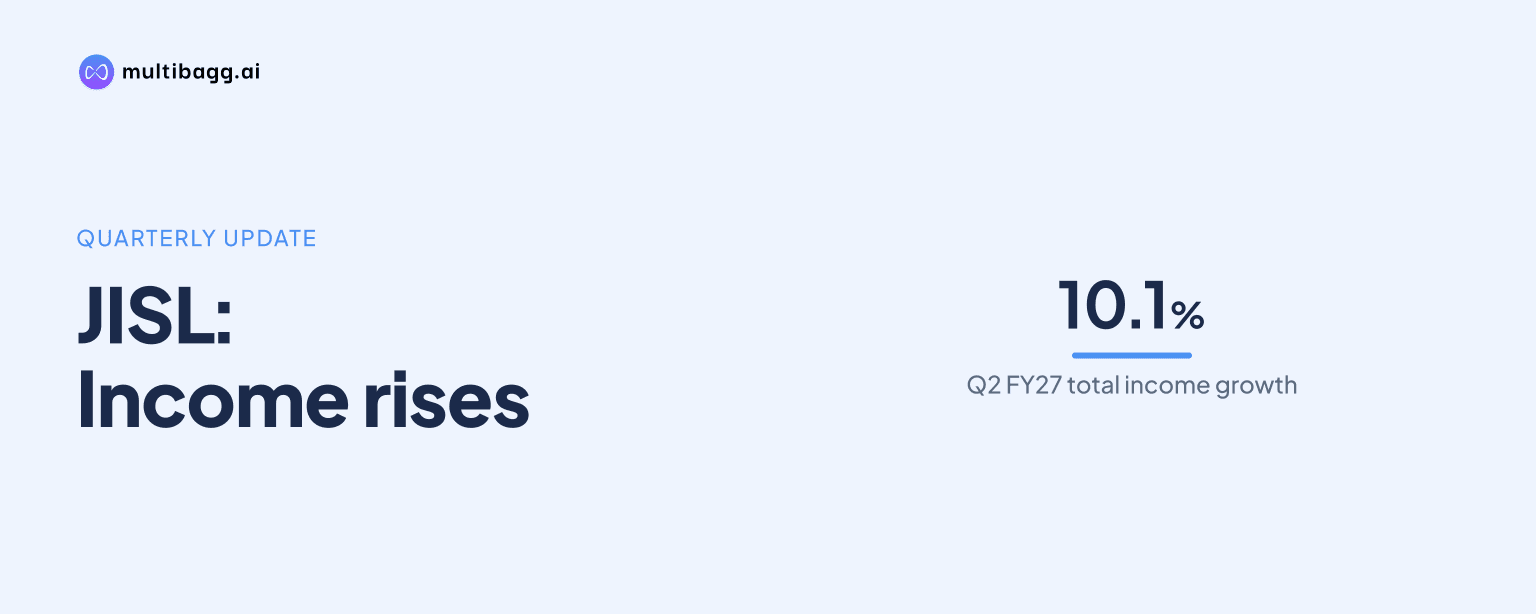
Jain Irrigation Systems Limited (JISL) reported consolidated total income of ₹1,576.7 crore in Q2 FY27, up 10.1% year on year, while earnings before interest, tax, depreciation and amortisation (EBITDA) margin declined 75 basis points to 13.2% from 13.9%. Reported profit after tax (PAT) rose 17.4% to ₹18.0 crore.
Know Jain Irrigation Systems inside out
Results, valuation, peers and who's buying, in one view.
How did JISL perform in Q2 FY27?
JISL’s consolidated total income rose by ₹144.4 crore to ₹1,576.7 crore in Q2 FY27 from ₹1,432.3 crore in Q2 FY26. EBITDA increased 4.2% to ₹207.5 crore from ₹199.2 crore, meaning operating profit grew more slowly than income during the quarter ended September 30, 2026.
That difference was reflected in the EBITDA margin, which moved down to 13.2% from 13.9%. A basis point is one-hundredth of a percentage point. Adjusted PAT, which JISL calculates before non-cash unwinding of finance costs related to 0.01% non-convertible debentures and EBCs, increased 13.2% to ₹39.5 crore from ₹34.9 crore.
Reported PAT grew faster than EBITDA, rising by ₹2.7 crore to ₹18.0 crore from ₹15.3 crore. Cash PAT rose 7.2% to ₹91.8 crore, although its margin fell 16 basis points to 5.8% from 6.0%, showing that the income increase did not translate into a higher cash-PAT margin.
Why did JISL’s EBITDA margin decline in Q2 FY27?
JISL said adverse weather patterns and drought conditions in parts of India moderated demand for micro-irrigation systems and agricultural pipes in Q2 FY27. It also cited higher polymer prices and freight costs following developments in West Asia, alongside the 75-basis-point movement in consolidated EBITDA margin.
Polymer prices had declined earlier but rose sharply again in Q2 FY27 because of supply concerns, according to management. JISL said it responded through pricing actions and supply-chain management, while a Minimum Import Price on suspension-grade polyvinyl chloride resin and withdrawal of a customs-duty exemption helped reduce price volatility.
The standalone result showed a larger margin decline than the consolidated result. Standalone total income increased 4.9% to ₹725.1 crore, but EBITDA fell 9.7% to ₹97.2 crore and EBITDA margin declined 216 basis points to 13.4% from 15.6%; standalone PAT was a loss of ₹14.5 crore against a ₹2.0 crore profit a year earlier.
What do JISL’s first-half FY27 results show?
JISL’s consolidated total income rose 3.6% to ₹3,085.0 crore in 1H FY27 from ₹2,978.0 crore in 1H FY26. This first-half growth rate was below the 10.1% increase recorded in Q2 FY27, while first-half EBITDA declined 7.3% to ₹371.9 crore from ₹401.2 crore.
The half-year EBITDA margin fell 142 basis points to 12.1% from 13.5%. Reported PAT dropped 99.2% to ₹20 lakh from ₹26.5 crore, while adjusted PAT declined 34.8% to ₹42.7 crore and cash PAT decreased 10.4% to ₹147.7 crore.
Standalone first-half income declined 11.5% to ₹1,424.4 crore, compared with a 3.6% rise in consolidated income. Standalone EBITDA fell 21.4% to ₹181.5 crore and its margin decreased 160 basis points to 12.7%, while standalone PAT was a ₹28.4 crore loss versus a ₹9.0 crore profit in 1H FY26.
Got a follow-up? Ask IRIS
Which JISL businesses supported Q2 FY27 income?
JISL said Agro Processing and overseas Plastics businesses continued to deliver strong growth in Q2 FY27, when consolidated income reached ₹1,576.7 crore. The release did not disclose revenue, EBITDA or profit by business, so the individual contribution of either segment to the ₹144.4 crore increase in consolidated income was not quantified.
Management contrasted those businesses with softer demand for domestic micro-irrigation systems and agricultural pipes, where drought conditions affected demand in parts of India. JISL’s disclosed operations also include PVC pipes, high-density polyethylene pipes, plastic sheets, renewable-energy solutions, tissue-culture plants, financial services and other agricultural inputs.
Improved receivables collections lifted standalone operating cash flow to 180% of EBITDA in Q2 FY27, according to management. JISL said this enabled timely repayment of non-convertible debentures, linking collections performance to cash generation rather than to the 13.2% consolidated EBITDA margin.
What is JISL expecting after Q2 FY27?
JISL management expects Hi-Tech Agri and domestic Piping businesses to recover after Q2 FY27, while saying Agro Processing and overseas businesses were performing well as of the November 4, 2026 release. Management expects this mix to improve operational efficiencies, but did not provide a revenue, EBITDA or margin target.
The disclosed factors to track are domestic demand for micro-irrigation systems and agricultural pipes, polymer and freight costs, and receivables collections. These factors affected the September quarter as polymer prices rose sharply, adverse weather moderated demand, and standalone operating cash flow reached 180% of EBITDA.
Conclusion
JISL delivered higher Q2 FY27 consolidated income and reported PAT, but its 10.1% income growth exceeded the 4.2% increase in EBITDA. The resulting 75-basis-point decline in EBITDA margin contrasted with the stronger contribution management cited from Agro Processing and overseas Plastics, while domestic agri-linked demand remained affected by weather conditions.
The next results will indicate whether the recovery management expects in Hi-Tech Agri and domestic Piping materialises. Polymer and freight costs, demand for micro-irrigation and agricultural pipes, and collections will remain relevant after the September-quarter cash-flow performance that management said supported timely non-convertible debenture repayments.