










Jain Irrigation targets positive H2 despite monsoon threat
Key highlights
- Jain Irrigation said 80%-85% of its business is in west and south India, where deficient rainfall poses its largest demand risk.
- First-half revenue was about Rs 3,100 crore, around 4% above the prior year, and earnings before interest, tax, depreciation and amortisation were Rs 372 crore.
- Jain Irrigation generated Rs 206 crore of cash from Rs 208 crore of quarterly earnings before interest, tax, depreciation and amortisation and made Rs 230 crore of repayments.
- Management expects government-linked receivables to decline by more than Rs 300 crore on a net basis by March.
powered by IRIS
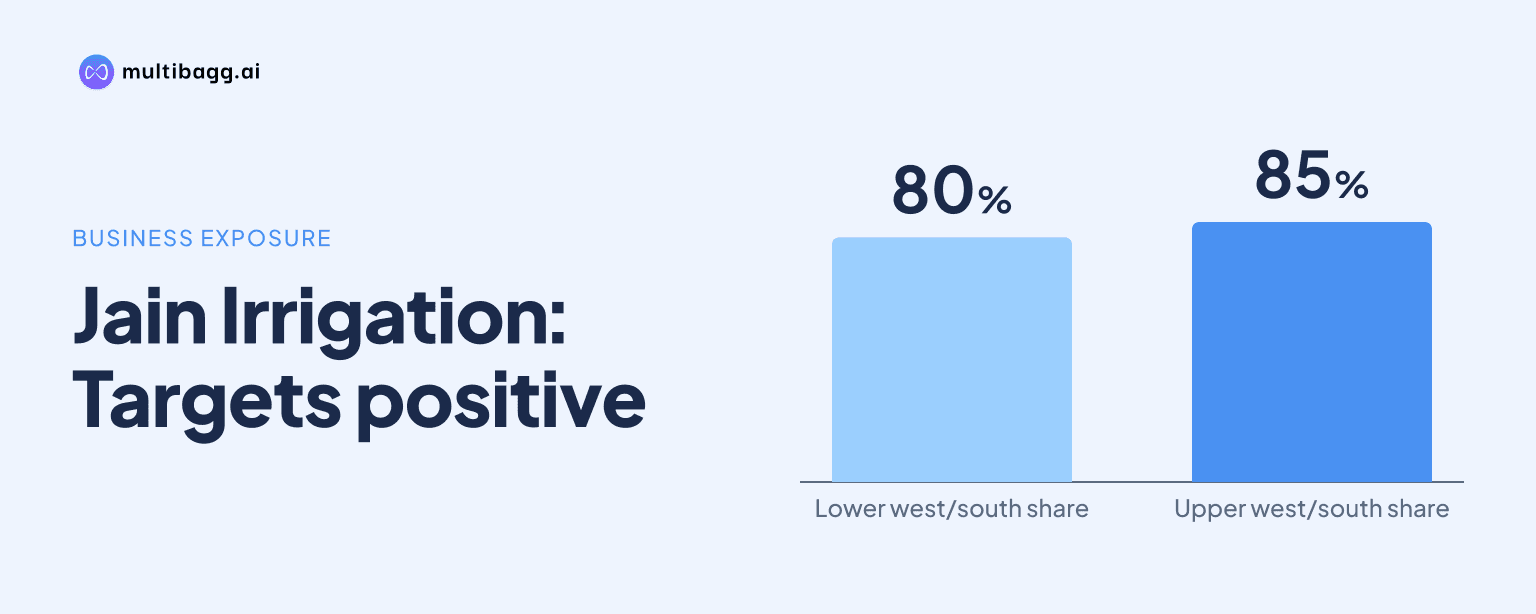
Jain Irrigation said it still expects positive performance in H2 despite deficient monsoon conditions threatening demand in west and south India, where 80%-85% of its business is generated. Management said agricultural water restrictions could reduce demand for drip systems and pipes, while exports, infrastructure pipes, solar pumps and food processing are intended offsets.
Know Jain Irrigation Systems inside out
Results, valuation, peers and who's buying, in one view.
How exposed is Jain Irrigation to the deficient monsoon?
Jain Irrigation is materially exposed because management said 80%-85% of its business takes place in west and south India, the regions facing the larger water-related challenge. It said kharif crops had already been affected and rabi crops could also be affected, with Maharashtra identified as an important state for the company.
The demand risk depends on water allocation for agriculture. Management said governments in some areas could reserve water for drinking rather than farming; without water for irrigation, farmers would not need drip systems or agricultural pipes. It said some locations still have adequate water, and the company is working with dealers and farmers in those areas to place capacity in the market.
Management cited experts describing the national monsoon as the worst in around 35 years and Maharashtra's as the worst in more than 50 years. Those were management's descriptions of the operating backdrop, rather than company forecasts, but they explain its caution on agricultural demand during H2.
What businesses could offset Jain Irrigation's farm-demand risk?
Jain Irrigation said exports and non-agricultural demand could partly offset pressure on drip and rural pipes. Management cited demand for large-diameter pipes used in infrastructure projects, solar water pumps, global food products, a growing beverage business and the overseas plastics segment.
The latest quarterly results showed growth in several of those businesses. Agro-processing revenue was about Rs 560 crore, up 8.4%, while plastics including domestic and overseas operations grew about 17%. Management also said food subsidiaries and the overseas plastic-sheet business performed well during the quarter.
Management's response combines geography and product mix. It plans to pursue sales in water-available regions and improve exports, while seeking growth from infrastructure-oriented pipes, food products and solar pumps. It said this effort would be pursued without losing discipline on working capital.
Why has Jain Irrigation's pipe business lagged?
Jain Irrigation said domestic pipe sales have been weak because almost all its pipe volume is sold into rural agricultural applications. Management contrasted that portfolio with competitors that sell substantial volumes into urban, commercial-building, plumbing and drainage markets.
The pipe business improved from the first quarter but was nearly flat against the prior-year level in the quarter discussed. Management said piping revenue had declined 25%-30% in the first quarter, and rural demand remained subdued when high resin costs caused customers to defer purchases.
Management nevertheless expects full-year pipe growth of 8%-10%, if conditions develop as it expects. It said this growth should come primarily from applications outside agriculture, where it sees good second-half demand, rather than from a broad recovery in rural agricultural demand.
Polymer prices and availability are the second major uncertainty identified by management. It said the West Asian war had affected energy needs, downstream polymer availability and polymer costs, leaving the company exposed to higher input prices or unpredictable supply alongside the monsoon-related demand risk.
Got a follow-up? Ask IRIS
What do Jain Irrigation's recent results show?
Jain Irrigation entered H2 after a second quarter that management described as markedly better than the first. First-half revenue was about Rs 3,100 crore, around 4% above the prior year, after first-quarter revenue had declined by 24%-25%, particularly in business outside India.
First-half earnings before interest, tax, depreciation and amortisation were Rs 372 crore, equal to 12.1% of revenue, and adjusted profit after tax was about Rs 43 crore. For the quarter, management said adjusted profit after adjusting for the wind-down effect of debentures in the profit and loss account was about Rs 40 crore.
Cash conversion was a central feature of the quarter. Management said Rs 206 crore of cash was generated from Rs 208 crore of quarterly earnings before interest, tax, depreciation and amortisation, supporting Rs 230 crore of repayments. The working-capital cycle fell to 179 days from 183 days during the period and from 205 days at the prior year's end-September.
Can Jain Irrigation meet its March repayments?
Jain Irrigation said it does not anticipate an issue in meeting the second part of its repayments due in March. Management said expected receivable collections and additional earnings generation should be sufficient, after one part of the year's repayment obligations had already been paid.
Management put standalone receivables at about Rs 1,860 crore at the September quarter. About Rs 800 crore was linked to projects and about Rs 400 crore to business where government subsidy plays a role, while the remaining balance related to retail, institutional, solar and export receivables.
Management expects government-linked project and subsidy-related receivables to decline by more than Rs 300 crore on a net basis by March. It said Rs 320 crore would represent 40% of the Rs 800 crore project-receivable balance, although ongoing subsidy-related business will continue to create billing.
The company said it had reduced active large projects to about seven or eight after closing roughly 15-20 over the preceding six months. Management expects project business to reach zero in the next fiscal year, with most of the remaining work completed by the following September, though settlement after physical closure can take longer.
Conclusion
Jain Irrigation's positive H2 target depends on offsetting a concentrated agricultural-demand risk with businesses that showed growth in the latest quarter. The 80%-85% exposure to west and south India leaves drip and rural pipe demand dependent on water availability, but agro-processing grew 8.4%, plastics grew about 17%, and management identified exports and infrastructure applications as additional support.
The next points to watch are management's planned reduction of more than Rs 300 crore in government-linked receivables by March, its 8%-10% full-year pipe-growth expectation and further movement from the 179-day working-capital cycle. Management also expects most remaining project activity to be completed by the following September and says legacy receivables should reduce over the next few quarters.