










JISL cuts 0.01% NCDs to Rs 603.5 crore, faces Rs 610.9 crore due
Key highlights
- JISL’s 0.01% NCD balance fell by Rs 227.6 crore to Rs 603.5 crore at 30 September 2026.
- JISL lists Rs 610.9 crore of long-term debt repayments in FY27’s remaining six months.
- JISL’s total reported debt was Rs 3,874.0 crore at September 2026, down Rs 27.6 crore from March 2026.
- JISL’s consolidated net working-capital cycle improved by 26 days year on year to 179 days at September 2026.
powered by IRIS
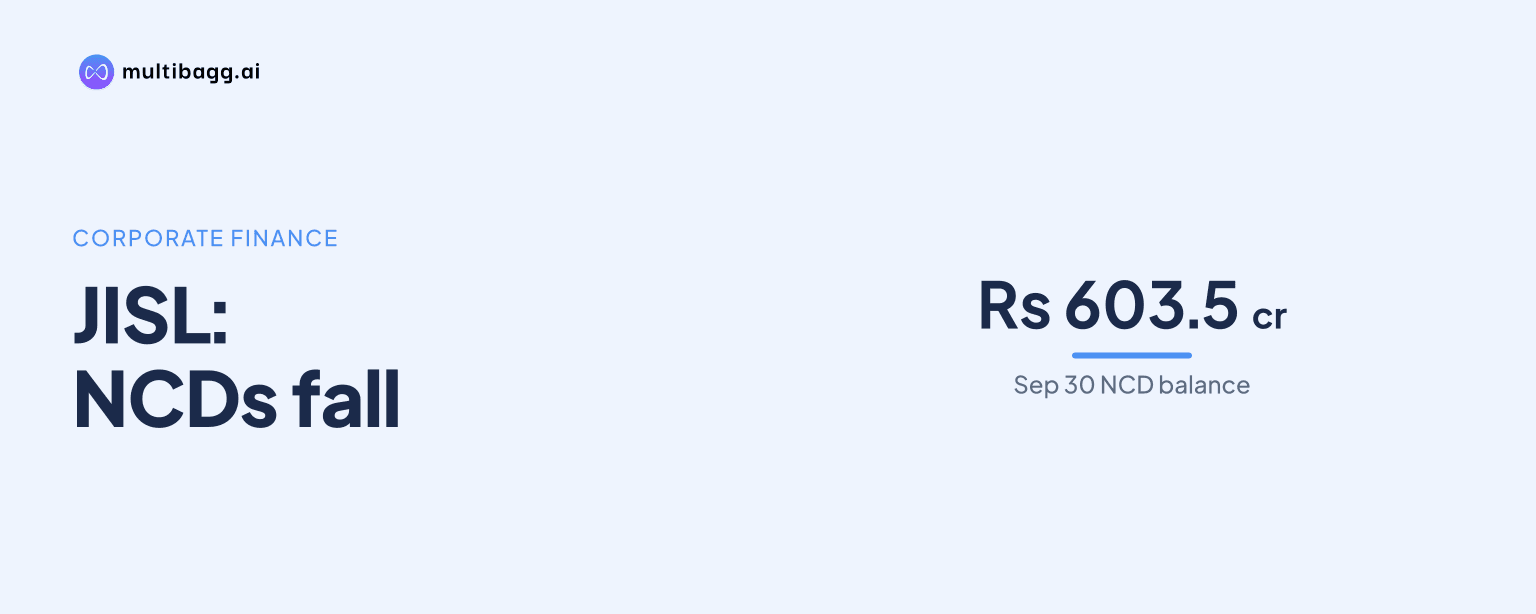
Jain Irrigation Systems Ltd. reduced its 0.01% non-convertible debentures, or NCDs, to Rs 603.5 crore at 30 September 2026 from Rs 831.1 crore at 31 March 2026, while JISL’s repayment schedule for the remaining six months of FY27 totals Rs 610.9 crore across long-term debt facilities.
Know Jain Irrigation Systems inside out
Results, valuation, peers and who's buying, in one view.
What debt repayments does JISL face in the second half of FY27?
JISL faces Rs 610.9 crore of scheduled long-term debt repayments in FY27’s remaining six months, according to its 30 September 2026 consolidated debt profile. The largest item is Rs 462.6 crore of repayments on the 0.01% NCDs, followed by Rs 136.1 crore in Food-Consolidated debt, Rs 9.1 crore in JISL ECLGS-WDTL debt and Rs 3.1 crore in overseas Plastic debt.
The repayment concentration differs materially in later years. JISL lists Rs 462.9 crore due in FY28, Rs 153.4 crore in FY29, Rs 68.8 crore in FY30 and Rs 174.1 crore after FY31. The Food-Consolidated FY27 amount also carries an update: JISL said it subsequently made a Rs 74 crore payment in October 2026, though the presentation does not provide a revised outstanding balance or revised remaining FY27 schedule.
How far has JISL reduced its NCD and term-debt balances?
JISL cut its outstanding 0.01% NCDs by Rs 227.6 crore over the six months to 30 September 2026, taking the balance from Rs 831.1 crore at 31 March to Rs 603.5 crore. This NCD reduction accounts for most of the Rs 182.1 crore decline in total long-term debt, which moved from Rs 1,652.2 crore to Rs 1,470.1 crore over the same period.
Reported term debt, which reflects the fair-value gain on the 0.01% NCDs, was Rs 1,427.3 crore at 30 September, down from Rs 1,566.9 crore at 31 March. The fair-value gain deducted from debt was Rs 42.8 crore at September, versus Rs 85.3 crore at March. Separately, ECLGS-WDTL debt rose from Rs 33.5 crore to Rs 109.5 crore, while Food-Consolidated long-term debt increased from Rs 537.6 crore to Rs 552.0 crore.
Has working-capital borrowing offset part of the term-debt reduction?
Yes. JISL’s fund-based working-capital borrowings increased by Rs 112.0 crore from Rs 2,334.7 crore at 31 March 2026 to Rs 2,446.7 crore at 30 September 2026. That increase offset part of the Rs 182.1 crore reduction in long-term debt, leaving total reported debt only Rs 27.6 crore lower at Rs 3,874.0 crore.
The increase was led by JISL, India, where working-capital borrowing rose Rs 86.6 crore to Rs 1,717.4 crore. Overseas Plastic borrowing increased Rs 31.5 crore to Rs 115.5 crore, while Food-Consolidated working-capital borrowing declined Rs 6.1 crore to Rs 613.8 crore. The capital-allocation statement also reports consolidated borrowings of Rs 3,874.0 crore at 30 September, compared with Rs 3,891.2 crore at 30 June and Rs 3,812.2 crore at 30 September 2025.
Got a follow-up? Ask IRIS
What operating-cash and working-capital trends support JISL’s repayments?
JISL reported cash from operations equivalent to 90% of earnings before interest, tax, depreciation and amortisation, or EBITDA, in 1H FY27, while consolidated net working-capital days improved by 26 days year on year to 179 days at 30 September 2026. Total receivables days sales outstanding, or DSO, fell to 121 days from 136 days a year earlier, and inventory days declined to 125 from 130 days.
The second quarter showed a further improvement from June. Consolidated net working-capital days declined to 179 at September from 183 at 30 June, driven principally by Hi-Tech Agri, where net working-capital days fell to 286 from 316. JISL said substantial recovery of Hi-Tech receivables contributed to a 15-day year-on-year improvement in overall receivables DSO, while gross working capital improved by Rs 60 crore during Q2 FY27 despite higher sales.
How do earnings trends affect JISL’s debt-servicing context?
JISL reported 1H FY27 consolidated revenue growth of 3.6% year on year, but EBITDA margin was 12.1%, with higher polymer prices and lower fixed-cost absorption cited as the factors. In the standalone business, revenue for 1H FY27 fell 11.5% to Rs 1,424.4 crore, EBITDA declined 21.4% to Rs 181.5 crore and cash profit after tax was Rs 58.6 crore, versus Rs 91.7 crore in 1H FY26.
For Q2 FY27, management said consolidated cash from operations equalled 99% of EBITDA, and its commentary specified that standalone operating cash flow reached 180% of EBITDA following improved receivables collections. Consolidated revenue grew 10.1% year on year in the quarter and EBITDA grew 4.2%, although EBITDA margin was 13.2%, down from 13.9% in Q2 FY26. Management said it expects recovery in the second half from Hi-Tech Agri and domestic Piping, alongside operating efficiencies.
Conclusion
JISL’s September debt data show a Rs 227.6 crore reduction in the 0.01% NCD balance over six months, but the company still has Rs 610.9 crore of scheduled long-term repayments in FY27’s remaining six months. The decline in long-term debt was partly offset by a Rs 112.0 crore rise in fund-based working-capital borrowing, leaving total reported debt at Rs 3,874.0 crore.
The next disclosed markers are execution of the FY27 repayment schedule, including the effect of the Rs 74 crore Food-Consolidated payment made in October 2026, and management’s stated expectation of second-half operating recovery. Investors can also watch whether consolidated working-capital days remain below the 179 days reported at 30 September 2026 and whether cash from operations continues to support debt servicing.