










Karnataka Bank expects further NPA improvement after Q2 gains
Key highlights
- Karnataka Bank’s GNPA ratio fell 31 basis points sequentially to 2.27% at September 30, 2026.
- Karnataka Bank’s NNPA ratio declined to 0.74% from 1.35% a year earlier.
- Karnataka Bank’s standard restructured advances fell 15% quarter on quarter to Rs 649.37 crore.
- Karnataka Bank management expects delayed recoveries, including one or two major accounts, in Q3FY27.
powered by IRIS
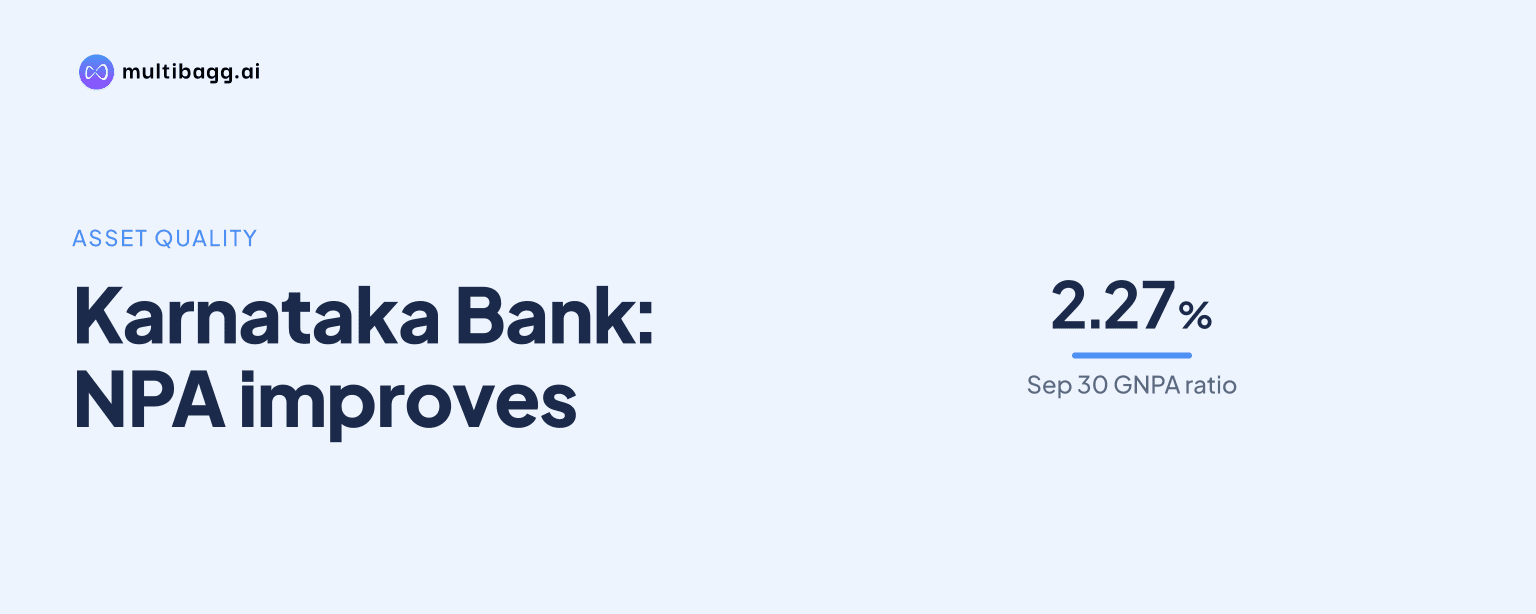
The Karnataka Bank Limited said its gross non-performing asset ratio fell to 2.27% at September 30, 2026, from 2.58% three months earlier, and management expects delayed recoveries from one or two major accounts in Q3FY27 to support further improvement in gross and net bad-loan ratios.
Know Karnataka Bank inside out
Results, valuation, peers and who's buying, in one view.
How much did Karnataka Bank’s asset quality improve in Q2FY27?
Karnataka Bank reported lower gross non-performing assets, or GNPA, and net non-performing assets, or NNPA, for the quarter ended September 30, 2026. GNPA declined 31 basis points to 2.27% from 2.58% at June 30, 2026, while NNPA decreased 13 basis points to 0.74% from 0.87%. A basis point is one-hundredth of a percentage point.
The year-on-year comparison shows a larger reduction. GNPA was 3.33% at September 30, 2025, meaning the September 2026 ratio was lower by 106 basis points. NNPA was 1.35% a year earlier, making the latest 0.74% ratio lower by 61 basis points. Management separately said GNPA had fallen from 3.08% and NNPA from 1.31% at March 31, 2025.
Standard restructured advances, including related accounts, fell to Rs 649.37 crore at September 30, 2026. The balance was 15% below Rs 762.62 crore at June 30, 2026 and 31% below Rs 939 crore a year earlier. These accounts remain classified as standard, but Karnataka Bank cited the decline as evidence that stress in the loan book had reduced.
What drove Karnataka Bank’s lower bad-loan ratios?
Karnataka Bank attributed the Q2FY27 change to earlier stress control, regional collection centres and credit underwriting within its stated guardrails. Management said a national team and collection teams across 15 regions had helped curb stress and slippages while gross advances rose 25% year on year to Rs 92,015 crore at September 30, 2026.
The reported slippage ratio, measuring loans newly becoming non-performing in a period, declined to 0.11% in Q2FY27 from 0.14% in Q1FY27. Management also said gross slippage had reduced from an earlier 0.86% to 0.11%, while net slippage had fallen from 0.75% in September 2025 to 0.11%.
Credit cost was 0.002% in Q2FY27, versus 0.03% in Q1FY27. An analyst referred to provisions of about Rs 20 crore during the quarter, and management responded that it continued to make provisions based on overall requirements, audit requirements and its internal capacity. The transcript does not provide the reported absolute provision expense for Q2FY27.
Is Karnataka Bank increasing its coverage of problem loans?
Karnataka Bank increased its provision coverage ratio, or PCR, to 68.05% at September 30, 2026 from 67.03% at June 30, 2026. PCR indicates provisions relative to gross NPAs. Including technically written-off accounts, PCR rose to 85.78% from 84.70% over the same three-month period.
Management said it had used accelerated provisioning and had raised PCR from about 58% around March 2025 to about 68% after six quarters. It said its earlier internal commitment envisaged roughly a 1-percentage-point increase each quarter. The call did not break out how much of the latest increase resulted from fresh provisions and how much reflected the lower GNPA balance.
Karnataka Bank is also assessing the expected credit loss, or ECL, framework scheduled to apply from April 1, 2027. Management estimated a possible 1% to 1.75% impact, while saying that recoveries and lower stress could reduce the burden. It added that applicable rules may allow an impact to be spread over five years, subject to regulatory prescriptions, bank policy and audit requirements.
Got a follow-up? Ask IRIS
What recoveries does Karnataka Bank expect in Q3FY27?
Karnataka Bank management expects recoveries delayed from Q2FY27 to occur in Q3FY27, including one or two major accounts, but did not disclose their value. The managing director said these recoveries could improve both GNPA and NNPA further, while noting that the timing of recoveries can shift between quarters.
That expectation remains a management outlook rather than a reported result. Management said it had anticipated major recoveries in the previous quarter, but they did not materialise in Q2FY27. It nevertheless said Q3FY27 would bring a “big number,” leaving the amount and completion date unresolved until the quarter’s results are reported.
Asset quality also faces external risks discussed in the call. In response to a question about drought conditions in Maharashtra, Karnataka and another state, management said it was monitoring agriculture and agricultural gold-loan exposures and did not see an immediate serious problem. It added that the duration of drought, or a possible later flooding event, could not be predicted in October 2026.
How does loan growth shape Karnataka Bank’s asset-quality outlook?
Karnataka Bank is growing advances while changing its portfolio mix towards retail, agriculture and micro, small and medium enterprises, or MSME. Gross advances increased to Rs 92,015 crore at September 30, 2026 from Rs 86,610 crore at June 30, 2026. Its retail, agriculture and MSME portfolio rose 7% sequentially to Rs 56,968 crore.
MSME, housing, gold, agriculture and car loans contributed about Rs 3,598 crore to the retail segment during Q2FY27. Management’s plan is to lift retail’s share of advances from 56% to 60%, increase mid-corporate lending from 20% to 22%, and reduce large-corporate lending from 24% to 18%. It maintained advance-growth guidance of 15% to 20%, without setting a separate NPA-ratio target.
The expansion is occurring alongside an increase in the credit-deposit ratio to 79.93% at September 30, 2026 from 78.45% at June 30, 2026. Aggregate business increased 17% year on year to Rs 2,07,132 crore. Management’s case for continued asset-quality improvement relies on underwriting, collection operations and stress controls keeping slippages contained as the loan book grows.
Conclusion
Karnataka Bank’s Q2FY27 data shows lower reported loan stress across several measures: GNPA reached 2.27%, NNPA was 0.74%, standard restructured advances were Rs 649.37 crore and quarterly slippage was 0.11%. The improvement from September 2025 was larger than the sequential movement, while PCR increased to 68.05%.
The next result to watch is Q3FY27, when management expects delayed recoveries, including one or two major accounts, to support further reductions in NPA ratios. Investors can also monitor whether slippages remain low as advances pursue management’s 15% to 20% growth plan, and how Karnataka Bank finalises its ECL approach before April 1, 2027.