










Karnataka Bank targets 60% retail mix, cuts corporate share
Key highlights
- Karnataka Bank reported gross advances of Rs 92,015 crore at September 30, 2026, up 25% year on year.
- Karnataka Bank targets a 60% retail mix from 56% and an 18% large-corporate mix from 24%.
- Karnataka Bank's RAM portfolio rose 7% quarter on quarter to Rs 56,968 crore in Q2FY27.
- Karnataka Bank reduced its IBPC portfolio by Rs 66 crore to Rs 1,309 crore during Q2FY27.
powered by IRIS
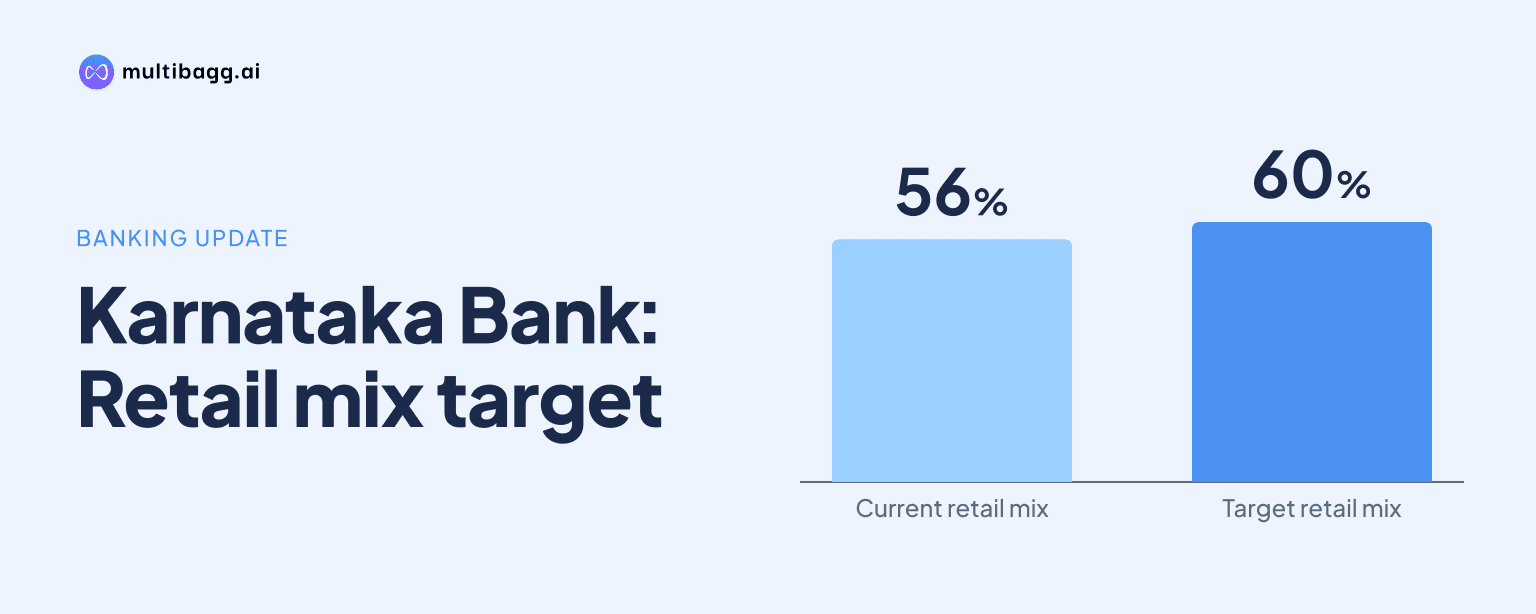
The Karnataka Bank Limited plans to raise retail lending to 60% of its loan mix from 56% and reduce large-corporate exposure to 18% from 24%, management said in Q2FY27. The shift accompanies 25% year-on-year growth in gross advances to Rs 92,015 crore as of September 30, 2026, with retail, agriculture and micro, small and medium enterprises driving incremental lending.
Know Karnataka Bank inside out
Results, valuation, peers and who's buying, in one view.
How is Karnataka Bank changing its loan mix?
Karnataka Bank is directing growth towards retail, agriculture, MSME and mid-corporate lending while reducing the relative share of large corporates. Management said the mix was 56% retail, 20% mid-corporate and 24% large corporate as of the Q2FY27 call. Its stated target is 60% retail, 22% mid-corporate and 18% large corporate, representing a four-percentage-point rise in retail and a six-point reduction in large corporate exposure.
The strategy does not mean Karnataka Bank will exit corporate lending. Management said it would stabilise the corporate portfolio through high-quality, better-yielding assets while focusing new business on retail, agriculture and MSME segments. Gross advances rose 6% from Rs 86,610 crore on June 30, 2026, to Rs 92,015 crore on September 30, showing that the planned mix change is being pursued alongside loan-book growth.
Is Karnataka Bank growing RAM faster than total advances?
Karnataka Bank's retail, agriculture and MSME portfolio, referred to by management as RAM, grew faster than total advances in Q2FY27. The RAM portfolio increased 7% quarter on quarter to Rs 56,968 crore on September 30, 2026, compared with 6% growth in gross advances. It was also 19% above Rs 47,958 crore a year earlier, while gross advances were 25% higher year on year.
Management said MSME, housing, gold, agriculture and car loans together contributed around Rs 3,598 crore to the retail segment during Q2FY27. The bank launched a goods and services tax overdraft, a loan-against-property product for MSMEs and a dropline overdraft for MSMEs. It also launched Express Digi Gold Loan on September 21, 2026, while digitisation of key MSME products and KBL Startup Finance remained in the pipeline.
Karnataka Bank retained its guidance for 15% to 20% advances growth, with management saying this could result in average year-on-year growth of 18% to 19%. The bank did not give a deadline for reaching its 60% retail, 22% mid-corporate and 18% large-corporate mix targets. Management said Q3 and Q4 are usually more active business quarters.
Got a follow-up? Ask IRIS
Why is Karnataka Bank reducing IBPC and low-yield exposure?
Karnataka Bank is reducing low-yield corporate and IBPC exposure and replacing it with higher-yielding loans, according to management. Its IBPC portfolio declined by Rs 66 crore during Q2FY27, to Rs 1,309 crore on September 30, 2026, from Rs 1,375 crore on June 30. Management said this replacement is intended to support margin expansion while corporate lending is stabilised.
The lending-yield trend was positive in Q2FY27, although net interest margin, or NIM, moved lower sequentially. Yield on advances rose 8 basis points to 8.76% from 8.68% in Q1FY27, while cost of funds fell 1 basis point to 5.15%. NIM declined 3 basis points to 3.17%, but remained above 2.72% in Q2FY26; management attributed the sequential movement partly to average balances, deposit costs and borrowings.
Management reiterated a NIM range of 3% to 3.4% and a return on assets range of 1.1% to 1.35%. It also said about 70% of advances were linked to the external benchmark lending rate and around 5% to the marginal cost of funds-based lending rate. Management said asset repricing generally takes place within about three months, which could affect loan yields as benchmark rates change.
Can Karnataka Bank's deposit strategy support the loan shift?
Karnataka Bank is seeking to fund loan growth by replacing higher-cost bulk deposits with granular retail deposits below Rs 3 crore. Retail term deposits rose 4% quarter on quarter to Rs 72,197 crore at September 30, 2026, from Rs 69,410 crore, and increased 10% from Rs 65,532 crore a year earlier. Aggregate deposits grew 4% sequentially to Rs 1,15,117 crore.
The current account and savings account ratio was 31.80% at September 30, down from 32.42% in June but above 31.01% a year earlier. Meanwhile, the credit-to-deposit ratio rose to 79.93% from 78.45% in June and 71.63% in September 2025 as advances grew faster than deposits. Management said it was seeking to renew deposits largely at established card rates to manage funding costs.
Net interest income rose 5% sequentially to Rs 982.44 crore in Q2FY27 and increased 35% from Rs 728.12 crore in Q2FY26. Profit after tax was Rs 435.89 crore, compared with Rs 418.95 crore in Q1FY27 and Rs 319.12 crore a year earlier. These results provide the earnings context for the plan to expand higher-yield RAM lending while reducing lower-yield exposure.
Conclusion
Karnataka Bank's loan-book plan is a specified reallocation rather than a broad withdrawal from corporate credit. Retail is targeted to increase from 56% to 60%, mid-corporate from 20% to 22%, and large corporate to decline from 24% to 18%. The 7% quarterly increase in the Rs 56,968 crore RAM portfolio and the Rs 66 crore decline in IBPC exposure are consistent with that direction.
The next disclosures to watch are Q3 and Q4 advances growth against management's 15% to 20% target, the progress of retail deposits below Rs 3 crore, and movement in NIM against the stated 3% to 3.4% range. Management also said it is assessing a possible 1% to 1.75% impact from the expected credit loss framework scheduled to start on April 1, 2027.