










Karnataka Bank targets 51%-52% ratio despite tech costs
Key highlights
- Karnataka Bank's cost-to-income ratio declined to 52.68% in Q2FY27 from 55.14% in Q1FY27.
- Management said 40%-50% of technology spending goes to licences and upgrades, while 20%-25% goes to regulatory and compliance needs.
- Net interest income increased 35% year on year to Rs 982.44 crore in Q2FY27.
- Karnataka Bank's RAM portfolio grew 19% year on year to Rs 56,968 crore at September 30, 2026.
powered by IRIS
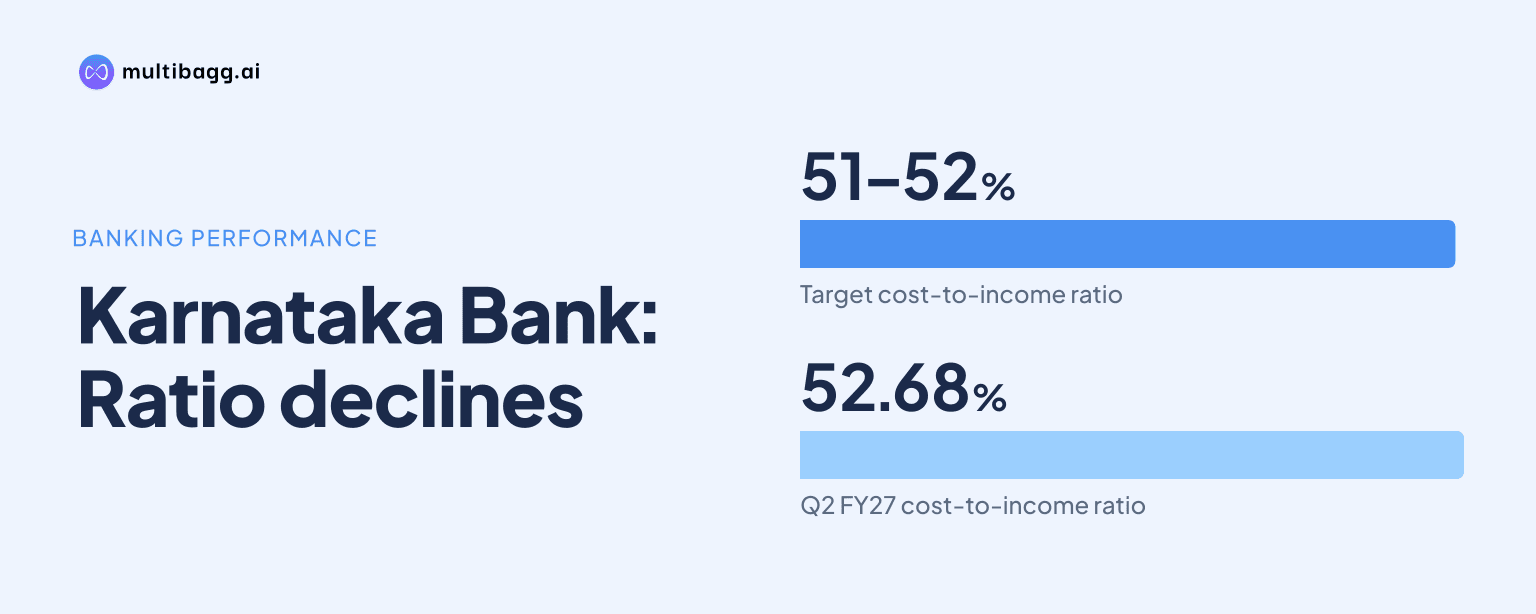
Karnataka Bank reduced its cost-to-income ratio to 52.68% in Q2FY27 from 69% in Q4 FY25 and is targeting 51%-52%, even as management said 60%-75% of technology spending is absorbed by licences, upgrades, regulatory and compliance needs. The plan relies on higher operating income, digital delivery and artificial intelligence-led process efficiency.
Know Karnataka Bank inside out
Results, valuation, peers and who's buying, in one view.
How far has Karnataka Bank reduced its cost-to-income ratio?
Karnataka Bank reduced its cost-to-income ratio to 52.68% for the quarter ended September 30, 2026, from 55.14% in Q1FY27 and 58.93% in Q2FY26. Management said the ratio was 69% in Q4 FY25 and 60% for the full FY25 period, before the bank’s recent focus on operating income, cost control and technology leverage.
The Q2FY27 ratio was 246 basis points lower than in Q1FY27, providing the immediate basis for management’s 51%-52% objective. Profit after tax rose 37% year on year to Rs 435.89 crore in Q2FY27, while net interest income increased 35% to Rs 982.44 crore, giving the bank higher income over which to absorb operating costs.
Management said the intended route is to improve interest income and other income while reducing costs, rather than relying on a single measure. Operating income increased 37% in Q2FY27, according to management’s response to an analyst, but Karnataka Bank did not provide a dated target for reaching the 51%-52% cost-to-income range.
What technology costs does Karnataka Bank still carry?
Karnataka Bank said 40%-50% of every Rs 100 of technology investment goes towards licences and upgrades, while another 20%-25% goes to regulatory and compliance requirements. This means 60%-75% of the technology budget is committed to maintenance and mandatory needs rather than being directly deployable toward business expansion.
Management said it had budgeted a couple of major technology investments during FY27, without disclosing their rupee value. It described the need to improve operational efficiency alongside the digital journey and said it was focusing on three or four areas where artificial intelligence, or AI, could improve internal processes.
Several technology systems were live by the September 2026 quarter: digitised gold loans, interest-bearing credit lines on Unified Payments Interface, software-defined wide area network, a common data platform, Mule Hunter and Sales Buddy, an AI assistant. Karnataka Bank also said it was taking measures to mitigate cyber and AI-related risks as it expanded technology use.
Projects in progress included digital loans against mutual funds and shares, secured credit cards, a Digital Personal Data Protection solution, a new treasury application and a new non-performing asset management system. Management said the benefits of IT spending could be delayed, rather than appearing in the quarter in which the investment is made.
Which business changes support Karnataka Bank's efficiency target?
Karnataka Bank is combining the technology programme with a shift toward retail, agriculture and micro, small and medium enterprise, or RAM, lending. Gross advances rose 25% year on year to Rs 92,015 crore at September 30, 2026, while the RAM portfolio grew 19% to Rs 56,968 crore, supporting management’s aim of increasing higher-yield lending.
The bank is also reducing low-yield corporate exposure and replacing its inter-bank participation certificate, or IBPC, portfolio with higher-yielding loans. The IBPC portfolio declined by Rs 66 crore during Q2FY27 to Rs 1,309 crore at September 30, 2026, from Rs 1,375 crore three months earlier.
On the funding side, retail term deposits below Rs 3 crore increased 4% sequentially to Rs 72,197 crore at September 30, 2026. Management said it was replacing higher-cost bulk deposits with granular retail deposits at card rates, although the current account savings account ratio declined to 31.80% from 32.42% in June 2026.
Net interest margin, or NIM, nevertheless declined by 3 basis points sequentially to 3.17% in Q2FY27. Management attributed quarter-to-quarter movements to average balances, changes in current account savings account deposits, average deposit costs and borrowing, and said an interest-on-income-tax item affected Q1FY27.
Got a follow-up? Ask IRIS
How do digital products fit Karnataka Bank's operating plan?
Karnataka Bank launched Express Digi Gold Loan on September 21, 2026, describing it as a faster digital gold-loan process intended to broaden reach and accelerate customer acquisition. The bank also launched UPI Help and MyUPI, which allow customers to view transaction history, raise and track complaints, and manage Unified Payments Interface mandates.
Other launches included pin-less central bank digital currency transactions of up to Rs 500 per transaction and Trade Konnect for import, export and outward remittances. These products sit alongside the bank’s stated use of digital channels to improve customer service and operational processes while it seeks a lower cost-to-income ratio.
The pipeline includes a retail internet banking revamp with a new user interface and user experience, Unified Payments Interface services for non-resident Indian customers, and digital enablement for Soulabhya Plus deposits. For the micro, small and medium enterprise segment, Karnataka Bank plans end-to-end digitisation of key products after launching goods and services tax overdraft, loan-against-property and dropline overdraft facilities.
Management’s broader loan-mix plan is to increase retail advances from 56% to 60%, increase mid-corporate advances from 20% to 22%, and reduce large-corporate advances from 24% to 18%. It also maintained FY27 guidance of 15%-20% advances growth and 10%-15% liabilities growth, making digital origination, underwriting and servicing relevant to the operating-cost target.
What could determine whether Karnataka Bank reaches 51%-52%?
Karnataka Bank’s progress toward 51%-52% depends on whether digital and AI projects create efficiency faster than recurring technology obligations add costs. Management did not disclose a rupee savings target, implementation date for each system, or a quarter in which it expects the cost-to-income objective to be achieved.
Asset quality and recoveries may also affect the pace of improvement. Gross non-performing assets declined to 2.27% at September 30, 2026 from 2.58% in June 2026, while slippages fell to 0.11% in Q2FY27 from 0.14% in Q1FY27; management cited collection teams in 15 regions and underwriting guardrails.
Management said recovery from one or two larger accounts expected in Q2FY27 could occur in Q3FY27, but did not quantify the potential recoveries. It also said expected credit loss, or ECL, requirements beginning April 1, 2027 could have a 1%-1.75% impact, although management said the bank was studying the transition and that the impact could be spread over five years under applicable requirements.
Conclusion
Karnataka Bank has lowered its cost-to-income ratio from 69% in Q4 FY25 to 52.68% in Q2FY27 while continuing technology expenditure that management says is mostly required for licences, upgrades, regulation and compliance. Its 51%-52% goal depends on income growth from the RAM portfolio, retail-deposit mobilisation and measurable operating benefits from digital and AI systems.
The next point to watch is Q3FY27, when management expects some previously anticipated recoveries and continues work on digital loans against mutual funds and shares, the treasury application and the non-performing asset management system. Management has also retained FY27 guidance for 15%-20% advances growth and plans to raise retail advances to 60% of the book.