










Karnataka Bank expects NIM to remain within 3%-3.4% band
Key highlights
- Karnataka Bank reported Q2FY27 NIM of 3.17%, versus 3.20% in Q1FY27 and 2.72% in Q2FY26.
- About 70% of Karnataka Bank advances are T-bill-linked and typically reprice within three months.
- Karnataka Bank's Q2FY27 yield on advances rose 8 basis points to 8.76%, while cost of funds fell 1 basis point to 5.15%.
- Karnataka Bank maintained FY27 guidance of 15% to 20% advance growth and 10% to 15% liability growth.
powered by IRIS
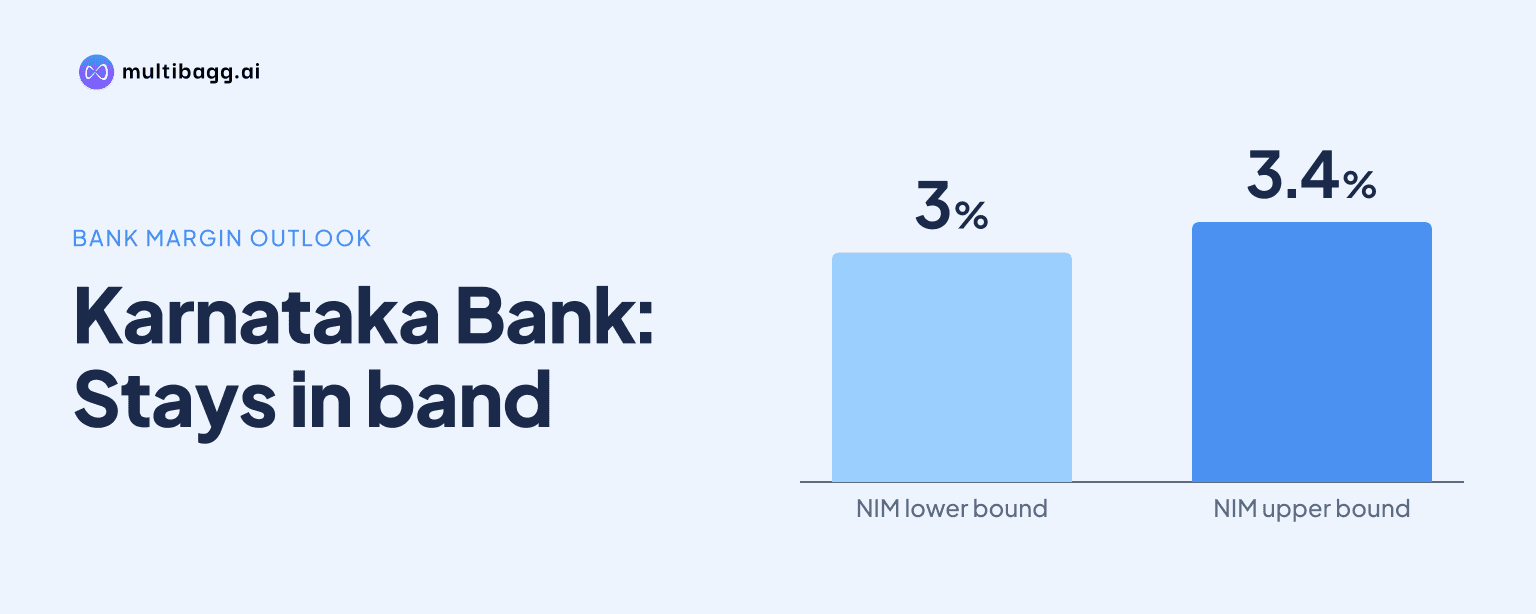
Karnataka Bank expects net interest margin, or NIM, to remain in its 3% to 3.4% band after about 70% of advances linked to Treasury bills, or T-bills, reprice within roughly three months. The bank reported a 3.17% NIM in Q2FY27 and said asset repricing should occur faster than liability repricing.
Know Karnataka Bank inside out
Results, valuation, peers and who's buying, in one view.
What is Karnataka Bank's NIM guidance for the second half?
Karnataka Bank's stated NIM guidance is 3% to 3.4%, and management said it remains focused on maintaining NIM above 3% and return on assets, or ROA, above 1%. During the earnings call, management indicated an ROA range of 1.1% to 1.3%-1.35%, rather than setting a more specific quarterly NIM target. The Q2FY27 NIM of 3.17% was within the stated range.
An analyst asked whether the increase in the six-month T-bill yield over the preceding one to one-and-a-half months could move NIM closer to the upper end of the range. Karnataka Bank did not specifically endorse that outcome. Management instead repeated the 3% to 3.4% band and said the margin had bottomed in the previous year, with scope to remain stable or rise as loan rates reset.
Why should T-bill-linked loans support Karnataka Bank's margin?
Karnataka Bank said around 70% of its advances are linked to the external benchmark lending rate, or EBLR, and confirmed that this entire 70% is T-bill-linked. It described fixed-rate lending as a very small share of advances. Loans linked to the marginal cost of funds-based lending rate, or MCLR, account for around 5%, while deposit-backed and certain other loans carry fixed rates.
Management said T-bill-linked assets normally reprice within a gap of three months or less, whereas liabilities do not reset as quickly. It told investors that an October rise in T-bill rates would pass through on different dates within that three-month period. This difference in reset timing is the mechanism behind management's view that the benchmark increase should not cause further NIM compression.
How did Karnataka Bank's Q2FY27 margin compare with prior periods?
Karnataka Bank reported NIM of 3.17% in Q2FY27, down 3 basis points from 3.20% in Q1FY27 but up 45 basis points from 2.72% in Q2FY26. A basis point is one-hundredth of a percentage point. The sequential decline came even as yield on advances rose by 8 basis points to 8.76% and cost of funds fell by 1 basis point to 5.15%.
Management attributed quarter-to-quarter movements to average balances, changes in current account savings account, or CASA, balances, average deposit costs and borrowings. It also said Q1FY27 included an item relating to interest on income tax paid that affected the comparison. Karnataka Bank described the 3-basis-point Q2FY27 decline as limited and said underlying NIM and ROA were on an upward trend excluding that Q1 item.
Got a follow-up? Ask IRIS
What other factors could affect Karnataka Bank's NIM?
Karnataka Bank said it is reducing reliance on bulk deposits, replacing them with retail deposits at card rates and building CASA balances. Cost of funds was 5.15% in Q2FY27, compared with 5.16% in Q1FY27, and management expects the deposit strategy to support the sequential improvement. The bank also said growth in retail, agriculture and micro, small and medium enterprises, or MSME, loans should support advance yields.
The credit-to-deposit ratio was 79.93% in September 2026, compared with 78.45% in June 2026 and 71.63% in September 2025. That change shows advances expanded faster than deposits over both comparison periods. Karnataka Bank's NIM view rests on loan repricing and deposit-mix measures, although management did not quantify future deposit costs or forecast the NIM outcome for any individual quarter.
How does Karnataka Bank's lending mix fit its margin plan?
Karnataka Bank said retail represented 56% of advances at the time of the call, mid-corporate lending represented 20% and large corporate lending represented 24%. Its disclosed mix objective is to raise retail to 60% and mid-corporate to 22%, while reducing large corporate exposure to 18%. Management linked its loan-yield plan to faster retail growth and a corporate portfolio focused on higher-quality, better-yielding assets.
For FY27, Karnataka Bank maintained guidance for 15% to 20% advance growth and 10% to 15% liability growth. Management said its approved annual operating plan aims to increase business from Rs 83,000 crore to Rs 98,000 crore, after adding about Rs 5,000 crore in Q1FY27 and Rs 10,000 crore in Q2FY27. It said around Rs 18,000 crore of additional business remains to be added after about Rs 15,000 crore in the first half.
Karnataka Bank also cited product measures that could support lending growth. MSME products launched during the period included a goods and services tax overdraft facility, loan against property for MSME borrowers and a dropline overdraft for MSME borrowers. The bank launched Express Digi Gold Loan on September 21, 2026, while plans in progress include digital lending against mutual funds and shares, secured credit cards and a new non-performing asset management solution.
Conclusion
Karnataka Bank's margin message is that its 3.17% Q2FY27 NIM remains within the 3% to 3.4% band because about 70% of advances are T-bill-linked and generally reprice within three months. The 3-basis-point sequential NIM decline occurred despite an 8-basis-point rise in advance yield and a 1-basis-point reduction in cost of funds, while NIM was 45 basis points above Q2FY26.
The next points to watch are whether the October T-bill increase reaches asset yields during the stated three-month reset period and whether retail deposits and CASA keep funding costs contained. Karnataka Bank also plans to open 31 branches by March 31, including at least 15 before December-end, while pursuing FY27 advance growth of 15% to 20% and its target mix of 60% retail advances.