










Kilburn subsidiaries exceed half of H1 FY27 group sales
Key highlights
- Kilburn subsidiaries generated about Rs 141.7 crore in H1 FY27, compared with Rs 73.4 crore in H1 FY26.
- Kilburn consolidated H1 FY27 revenue was Rs 270.1 crore, down 4.5% year on year.
- Kilburn reported a Rs 471 crore consolidated order book on September 30, 2026, after winning Rs 136 crore of Q2 orders.
- Kilburn approved Rs 25 crore for Monga Strayfield’s Pune enclosure-capacity expansion over six to nine months.
powered by IRIS
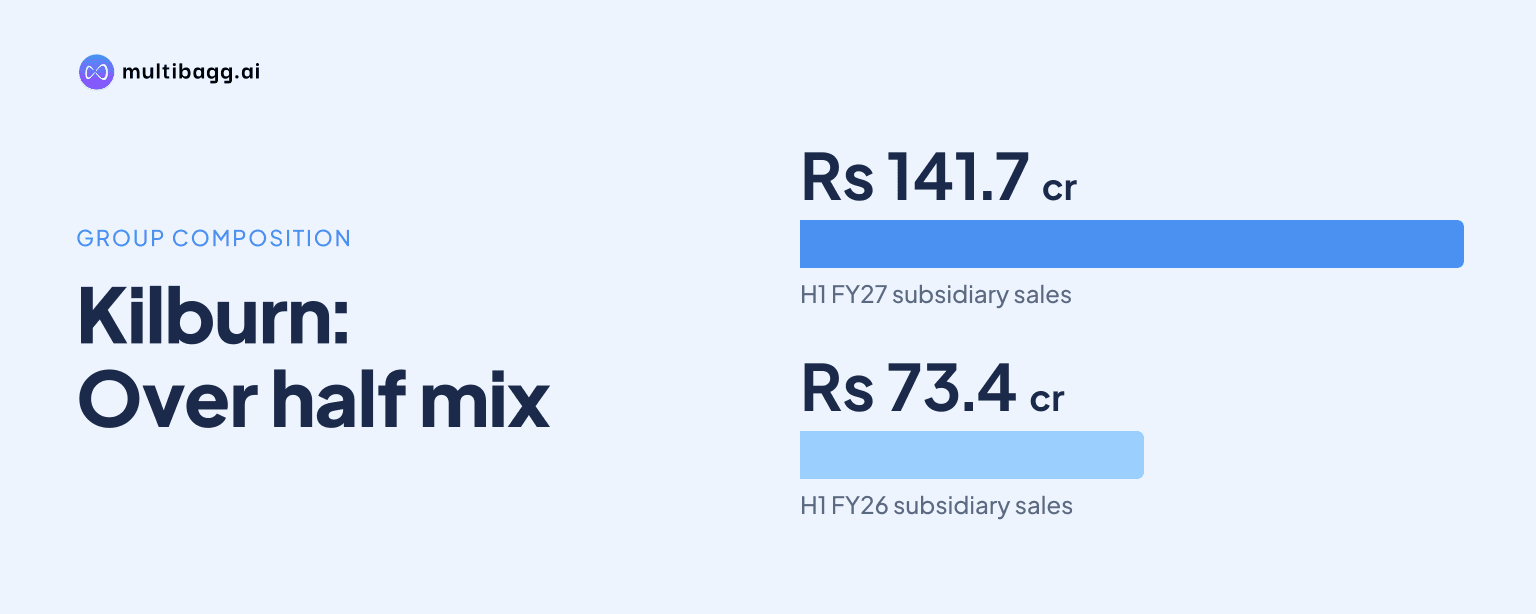
Kilburn Engineering Limited’s subsidiaries generated about Rs 141.7 crore in the half year ended September 30, 2026, versus Rs 73.4 crore a year earlier, taking their contribution above half of consolidated revenue of Rs 270.1 crore despite a 4.5% year-on-year decline in group sales.
Know Kilburn Engineering inside out
Results, valuation, peers and who's buying, in one view.
How did Kilburn subsidiaries change the H1 FY27 sales mix?
Kilburn’s subsidiaries roughly doubled their H1 revenue to about Rs 141.7 crore in H1 FY27 from Rs 73.4 crore in H1 FY26. Management said this made the subsidiaries responsible for more than half of the group’s Rs 270.1 crore consolidated revenue for the six months ended September 30, 2026.
Management said subsidiary contribution rose 21% year on year and profit contribution also increased 21%. It attributed the change to the integrated group structure comprising Kilburn, M.E. Energy Private Limited and Monga Strayfield Private Limited, which operate across process drying, energy efficiency, radio-frequency technology and precision engineering.
The comparison shows a Rs 12.7 crore reduction in consolidated revenue between H1 FY26 and H1 FY27, while subsidiary revenue increased by about Rs 68.3 crore. The group’s sales mix therefore became more dependent on the subsidiaries during a period when customers delayed capital-equipment decisions.
Why did Kilburn’s group revenue decline despite subsidiary growth?
Kilburn’s consolidated revenue declined 4.5% year on year to Rs 270.1 crore in H1 FY27 because customers postponed order finalisation and dispatch schedules, according to management. It identified export and capital-goods markets as particularly affected by geopolitical uncertainty and said one or two large orders were kept on hold in the first half.
The standalone business reported Q2 FY27 revenue of Rs 69.5 crore and profit after tax of Rs 5.7 crore, against profit after tax of Rs 18 crore in the comparable quarter a year earlier. Management described the lower standalone performance as a timing issue, rather than a structural change in its products, technology, customer relationships or market position.
Execution improved sequentially in the second quarter. Consolidated Q2 FY27 revenue was Rs 153.1 crore, almost unchanged from Rs 153.6 crore a year earlier but 30.9% higher than Q1, while management said standalone revenue increased 18.1% from the preceding quarter.
Management said the second-quarter improvement reflected execution picking up after the slower first quarter. However, its FY27 revenue expectation of Rs 600 crore to Rs 650 crore assumes delayed orders contribute early in the next financial year rather than within the current year.
What was Kilburn’s order position at September 2026?
Kilburn’s consolidated order book was Rs 471 crore on September 30, 2026, compared with Rs 485 crore at the beginning of Q2. Management said the book stayed broadly stable even after the group executed Rs 151 crore of orders during the quarter.
The group won Rs 136 crore of orders in Q2 across sectors led by fertilizers, carbon black and artificial-intelligence data centers. The closing order book included work in fertilizers, carbon black, iron and steel, and nuclear power, giving it exposure across several industrial end markets.
Management also cited multiple inquiries after Kilburn entered the global fertilizer engineering, procurement and construction vendor ecosystem. It did not put a value on those inquiries or say they had converted into orders, so they remain part of the opportunity pipeline rather than the Rs 471 crore reported order book.
Chairman Amritanshu Khaitan said management expected certain large orders to reach finalisation in the next two to three months. These included one prospective order in the Middle East, one in the Far East and one or two domestic opportunities in nuclear power, which management said could support standalone growth in the following year.
Got a follow-up? Ask IRIS
How is Kilburn increasing capacity across its businesses?
Kilburn is undertaking brownfield capacity additions at its existing facilities, with the stated aim of supporting more than Rs 1,000 crore of annual group revenue capacity. Expansion at Kilburn’s Saravali plant and Phase 2 of M.E. Energy’s Pune plant were under way and expected to be completed by Q3 or early Q4.
Monga Strayfield also has a planned Pune expansion as part of the manufacturing build-out. Management said brownfield projects allow capacity to be added faster while keeping capital cost lower and reducing execution risk compared with establishing a new site.
M.E. Energy is pursuing waste-heat-recovery opportunities in ferro alloys, steel and cement. Management said a Bhutan order opened opportunities in ferro alloys, while M.E. Energy had qualified to quote for a waste-heat-recovery boiler system for a cement plant, although it had not secured that cement order.
Management also said M.E. Energy expects potential large waste-heat-recovery orders from the steel sector. These opportunities are not reported orders, but form part of the group’s plan to broaden the subsidiary platforms while the standalone business awaits deferred customer decisions.
What are management’s plans for Monga Strayfield’s enclosure business?
Kilburn’s board approved Rs 25 crore of investment, primarily at Monga Strayfield’s Pune facility, to be implemented over six to nine months. The project is intended to expand capacity for enclosures, cabinets and engineered assemblies used in data centers, transformers, battery energy storage and critical power infrastructure.
Management expects the enclosure business to generate Rs 50 crore to Rs 60 crore of FY27 revenue at current capacity. It said Vertiv, described as a long-standing Monga Strayfield customer, had indicated a Rs 90 crore requirement during the current financial year.
Management expects the enclosure business with Vertiv to generate about Rs 100 crore of annual revenue in FY27-FY28, subject to customer orders, capacity ramp-up and execution. Once fully utilised, the expanded capacity could support Rs 120 crore to Rs 130 crore of annual revenue, according to management.
Monga Strayfield described its enclosures as customised sheet-metal cabinets that house server racks, batteries, networking equipment and other power-related hardware. It said its current work is limited to power transformers, batteries and data centers, and that it has no current connection with aerospace or defence work.
Conclusion
Kilburn’s H1 FY27 results show that its subsidiaries became the larger contributor to group sales, generating about Rs 141.7 crore against consolidated revenue of Rs 270.1 crore. Their increased contribution limited the effect of postponed capital-equipment decisions, while group revenue still declined 4.5% from the prior-year half.
The next points to watch are completion of the Saravali and Pune projects by Q3 or early Q4, implementation of Monga Strayfield’s Rs 25 crore enclosure investment over six to nine months, and the potential conversion of large orders management expects to reach finalisation within two to three months. Management’s Rs 600 crore to Rs 650 crore FY27 revenue expectation and its FY26-to-FY28 growth target depend on those orders, customer demand and capacity ramp-up.