










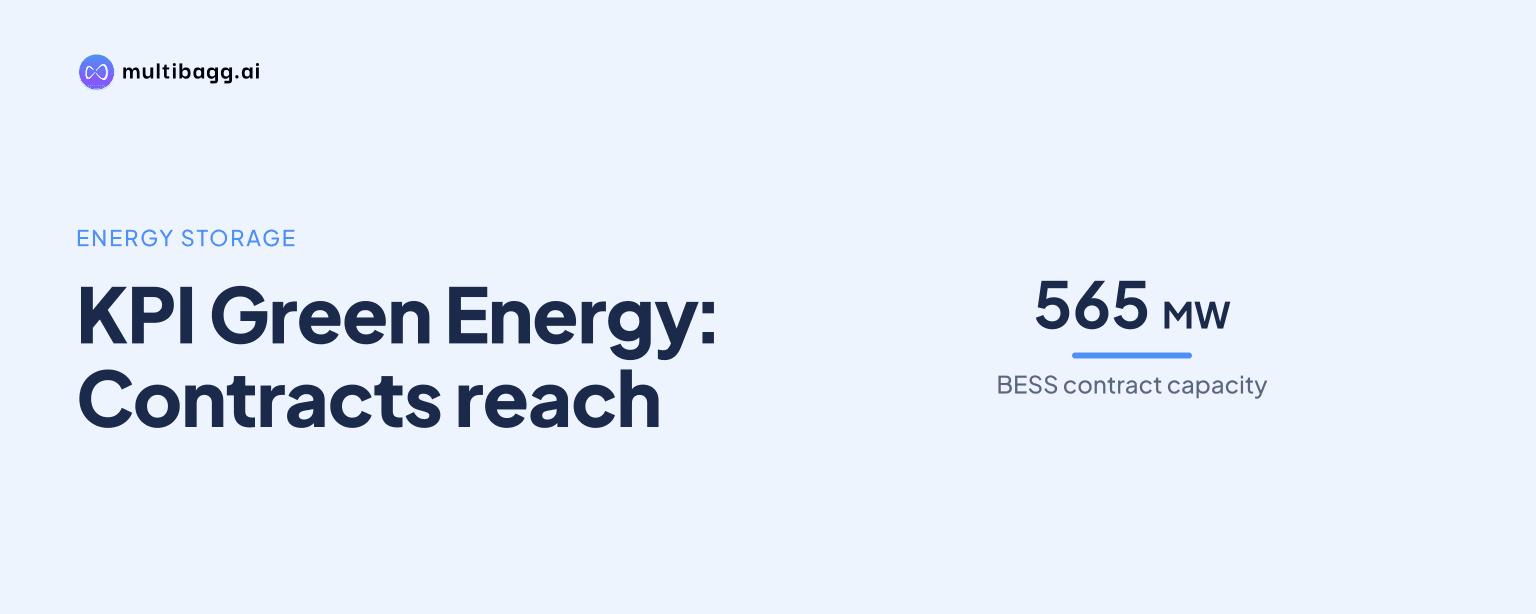
KPI Green Energy Limited's BESS contracts reach 565 MW
Key highlights
- KPI Green executed BESS purchase agreements for 565 MW and 1,130 MWh.
- Sun Drops Energia plans a Gujarat campus starting with BESS assembly before phased cell manufacturing.
- KPI Green reported an 8.33 GW renewable portfolio, including 3.02 GW of installed capacity.
- KPI Green's Q2 FY27 consolidated total income rose to Rs 741 crore from Rs 641 crore in Q2 FY26.
powered by IRIS
KPI Green Energy Limited said on November 13, 2026 that it had executed Battery Energy Storage Purchase Agreements for 565 MW and 1,130 MWh of battery energy storage systems, while its subsidiary planned a Gujarat campus beginning with battery assembly and followed by phased cell manufacturing.
Know KPI Green Energy inside out
Results, valuation, peers and who's buying, in one view.
What BESS portfolio has KPI Green contracted?
KPI Green has contracted 565 MW of BESS capacity with 1,130 MWh of energy capacity under executed Battery Energy Storage Purchase Agreements. Management described the portfolio as an important growth pillar, but did not report any commissioned BESS capacity, project customers, locations, tariffs or commissioning dates during the Q2 FY27 call.
The BESS agreements add storage to KPI Green's wider renewable portfolio of approximately 8.33 GW. That portfolio included 3.02 GW of installed capacity and 5.3 GW under execution, with 3.22 GW classified under the independent power producer, or IPP, model and 5.11 GW under engineering, procurement and construction, or EPC, activity.
KPI Green did not disclose an earlier BESS portfolio figure, so the transcript does not support a period-on-period comparison for storage contracts. Management did, however, list delivery of the 565 MW BESS portfolio among its priorities alongside IPP commissioning, financial closure and execution of its approximately Rs 5,700 crore order book.
Why is KPI Green building a Gujarat battery-storage campus?
KPI Green is developing the Gujarat campus to start BESS assembly before adding cell manufacturing in phases. Sun Drops Energia, identified by management as a KPI Green subsidiary, is developing the integrated energy-storage facility, with assembly explicitly set as the first stage of the plan.
Management said the phased campus is intended to give KPI Green greater control over technology, supply chain, working capital and project economics over time. This is a stated operational objective rather than a forecast of savings, margin improvement or return on investment. The November 13 call did not disclose the campus location, production capacity, capital expenditure, technology partner, funding plan or commissioning date.
The separation between assembly and later cell manufacturing defines the scope of the plan. BESS assembly would be the initial manufacturing activity supporting storage-system delivery, while cell manufacturing would follow in phases. Management gave no target date for the cell-manufacturing phase, using the term “over time” for the expected benefits of greater integration.
Got a follow-up? Ask IRIS
How does BESS fit into KPI Green's renewable buildout?
KPI Green is positioning BESS alongside solar, wind, hybrid and floating-solar projects rather than as a replacement for its IPP and EPC businesses. Management said rising solar additions make it increasingly important to move surplus daytime power to evening and peak-demand periods, linking the 565 MW storage portfolio to grid-balancing needs.
In H1 FY27, KPI Green energized an additional 317 MW within its 677 MW Gujarat Urja Vikas Nigam Limited hybrid IPP project, bringing cumulative capacity in that project to 511 MW. It also energized 50 MW within its 350 MW Gujarat Urja Vikas Nigam Limited solar IPP project, taking cumulative capacity to 301 MW. Unlike these projects, the BESS portfolio was reported as contracted rather than energized.
KPI Green also commissioned 269 MW of solar capacity for Coal India's Khavda project and a 128 MW solar project for MAHAGENCO in Maharashtra during H1 FY27. Its EPC pipeline expanded with an approximately Rs 2,000 crore order from NACOF Oorja Private Limited for a 500 MW solar project in Rajasthan, showing that solar execution continued while the BESS programme was being developed.
What financial and infrastructure base supports KPI Green's plans?
KPI Green reported consolidated total income of Rs 741 crore in Q2 FY27, up 16% from Rs 641 crore in Q2 FY26, while earnings before interest, tax, depreciation and amortisation, or EBITDA, rose 22% to Rs 283 crore from Rs 232 crore. EBITDA margin was 38% in Q2 FY27.
Profit after tax moved in the opposite direction, declining to Rs 92 crore from Rs 117 crore. Management attributed the change to higher depreciation and finance costs associated with IPP energization before revenue from those assets stabilises. For H1 FY27, KPI Green reported Rs 1,451 crore of total income, Rs 545 crore of EBITDA, Rs 187 crore of profit after tax and Rs 355 crore of cash profit.
KPI Green reported a land bank of 8,807 acres and evacuation access of approximately 5.2 GW, which management said it was building ahead of project requirements. Separately, the company made a binding offer to acquire 100% of Alfanar Energy Private Limited and Netra Wind Private Limited at an enterprise value of approximately Rs 2,410 crore; the two companies own 507.9 MW of operational wind assets in Gujarat's Kutch corridor.
Conclusion
KPI Green's 565 MW and 1,130 MWh BESS agreements establish contracted storage as part of an 8.33 GW renewable platform that remains led by IPP and EPC projects. The Gujarat facility would extend this strategy from project delivery into BESS assembly, with cell manufacturing planned only as a later phased step.
The next disclosures to watch are delivery milestones for the 565 MW BESS portfolio and details of the Gujarat campus, including capacity, spending, financing and timetable. Management also said it aims to exit FY27 with around 2.1 GW of installed IPP capacity and expects the Alfanar Energy and Netra Wind acquisition to close by March 2027.