










KPI Green Energy Q2 Income Rises 16% to Rs 741 Crore
Key highlights
- KPI Green Energy reported Q2 FY27 total income of Rs 741 crore, up 16% from Rs 641 crore in Q2 FY26.
- Q2 FY27 EBITDA increased 22% year on year to Rs 283 crore, with an EBITDA margin of 38%.
- Q2 FY27 profit after tax was Rs 92 crore, compared with Rs 117 crore a year earlier.
- KPI Green Energy's renewable portfolio stood at about 8.33 GW, including 5.3 GW under execution.
powered by IRIS
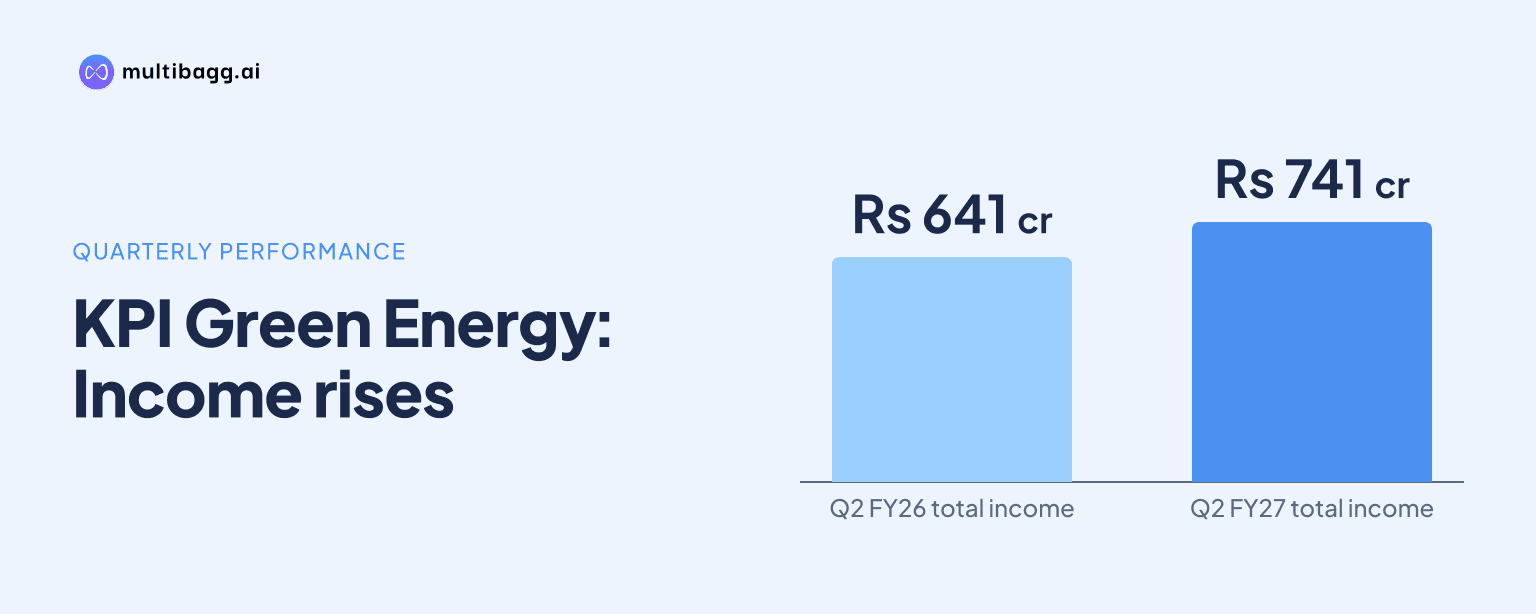
KPI Green Energy Limited reported Q2 FY27 total income of Rs 741 crore, up 16% year on year from Rs 641 crore, while profit after tax fell to Rs 92 crore from Rs 117 crore as higher independent power producer capacity increased depreciation and finance costs.
Know KPI Green Energy inside out
Results, valuation, peers and who's buying, in one view.
What did KPI Green Energy report for Q2 FY27?
KPI Green Energy reported consolidated total income of Rs 741 crore for Q2 FY27, compared with Rs 641 crore in Q2 FY26. The 16% year-on-year increase indicates continued growth in the company's reported income during the quarter.
EBITDA rose 22% year on year to Rs 283 crore from Rs 232 crore in the corresponding quarter last year. EBITDA margin was 38%. The company reported cash profit of Rs 182 crore for the quarter, providing another measure of earnings before the impact of non-cash depreciation.
However, profit after tax stood at Rs 92 crore, down from Rs 117 crore in Q2 FY26. Management said the decline was linked to higher energisation of independent power producer, or IPP, assets, which increased depreciation and finance costs while revenue from those assets was yet to stabilise.
The quarterly results therefore showed a difference between operating earnings growth and reported net profit. Income and EBITDA increased, while the higher costs associated with newly energised IPP capacity weighed on profit after tax.
Why did profit after tax decline despite higher income?
Profit after tax declined because higher IPP energisation raised depreciation and finance costs during the period, according to KPI Green Energy's management. The company said these costs would affect earnings while revenue from the IPP assets stabilises.
This distinction matters for investors assessing companies building renewable generation assets. As projects move into operation, accounting depreciation and borrowing-related finance costs can rise before the operating contribution from the assets is fully reflected in reported earnings. In KPI Green Energy's case, management specifically identified this timing effect as the reason for the lower quarterly profit.
The company did not provide a separate quarter-on-quarter comparison, project-level cost break-up, or a timeline for IPP revenue stabilisation in the information disclosed in the earnings call. The stated explanation is therefore limited to the increase in depreciation and finance costs associated with greater energisation.
For the first half of FY27, KPI Green Energy reported total income of Rs 1,451 crore, EBITDA of Rs 545 crore, profit of Rs 187 crore and cash profit of Rs 355 crore. These figures place the Q2 performance in the context of the company's six-month financial results.
Got a follow-up? Ask IRIS
How large is KPI Green Energy's renewable portfolio?
KPI Green Energy said its total renewable portfolio was approximately 8.33 GW, comprising 3.02 GW of installed capacity and 5.3 GW under execution. The portfolio spans solar, wind, hybrid projects, floating solar and battery storage.
The portfolio composition is relevant because assets under execution can require capital deployment before they begin contributing stable operating revenue. The company described itself as building an integrated renewable energy platform across these technologies, rather than operating only standalone solar projects.
Management placed its expansion within India's wider renewable-energy market. It said India had crossed 300 GW of non-fossil capacity and was working towards a 500 GW target by 2030. The company also identified hybrid round-the-clock projects, firm and dispatchable renewable energy projects, battery energy storage, floating solar, energy trading and commercial and industrial renewable solutions as areas of sector opportunity.
These comments provide the industry setting for the company's project build-out, but the earnings call did not disclose fresh order wins, plant commissioning dates, customer contracts or capacity additions during Q2 FY27. Investors will need further company disclosures to track progress within the 5.3 GW execution portfolio.
What does the Q2 result mean for investors and operations?
The Q2 result shows that KPI Green Energy grew income and EBITDA while reported profit after tax was affected by costs tied to the energisation of IPP assets. The 38% EBITDA margin and Rs 182 crore cash profit are the key operating and cash-generation figures disclosed for the quarter.
For investors, the results underline the importance of tracking income, EBITDA, cash profit, depreciation, finance costs and profit after tax together. A rise in income alone does not show the full effect of a capacity expansion programme when newly operational assets increase funding and accounting costs.
Management also said that profit for FY27 would be about Rs 500 crore. This is a management statement made during the earnings call, not a reported result. The call did not provide a detailed bridge showing how quarterly income, project execution, financing costs and IPP revenue stabilisation would contribute to that figure.
The broader market context remains focused on India's electricity demand, electrification, manufacturing activity, electric mobility, data centres and energy security, all of which management cited as support for renewable energy demand. For KPI Green Energy, the disclosed financial numbers show ongoing operating growth alongside the near-term cost effects of expanding its owned generation base.
Conclusion
KPI Green Energy's Q2 FY27 financial performance combined 16% growth in total income to Rs 741 crore and 22% EBITDA growth to Rs 283 crore with a decline in profit after tax to Rs 92 crore. Management attributed the lower profit to depreciation and finance costs following higher IPP energisation, before revenue from those assets stabilises.
The next disclosed benchmark is management's statement that FY27 profit will be about Rs 500 crore. Investors will also watch for updates on the 5.3 GW portfolio under execution, the stabilisation of IPP revenue, and the associated movement in depreciation and finance costs.