










KPI Green waits for 2-3 GW portfolio scale before IPP separation
Key highlights
- KPI Green management said an InvIT requires roughly 2-3 GW of IPP scale.
- KPI Green targets around 2.1 GW of installed IPP capacity by March 2027.
- The proposed Rs 2,410 crore acquisition would add 507.9 MW of operational wind assets.
- Q2 FY27 EBITDA rose 22% year on year to Rs 283 crore, while profit after tax was Rs 92 crore.
powered by IRIS
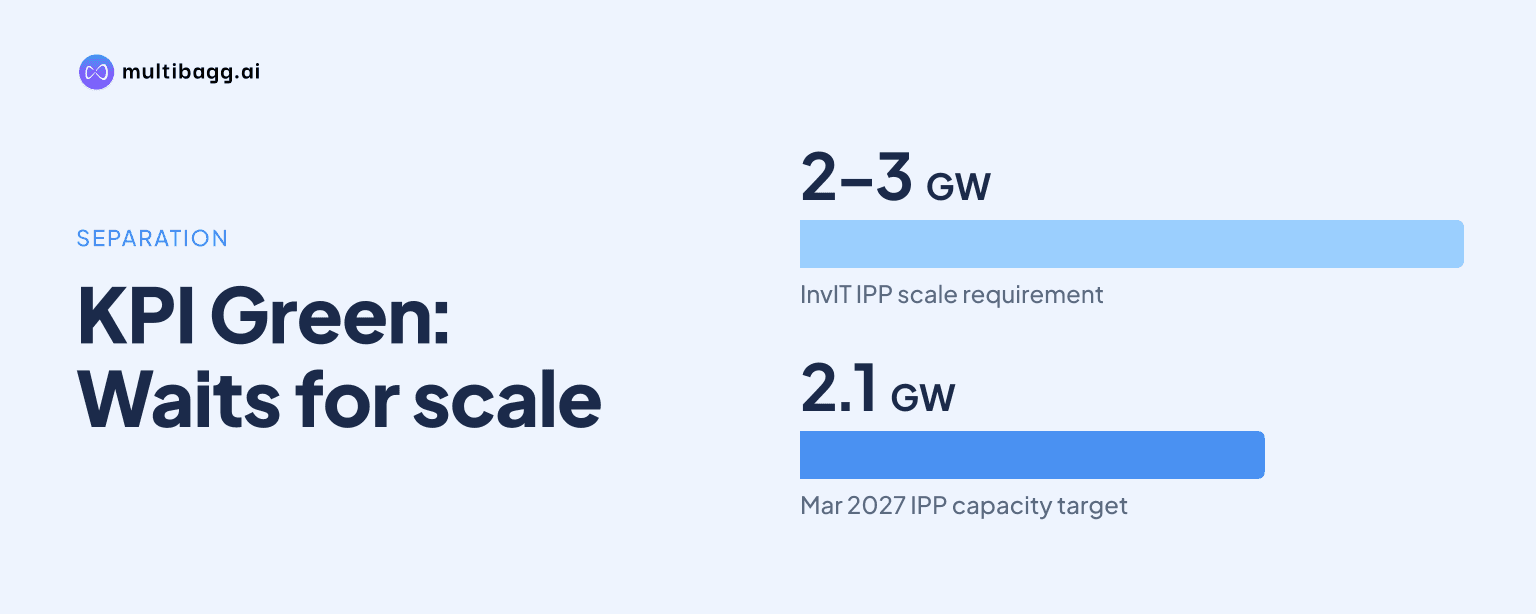
KPI Green Energy Limited said an Infrastructure Investment Trust, or InvIT, or a separation of its engineering, procurement and construction and independent power producer businesses will wait for roughly 2-3 gigawatts of IPP scale, while management targets around 2.1 GW of installed IPP capacity by March 2027.
Know KPI Green Energy inside out
Results, valuation, peers and who's buying, in one view.
When will KPI Green separate its IPP and EPC businesses?
KPI Green has not set a date for an InvIT or a demerger of its IPP and engineering, procurement and construction, or EPC, businesses. Management said the businesses could be separated only after the IPP operation had reached adequate size, and described the company as being in a growth phase after building from almost zero IPP capacity about four years ago to a targeted 2.1 GW by March 2027.
Management distinguished between the two potential structures but attached a similar scale condition to each. It said an InvIT would be the easier route to obtain a valuation for IPP assets, but added that such a vehicle needs roughly 2-3 GW of scale. The 2.1 GW target would place KPI Green near the lower end of that range, rather than representing a stated commitment to launch an InvIT immediately.
The decision therefore remains contingent on portfolio expansion rather than a disclosed legal, regulatory or board-approved timetable. Management said it was working on various growth strategies and would continue to execute projects, secure financial closure and commission IPP assets before pursuing a structural change.
How is KPI Green building IPP capacity to 2.1 GW?
KPI Green is pursuing the 2.1 GW target through commissioning and the proposed acquisition of operating wind assets. Its renewable portfolio stood at about 8.33 GW, comprising 3.02 GW of installed capacity and 5.3 GW under execution. The portfolio included 3.22 GW under IPP and 5.11 GW under EPC, showing that EPC remains the larger part of the overall project base.
During H1 FY27, KPI Green energised an additional 317 megawatts under its 677 MW Gujarat Urja Vikas Nigam Limited hybrid IPP project, taking that project to 511 MW. It also energised 50 MW under its 350 MW Gujarat Urja Vikas Nigam Limited solar IPP project, taking cumulative capacity there to 301 MW. Separately, it commissioned 269 MW for Coal India’s Khavda solar project and 128 MW for Maharashtra State Power Generation Company Limited under EPC work.
The binding offer to acquire Alfanar Energy Private Limited and Netra Wind Private Limited is a material part of the planned expansion. KPI Green offered an enterprise value of about Rs 2,410 crore for 100% of the companies, which together own 507.9 MW of operational wind assets in Gujarat’s Kutch corridor. The assets have a 25-year power purchase agreement with Solar Energy Corporation of India and about 21 years of remaining contract life on a capacity-weighted basis.
Management said the acquisition should close by March 2027, with timing potentially varying by about 15 days. As a result, achievement of the 2.1 GW installed-IPPs target depends partly on completing that transaction, alongside the commissioning and financial closure of internally developed projects.
Got a follow-up? Ask IRIS
What do KPI Green’s latest results show about IPP expansion?
KPI Green reported higher income and operating profit in Q2 FY27, but lower profit after tax as recently energised IPP assets increased depreciation and finance costs before revenue stabilised. Consolidated total income rose 16% year on year to Rs 741 crore, while earnings before interest, tax, depreciation and amortisation, or EBITDA, increased 22% to Rs 283 crore. EBITDA margin was 38%.
KPI Green attributed the decline in profit after tax to the timing effect of IPP energisation, which raises depreciation and finance costs until the associated revenue stabilises. Cash profit was Rs 182 crore in Q2 FY27, compared with profit after tax of Rs 92 crore. For H1 FY27, total income was Rs 1,451 crore, EBITDA was Rs 545 crore, profit after tax was Rs 187 crore and cash profit was Rs 355 crore.
Management guided for FY27 profit after tax of about Rs 500 crore and said FY28 guidance would be provided in Q4. It noted that the second half has historically been better than the first half, but retained the stated FY27 guidance at about Rs 500 crore rather than raising it.
What other plans could affect KPI Green’s path to scale?
KPI Green is supporting its project pipeline with land, transmission access, EPC work and battery energy storage systems, or BESS. It reported a land bank of 8,807 acres and evacuation access of about 5.2 GW, while its EPC order book stood at about Rs 5,700 crore. That order book includes an approximately Rs 2,000 crore contract for a 500 MW solar project from NACOF Oorja Private Limited in Rajasthan.
The company’s BESS portfolio was 565 MW and 1,130 megawatt-hours, with Battery Energy Storage Purchase Agreements executed. Its subsidiary Sun Drops Energia is developing an integrated energy-storage campus in Gujarat, starting with BESS assembly and followed by cell manufacturing in phases. Management said financial closure had been completed for some BESS IPP projects and that Sun Drops is expected to list in about 18 months following a smaller pre-initial public offering round.
These plans do not create a disclosed InvIT timetable, but they add execution and funding milestones alongside the IPP build-out. Management identified timely IPP commissioning, financial closure for projects and bids, contracted BESS delivery and development of the storage campus as priorities while the portfolio grows toward the 2-3 GW scale it cited.
Conclusion
KPI Green’s stated position is that a separate valuation structure for the IPP business remains a future option, not an immediate action. Management has linked both an InvIT and an EPC-IPP demerger to greater IPP scale, with 2-3 GW cited for an InvIT and around 2.1 GW of installed IPP capacity targeted by March 2027. The company is pursuing that scale through commissioning and the proposed addition of 507.9 MW of operating wind assets.
The next disclosed milestones are completion of the Alfanar Energy Private Limited and Netra Wind Private Limited acquisition by March 2027, progress toward the 2.1 GW IPP target and delivery of the 565 MW BESS portfolio. Management also plans to provide FY28 guidance in Q4, maintains FY27 profit-after-tax guidance of about Rs 500 crore and expects Sun Drops to be listed in about 18 months.