










Kratikal client revenue rises 1.8x as recurring mix holds
Key highlights
- Kratikal reported H1 FY27 revenue per client of Rs 5.1 lakh, up from Rs 2.84 lakh in H1 FY26.
- Recurring revenue represented 72.3% of Kratikal's H1 FY27 revenue, versus 71.5% a year earlier.
- Kratikal's top 10 customers accounted for 31.5% of H1 FY27 revenue, compared with 31.6% in FY26.
- Threatcop's H1 FY27 average ticket size was Rs 6.37 lakh, up 34% from Rs 4.76 lakh.
powered by IRIS
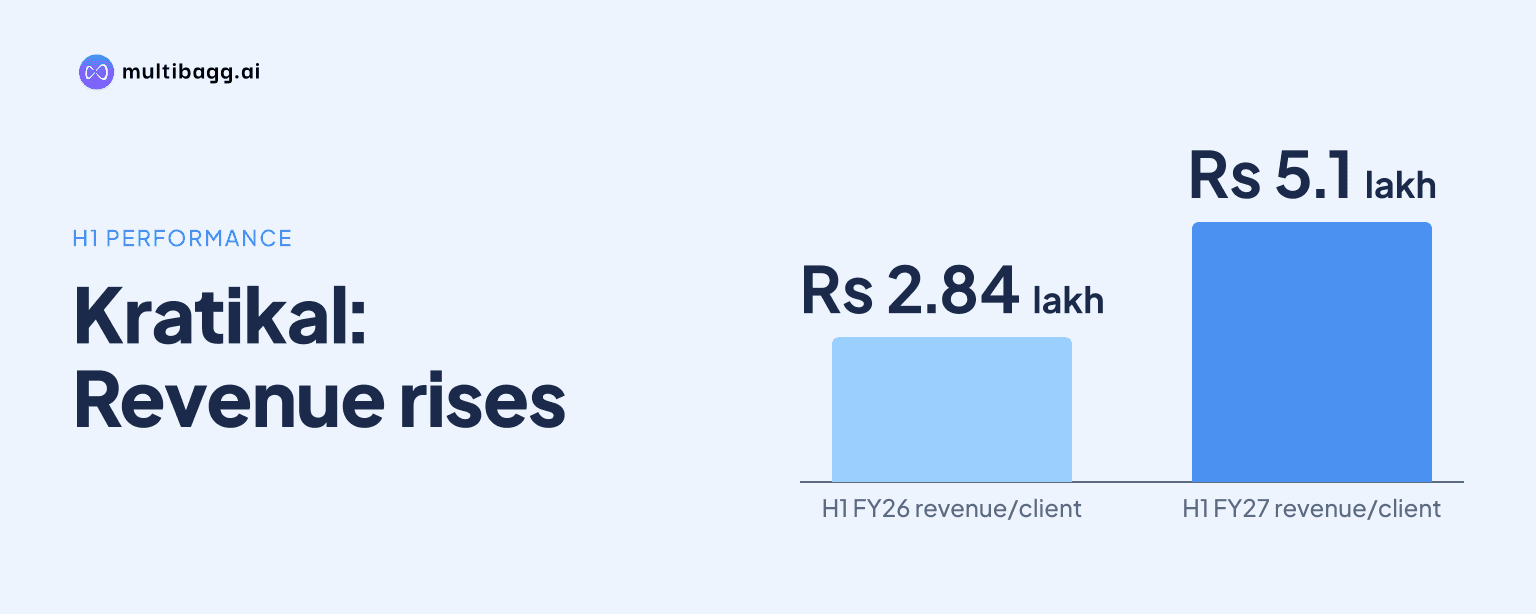
Kratikal reported revenue per client of Rs 5.1 lakh in H1 FY27, a 1.8x increase from Rs 2.84 lakh in H1 FY26, while recurring revenue represented 72.3% of revenue. The result came as revenue from operations rose 65.2% year on year to Rs 22.32 crore in the six-month period.
Know Kratikal Tech inside out
Results, valuation, peers and who's buying, in one view.
How did Kratikal's revenue per client change in H1 FY27?
Kratikal increased revenue per client to Rs 5.1 lakh in H1 FY27 from Rs 2.84 lakh in H1 FY26. The company described this movement as a 1.8x jump, alongside revenue from operations increasing by Rs 8.81 crore year on year, from Rs 13.51 crore to Rs 22.32 crore.
Kratikal served 438 clients in the first six months of FY27. This count should not be directly compared with the 677 clients served in FY26 or 638 in FY25, because those figures cover full financial years while the H1 FY27 figure covers six months.
The higher account-level revenue coincided with reported earnings growth. Earnings before interest, tax, depreciation and amortisation (EBITDA) rose to Rs 4.09 crore in H1 FY27 from Rs 1.79 crore in H1 FY26, while EBITDA margin increased by 500 basis points to 18.3%.
How did Kratikal's recurring revenue mix change?
Kratikal's recurring revenue was 72.3% of H1 FY27 revenue, compared with 71.5% in H1 FY26. One-time revenue declined by the same 0.8 percentage points to 27.7% from 28.5%, leaving recurring revenue above 70% in both half-year periods.
The movement in the mix was limited even as H1 FY27 revenue increased 65.2%. The presentation does not provide a further breakdown of recurring revenue by product, contract type or service category, so it does not identify which revenue streams drove the 0.8-percentage-point increase.
Threatcop contributed 52% of H1 FY27 revenue and Kratikal services contributed 48%. The split was closer to parity than FY26, when Threatcop represented 54% and Kratikal services 46%, although it remained different from FY24's 49% Threatcop and 51% Kratikal services mix.
Which offerings recorded higher average ticket sizes?
Kratikal reported higher average ticket sizes for both Threatcop and Kratikal services in H1 FY27. Threatcop's average ticket size increased 34% to Rs 6.37 lakh from Rs 4.76 lakh, while Kratikal services increased 10% to Rs 3.20 lakh from Rs 2.91 lakh.
Threatcop's H1 FY27 average ticket size was Rs 3.17 lakh higher than that of Kratikal services. The presentation also showed that Threatcop retained the larger revenue share at 52%, despite its share falling 2 percentage points from FY26.
Cross-sell bookings rose to Rs 2.22 crore in H1 FY27 from Rs 66.9 lakh in H1 FY26, a 3.3x increase. Kratikal services cross-sell bookings grew to Rs 1.88 crore from Rs 59.6 lakh, while Threatcop cross-sell bookings rose to Rs 34.1 lakh from Rs 7.3 lakh.
Got a follow-up? Ask IRIS
Is Kratikal becoming more dependent on major customers?
Kratikal's top 10 customers accounted for 31.5% of H1 FY27 revenue, compared with 31.6% in FY26. The top customer's share was 5.5% in H1 FY27, down from 8.9% in FY26, while the top-five share declined to 20.0% from 21.2%.
The comparison with FY26 is not like-for-like because H1 FY27 covers six months and FY26 covers a full year. However, the disclosed data show that the rise in revenue per client did not accompany an increase in the top-10 share relative to FY26.
Concentration was higher than in FY25, when the top 10 represented 21.9% of revenue and the top five represented 15.9%. Kratikal also reported more than 50 Forbes Global 2000 companies as clients, with 23 placing orders in H1 FY27, but did not disclose their revenue contribution.
What do existing customers and costs indicate in H1 FY27?
Kratikal said existing customers generated 48% of H1 FY27 revenue, up from 36% in H1 FY26. New customers represented 52%, down from 64%, meaning existing accounts contributed a larger portion of the revenue mix than a year earlier.
Returning customers generated Rs 16.8 crore, or 60%, of H1 FY27 bookings of Rs 27.8 crore. New customers contributed Rs 11.0 crore of bookings from 225 accounts, and the company separately reported that bookings doubled; bookings are distinct from the Rs 22.32 crore in revenue from operations.
Employee cost was 40% of revenue in H1 FY27, compared with 41% in FY26 and 48% in FY25. Employee benefits expense rose 39.9% year on year to Rs 8.98 crore, below the 65.2% increase in H1 FY27 revenue.
Other expenses, including professional and direct expenses, increased 74.5% to Rs 9.25 crore from Rs 5.30 crore. Kratikal attributed Rs 97 lakh of H1 FY27 spending to growth initiatives, including Rs 65 lakh for a US entity, Rs 34 lakh for a Dubai entity, two sales hires and entry into Nepal.
Conclusion
Kratikal's H1 FY27 disclosures show that increased revenue per client was accompanied by a recurring revenue mix that remained above 72%, higher ticket sizes in both offerings and a greater revenue contribution from existing customers. Customer concentration at the top-10 level was broadly unchanged from FY26, while EBITDA margin increased to 18.3% from 13.3% in H1 FY26.
The next disclosed development to watch is the deployment of Rs 39.7 crore raised through the initial public offering. Kratikal allocated Rs 23.1 crore to US and UAE subsidiaries and Rs 9.2 crore to product development; as of September 30, 2026, Rs 35.44 crore was unutilised in fixed deposits and escrow, while Rs 4.25 crore had been spent on issue expenses.