










Kratikal H1 revenue rises 65% as EBITDA more than doubles
Key highlights
- Kratikal’s H1 FY27 revenue rose 65.2% to ₹22.32 crore from ₹13.51 crore.
- Kratikal’s reported H1 FY27 EBITDA increased 128.5% to ₹4.09 crore after ₹97 lakh of identified growth spending.
- Kratikal reported ₹27.8 crore of H1 FY27 bookings, including ₹8.2 crore of international bookings.
- Kratikal had ₹35.44 crore of unutilised IPO proceeds at 30 September 2026.
powered by IRIS
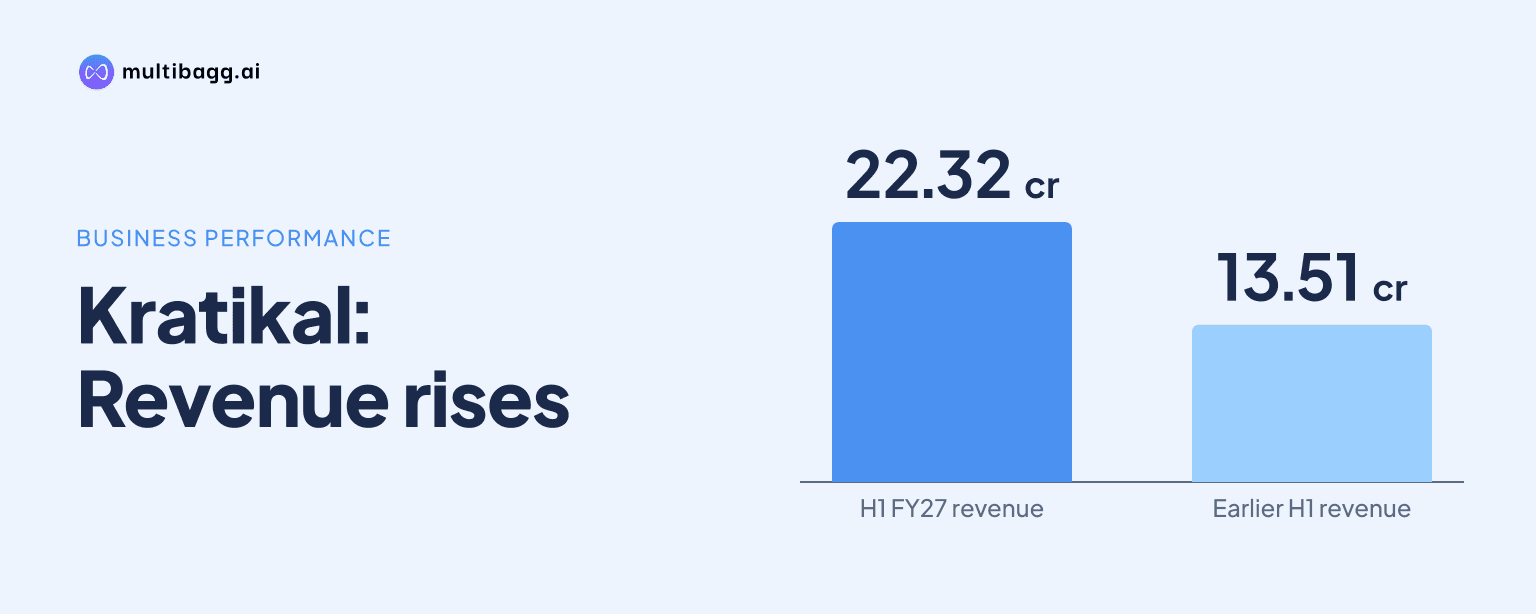
Kratikal reported H1 FY27 revenue of ₹22.32 crore, up 65.2% year on year, while reported EBITDA rose 128.5% to ₹4.09 crore after ₹97 lakh of identified growth spending. Profit after tax increased 129.5% to ₹2.80 crore and the reported EBITDA margin rose to 18.3% from 13.3%.
Know Kratikal Tech inside out
Results, valuation, peers and who's buying, in one view.
How did Kratikal perform in H1 FY27?
Kratikal delivered higher revenue, EBITDA and profit in H1 FY27 than in H1 FY26. Revenue from operations increased from ₹13.51 crore to ₹22.32 crore, while EBITDA increased from ₹1.79 crore to ₹4.09 crore. EBITDA margin rose by 500 basis points, where one basis point is one-hundredth of a percentage point, to 18.3% from 13.3%.
Kratikal’s profit after tax, or PAT, margin increased to 12.5% from 9.0%, a 350-basis-point change. Employee benefits expense rose 39.9% to ₹8.98 crore, slower than revenue growth, while other expenses, including professional and direct expenses, rose 74.5% to ₹9.25 crore. Depreciation and amortisation increased 57.1% to ₹33 lakh, and tax expense rose to ₹1.05 crore from ₹40 lakh.
The H1 FY27 margin increase contrasts with the full-year FY26 comparison. FY26 revenue rose 76.1% to ₹36.72 crore from ₹20.85 crore in FY25 and EBITDA increased 69.2% to ₹8.97 crore from ₹5.30 crore. However, FY26 EBITDA margin declined by 90 basis points to 24.5%, while PAT margin declined by 200 basis points to 16.9%.
What drove Kratikal’s H1 FY27 booking growth?
Kratikal reported H1 FY27 bookings of ₹27.8 crore, described as double the prior-period level, supported by more accounts and higher customer spending. Its account count increased to 494 from 324, and returning customers generated ₹16.8 crore, or 60% of bookings. New customers contributed ₹11.0 crore from 225 accounts, while 23 of more than 50 Forbes Global 2000 clients placed orders during the half year.
International bookings reached ₹8.2 crore, or 30% of total bookings, and were 3.1 times the prior-period level. Middle East bookings were ₹5.1 crore, three times the earlier level, with activity cited in government, healthcare and logistics. United States orders rose to 15 from three, while Kratikal also cited power and energy wins in critical infrastructure using the IEC 62443 industrial cybersecurity standard.
Cross-sell bookings increased faster than total bookings. Kratikal services cross-sell bookings rose from ₹59.6 lakh in H1 FY26 to ₹1.88 crore in H1 FY27, while Threatcop cross-sell bookings increased from ₹7.3 lakh to ₹34.1 lakh. Combined cross-sell bookings therefore rose 3.3 times to ₹2.221 crore from ₹66.9 lakh.
Got a follow-up? Ask IRIS
How did international expansion spending affect Kratikal’s EBITDA?
Kratikal’s EBITDA bridge identifies ₹97 lakh of H1 FY27 growth spending, reducing EBITDA from ₹5.06 crore before that spending to the reported ₹4.09 crore. EBITDA before growth spending carried a 22.7% margin on the bridge, compared with the reported EBITDA margin of 18.3%. The presentation separates this identified spending from the reported profit measure.
The bridge lists ₹65 lakh for a United States entity and ₹34 lakh for a Dubai entity, along with two sales hires in a team of four and entry into Nepal. The two listed entity amounts total ₹99 lakh, while the bridge labels total growth spending as ₹97 lakh; the presentation does not explain the ₹2 lakh difference. Other expenses were ₹9.25 crore in H1 FY27, but the consolidated statement does not allocate that full category to expansion.
Kratikal raised ₹39.7 crore through 29.4 lakh shares at ₹135 and listed on BSE SME on 7 July 2026. Its use-of-proceeds plan allocates ₹23.1 crore, or 58%, to United States and UAE subsidiaries, including ₹6.3 crore for United States sales and marketing and ₹4.1 crore for UAE sales and marketing, as well as local hires. At 30 September 2026, ₹35.44 crore remained unutilised in fixed deposits and escrow, and ₹4.25 crore had been spent on issue expenses.
What do Kratikal’s customer metrics show about revenue mix?
Kratikal’s H1 FY27 revenue per client was ₹5.1 lakh, 1.8 times the ₹2.84 lakh reported in H1 FY26. Threatcop’s average ticket size increased 34% to ₹6.37 lakh, while Kratikal services’ average ticket size increased 10% to ₹3.20 lakh. Existing customers accounted for 48% of H1 FY27 revenue, up from 36%, while the new-customer share fell to 52% from 64%.
Recurring revenue represented 72.3% of H1 FY27 revenue, compared with 71.5% in H1 FY26, while one-time revenue represented 27.7%, down from 28.5%. Threatcop accounted for 52% of H1 FY27 revenue and Kratikal services for 48%; the FY26 split was 54% Threatcop and 46% services. Employee cost was 40% of revenue in H1 FY27, following 41% in FY26 and 48% in FY25.
Kratikal served 677 clients in FY26, up 60% since FY24, and reported 438 clients in the six months of H1 FY27. The top 10 customers accounted for 31.5% of H1 FY27 revenue, close to 31.6% in FY26, while the top customer’s share declined to 5.5% from 8.9%. H1 FY27 geographic revenue was ₹16.8 crore from India, ₹4.0 crore from the UAE and Gulf, and ₹1.5 crore from the United States.
Conclusion
Kratikal’s operating data links ₹27.8 crore of bookings, higher average ticket sizes and a ₹2.221 crore cross-sell total with the H1 FY27 profit increase. International bookings of ₹8.2 crore accounted for 30% of bookings, while the bridge shows that the reported EBITDA figure includes, rather than excludes, ₹97 lakh of identified growth spending.
The next disclosed development to watch is deployment of the ₹35.44 crore of IPO proceeds that remained unutilised at 30 September 2026. Kratikal has earmarked ₹23.1 crore for United States and UAE subsidiaries and ₹9.2 crore for product development, including 49 planned hires for AutoGRC and the Threatcop email gateway, but the presentation gives no timetable or revenue target for these expenditures.