










Kratikal’s two cybersecurity engines grew more than 2.5 times
Key highlights
- Threatcop revenue increased from Rs 6.4 crore in FY24 to Rs 19.7 crore in FY26.
- Kratikal AutoSecT and services revenue rose from Rs 6.6 crore in FY24 to Rs 17 crore in FY26.
- Threatcop generated Rs 11.6 crore in H1 FY27, up 68% year on year.
- Kratikal reported a Rs 42.6 crore order book and Rs 8.2 crore of international order bookings.
powered by IRIS
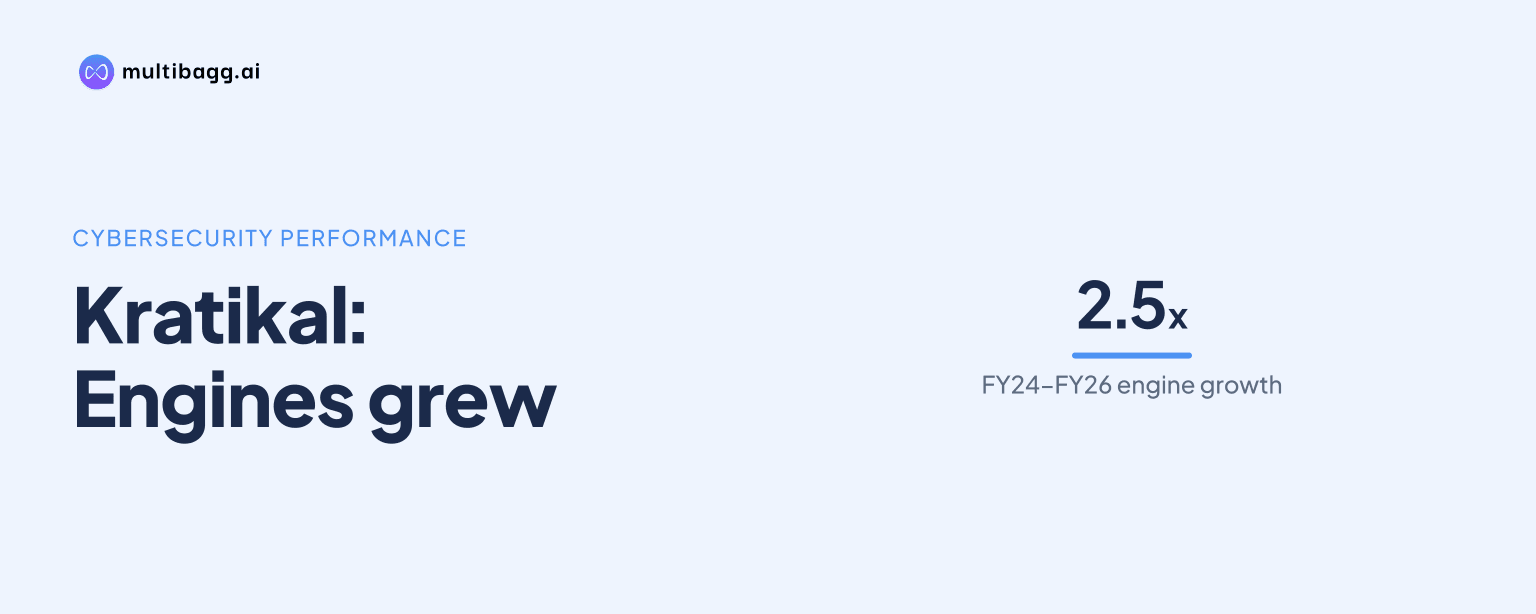
Kratikal Tech Limited’s Threatcop revenue rose from Rs 6.4 crore in FY24 to Rs 19.7 crore in FY26, while its technology and process-security services engine rose from Rs 6.6 crore to Rs 17 crore, so both expanded more than 2.5 times over two years.
Know Kratikal Tech inside out
Results, valuation, peers and who's buying, in one view.
How did Kratikal’s two revenue engines grow over two years?
Kratikal’s people-security product engine, Threatcop, increased revenue by about 3.1 times between FY24 and FY26. Revenue rose from Rs 6.4 crore in FY24 to Rs 10.8 crore in FY25 and Rs 19.7 crore in FY26. The suite comprises four products: Threatcop Security Awareness Training (TSAT), Threatcop Domain-based Message Authentication, Reporting and Conformance (TDMARC), Threatcop Learning Management System (TLMS) and Threatcop Phishing Incident Response (TPIR).
Kratikal’s technology and process-security engine, presented as Kratikal AutoSecT, increased revenue by about 2.6 times over the same period. Revenue moved from Rs 6.6 crore in FY24 to Rs 10.1 crore in FY25 and Rs 17 crore in FY26. This engine includes vulnerability assessment and penetration testing (VAPT), compliance and audit-readiness work, alongside AutoSecT, an artificial-intelligence-driven testing and vulnerability-management platform.
The product engine added Rs 13.3 crore of revenue from FY24 to FY26, compared with Rs 10.4 crore added by Kratikal AutoSecT and services. The differing growth multiples partly reflect the services engine’s higher FY24 base of Rs 6.6 crore against Threatcop’s Rs 6.4 crore. At the company level, products accounted for 54% of FY26 revenue and services for 46%, indicating that both engines contributed materially.
What is different about Kratikal’s product and services sales models?
Kratikal sells Threatcop as an artificial-intelligence-enabled people-security software-as-a-service suite, priced per user per year and billed upfront. Its stated sales motion starts with TSAT and adds modules and users, using partners, distributors and direct sales channels. The company’s strategy is to increase reach through more users, modules and markets.
Kratikal sells services through digital-inbound and direct-sales channels, with pricing by asset, managed work and project. Its stated motion begins with one-off VAPT work and seeks recurring engagements thereafter. Services target enterprises, government bodies, small and medium enterprises and global customers, while Threatcop is positioned for enterprises, global customers and banking, financial services and insurance (BFSI) clients.
The presentation identifies distinct scaling mechanisms for the two engines. Threatcop can expand through additional user seats and modules under annual subscriptions, whereas services seek to expand account value through testing, compliance and managed assignments. Both have recurring components, namely annual subscriptions and managed services, and share one team and research-and-development base across two brands.
How fast were Kratikal’s businesses growing in H1 FY27?
Kratikal reported Threatcop revenue of Rs 11.6 crore in H1 FY27, up 68% from Rs 6.9 crore in H1 FY26. The Rs 4.7 crore year-on-year increase came from a suite with about 1,500 customers to date and four products. The presentation continues to describe the pricing model as per user per year.
Kratikal AutoSecT and services reported Rs 10.7 crore in H1 FY27, up 62% from Rs 6.6 crore in H1 FY26. The business listed empanelments with the Indian Computer Emergency Response Team (CERT-In) and the National Stock Exchange (NSE), alongside a delivery team of about 70 specialists. It also cited ISO 27001 certification, plus ISO 27017 and ISO 27018.
Together, the engines generated Rs 22.3 crore in H1 FY27. Threatcop products represented 52% of that amount, VAPT represented 34%, compliance 13% and other revenue was below 1%. This differs from the FY26 split of 54% products and 46% services because the H1 FY27 presentation separately identifies VAPT and compliance within the services side.
Got a follow-up? Ask IRIS
What evidence does Kratikal provide for account expansion?
Kratikal reported that total cross-sell bookings grew 3.3 times in H1 FY27. Cross-selling within Kratikal services was up 3.2 times, while Threatcop cross-selling was up 4.7 times. Threatcop’s average ticket size also rose 34% in H1 FY27 compared with H1 FY26.
One client example began with a TLMS order worth Rs 7.6 lakh in FY24 from a leading e-commerce marketplace. In FY25, the account added TSAT and Kratikal VAPT, expanded to the parent company and added Rs 1.40 crore of value. The presentation records seven orders to date and Rs 1.48 crore of total order value.
The service case studies show the range of work intended to deepen client accounts. An NBFC subsidiary engagement covered web, mobile, information-technology infrastructure and cloud testing, with more than 80 attack surfaces tested and more than 700 key findings reported. A medical-wearable client used one control set for both SOC 2 and ISO 27001, showing how compliance work can address two frameworks in one programme.
How is Kratikal expanding its addressable markets?
Kratikal reported export revenue of Rs 5.5 crore in H1 FY27, equal to 25% of total revenue of Rs 22.3 crore. Export share was 13% in FY24 and FY25 before reaching 30% in FY26. The company served clients in 24 countries outside India in FY26 and listed subsidiaries in the United Arab Emirates, the United States and India.
Management’s stated priorities include global expansion and targeting large accounts worth about Rs 1 crore each. International order bookings grew 3.1 times to Rs 8.2 crore, representing 30% of total bookings against 19% previously. The presentation cites a Rs 2.48 crore Middle East government operational-technology security contract and a three-year Rs 3.7 crore United States government contract.
Kratikal reported an order book of Rs 42.6 crore, built a United States team for AutoSecT and incorporated Kratikal AI Inc. as a wholly owned US subsidiary. Management also disclosed plans to launch AutoGRC, an automated governance, risk and compliance platform, and a second email-security product outlined in its draft red herring prospectus. These are disclosed plans rather than reported revenue contributors.
Conclusion
Kratikal’s FY24-to-FY26 results show two growing but differently structured engines. Threatcop’s subscription-led people-security suite rose from Rs 6.4 crore to Rs 19.7 crore, while Kratikal AutoSecT and services rose from Rs 6.6 crore to Rs 17 crore. H1 FY27 growth of 68% for Threatcop and 62% for the services engine shows that both remained material within the Rs 22.3 crore half-year revenue base.
The next disclosures to watch are management’s execution against the Rs 42.6 crore order book, its plan to target accounts worth about Rs 1 crore each, and the launch of AutoGRC and the proposed email-security product. International expansion, including the US subsidiary and global system-integrator partnerships, is also part of management’s stated plan to increase overseas business.