










Kratikal allocates ₹32.3 crore to global growth and AI plans
Key highlights
- Kratikal raised ₹39.7 crore through 29.4 lakh IPO shares at ₹135 each and listed on 7 July 2026.
- Kratikal allocated ₹23.1 crore, or 58% of IPO proceeds, to US and UAE subsidiaries.
- Kratikal allocated ₹9.2 crore for 49 hires to develop AutoGRC and the Threatcop email gateway.
- Kratikal had ₹35.44 crore of IPO proceeds unutilised at 30 September 2026.
powered by IRIS
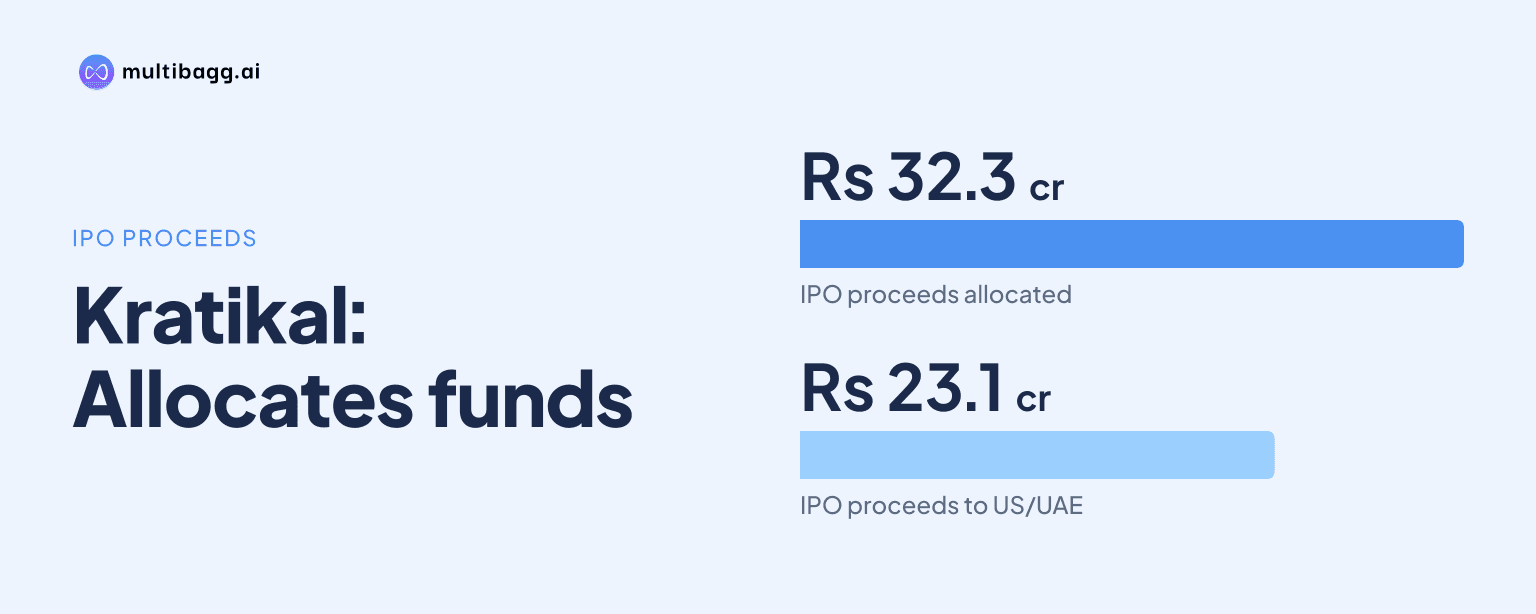
Kratikal allocated ₹32.3 crore, or 81% of its ₹39.7 crore initial public offering proceeds, to US and UAE subsidiaries and two planned artificial intelligence products after its 7 July 2026 listing. At 30 September 2026, ₹35.44 crore remained unutilised in fixed deposits and escrow, while ₹4.25 crore had been spent on issue expenses.
Know Kratikal Tech inside out
Results, valuation, peers and who's buying, in one view.
How will Kratikal use its IPO proceeds?
Kratikal will use ₹23.1 crore, or 58% of gross proceeds, for its US and UAE subsidiaries, and ₹9.2 crore, or 23%, for product development. The remaining ₹7.4 crore, or 19%, is earmarked for issue expenses and general corporate purposes. Kratikal raised ₹39.7 crore through 29.4 lakh shares at ₹135 each and listed on BSE SME on 7 July 2026.
The subsidiary allocation includes ₹6.3 crore for US sales and marketing and ₹4.1 crore for UAE sales and marketing, alongside local hiring. The presentation does not separately itemise the balance of the ₹23.1 crore allocation by country, hire category or other operating use.
As of 30 September 2026, Kratikal had used ₹4.25 crore for issue expenses and held ₹35.44 crore as unutilised proceeds in fixed deposits and escrow. Its H1 FY27 cash-flow statement says other working-capital changes included a ₹37.54 crore increase in current investments, largely reflecting the investment of IPO proceeds.
Why is Kratikal funding US and UAE expansion?
Kratikal is funding US and UAE expansion after international order bookings rose 3.1 times to ₹8.2 crore in H1 FY27, representing 30% of ₹27.8 crore total bookings, from 19% previously. Middle East bookings rose 3.0 times to ₹5.1 crore, while US orders increased to 15 from three.
The plan follows identified contract wins and local operating development. Kratikal reported a ₹2.48 crore government operational-technology security contract in the Middle East and a ₹3.7 crore US government contract. It also said it had built a US team for AutoSecT, its application, network and cloud-testing offering, and incorporated the wholly owned US subsidiary Kratikal AI Inc.
India remained the larger revenue market in H1 FY27. Kratikal reported ₹16.8 crore of revenue from India, against ₹4.0 crore from the UAE and Gulf and ₹1.5 crore from the United States. The presentation states that UAE and Gulf revenue includes other export markets.
International growth spending was already reflected in H1 FY27 profitability. Kratikal reported ₹0.97 crore of growth spending, including ₹0.65 crore for the US entity, ₹0.34 crore for the Dubai entity, two sales hires in a team of four and entry into Nepal. Earnings before interest, tax, depreciation and amortisation, or EBITDA, were ₹5.06 crore before this expenditure and ₹4.09 crore after it.
Got a follow-up? Ask IRIS
What products will Kratikal develop with ₹9.2 crore?
Kratikal will use ₹9.2 crore to hire 49 people to develop AutoGRC and the Threatcop email gateway. AutoGRC is an automated governance, risk and compliance platform, while the email-security product is described as extending Kratikal from services and awareness training into security automation.
The products would sit beside Kratikal's existing two operating engines. Threatcop, the people-security suite, generated ₹11.6 crore of H1 FY27 revenue, up 68% from ₹6.9 crore in H1 FY26. AutoSecT and related security services generated ₹10.7 crore, up 62% from ₹6.6 crore in the earlier half-year.
Threatcop's suite comprises TSAT, TDMARC, TLMS and TPIR, and its pricing model is per user per year. Threatcop accounted for 54% of FY26 revenue, compared with 49% in FY24; its share was 52% in H1 FY27, while Kratikal services accounted for 48%.
Kratikal reported a 34% rise in Threatcop average ticket size to ₹6.37 lakh in H1 FY27 from ₹4.76 lakh in H1 FY26. Intangibles under development were ₹12.63 crore at H1 FY27, compared with ₹8.63 crore at FY26. The presentation does not disclose a launch date, revenue target or expected return for either AutoGRC or the email gateway.
What business trends support Kratikal's spending plan?
Kratikal reported H1 FY27 revenue of ₹22.32 crore, up 65.2% from ₹13.51 crore in H1 FY26, while profit after tax rose 156.9% to ₹2.80 crore from ₹1.09 crore. Reported EBITDA increased 128.5% to ₹4.09 crore, and its margin rose to 18.3% from 13.3%.
Bookings doubled to ₹27.8 crore in H1 FY27, with returning customers contributing ₹16.8 crore, or 60%, and new customers contributing ₹11.0 crore from 225 accounts. Cross-sell bookings across Kratikal services and Threatcop rose 3.3 times to ₹2.22 crore from ₹66.9 lakh in H1 FY26.
Recurring revenue represented 72.3% of H1 FY27 revenue, compared with 71.5% in H1 FY26. Revenue per client rose 1.8 times to ₹5.1 lakh from ₹2.84 lakh, while existing customers' share of revenue increased to 48% from 36%.
Employee cost represented 40% of revenue in H1 FY27, compared with 41% in FY26 and 48% in FY25. The planned 49 product-development hires and locally recruited subsidiary staff are therefore additional elements of the operating plan, but Kratikal does not provide a post-hiring employee-cost target.
Conclusion
Kratikal's disclosed deployment plan directs its largest IPO allocation, ₹23.1 crore, to commercial capacity in the US and UAE, while ₹9.2 crore is reserved for AutoGRC and the Threatcop email gateway. The allocation follows H1 FY27 international bookings of ₹8.2 crore, revenue of ₹22.32 crore and a larger contribution from returning customers.
What to watch next is the use of the ₹35.44 crore that remained unutilised at 30 September 2026, the planned local sales and hiring activity, and progress on the 49 product-development hires. Kratikal has not disclosed launch dates or revenue targets for its two planned products, leaving execution milestones rather than scheduled financial outcomes as the next disclosed measures.