










Kratikal’s Threatcop and autoSect each grew over 60% in H1 FY27
Key highlights
- Threatcop revenue reached Rs 11.6 crore in H1 FY27, up 68% from Rs 6.9 crore in H1 FY26.
- autoSect revenue reached Rs 10.7 crore in H1 FY27, up 62% from Rs 6.6 crore a year earlier.
- Kratikal reported Rs 22.3 crore of H1 FY27 revenue, including Rs 5.5 crore of exports.
- International order bookings grew 3.1 times to Rs 8.2 crore and represented 30% of total bookings.
powered by IRIS
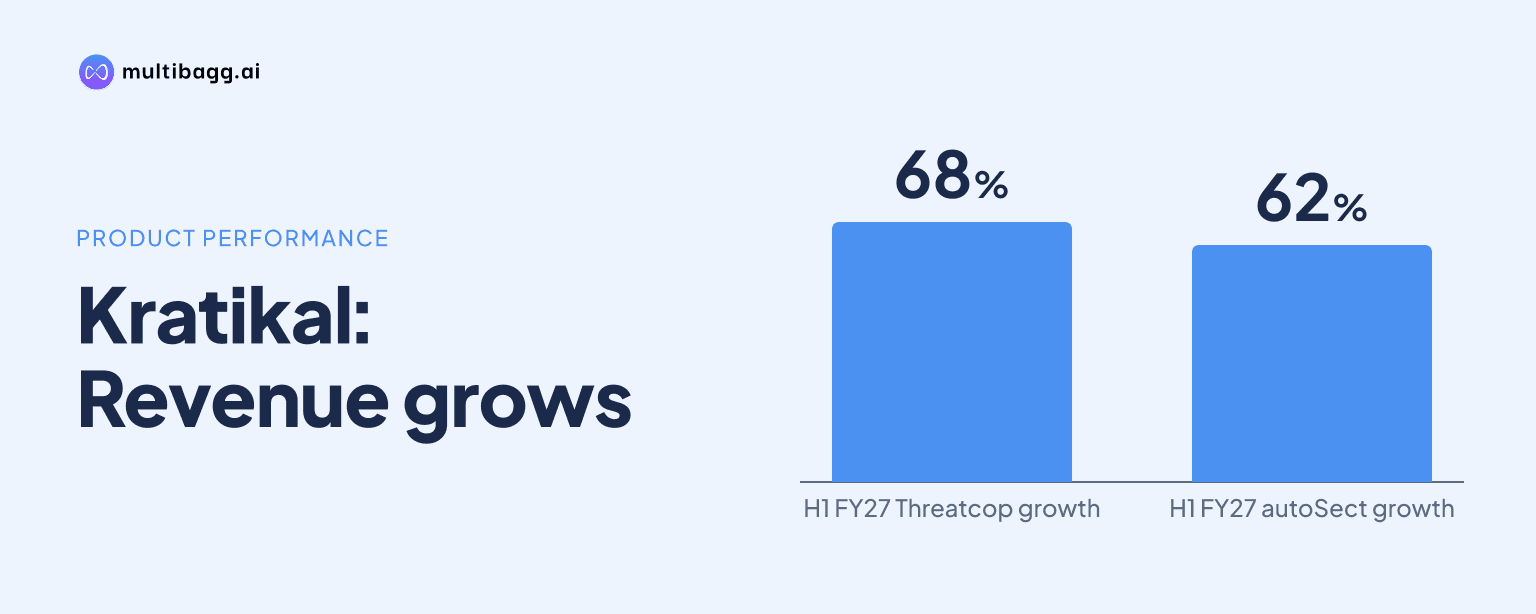
Kratikal reported Rs 11.6 crore of Threatcop revenue in H1 FY27, up 68% from Rs 6.9 crore a year earlier, while autoSect revenue rose 62% to Rs 10.7 crore from Rs 6.6 crore. The two businesses together accounted for the reported Rs 22.3 crore of H1 FY27 revenue.
Know Kratikal Tech inside out
Results, valuation, peers and who's buying, in one view.
What drove Kratikal’s H1 FY27 segment growth?
Kratikal’s Threatcop and autoSect businesses each increased revenue by more than 60% in H1 FY27. Threatcop added Rs 4.7 crore from H1 FY26 to reach Rs 11.6 crore, while autoSect added Rs 4.1 crore to Rs 10.7 crore. Their H1 FY27 revenues were separated by Rs 0.9 crore.
Threatcop’s 68% year-on-year increase was 6 percentage points higher than autoSect’s 62% increase. Threatcop assesses human cyber risk through simulated cyber attacks, employee training and protection from emails impersonating a client’s name. autoSect provides vulnerability assessment and penetration testing, or VAPT, for applications, networks and cloud environments, alongside audit-readiness services.
The reported business figures increased by a combined Rs 8.8 crore between H1 FY26 and H1 FY27. The presentation describes the businesses as two growth engines and does not provide H1 FY27 profit, margin or retention figures for either of them.
How balanced was Kratikal’s H1 FY27 revenue mix?
Kratikal’s H1 FY27 revenue was near evenly divided between Threatcop at Rs 11.6 crore and autoSect at Rs 10.7 crore. Threatcop products represented 52% of the reported Rs 22.3 crore total, while autoSect revenue was equivalent to about 48% of that total. The difference was Rs 0.9 crore during the half year.
The presentation categorises revenue as Threatcop products at 52%, VAPT at 34%, compliance at 13% and others at less than 1% in H1 FY27. autoSect includes VAPT and compliance and external-audit support, while the segment revenue figure of Rs 10.7 crore is broadly aligned with the VAPT and compliance categories together.
Kratikal also reported Rs 5.5 crore of export revenue, equal to 25% of H1 FY27 revenue. Export share was 13% in both FY24 and FY25 before rising to 30% in FY26. The H1 FY27 export share was therefore 5 percentage points below the FY26 share disclosed in the presentation.
What products and services sit within Kratikal’s two engines?
Threatcop has four products, TSAT, TDMARC, TLMS and TPIR, sold on a per-user, per-year pricing model. The business had about 1,500 customers to date, according to the H1 FY27 presentation. Its products focus on identifying employee-related cyber risk, providing awareness training and addressing phishing and impersonation threats.
A power-utility case study shows the reported operating mechanism of Threatcop Security Awareness Training, or TSAT. Over a four-month measurement period, the client recorded a 39% reduction in phishing-email open rates, a 47% reduction in phishing clicks and a 55% reduction in simulated credential submissions. The case study also reported 99% employee training engagement and 92% awareness impact.
autoSect combines VAPT with compliance and external-audit support, using a delivery team of about 70 specialists. The presentation lists CERT-In and National Stock Exchange empanelments, as well as ISO 27001, ISO 27017 and ISO 27018 certifications. In a non-banking financial company engagement, autoSect tested more than 80 attack surfaces and reported more than 700 key findings, including 113 critical and 693 high findings.
Got a follow-up? Ask IRIS
How have Threatcop and autoSect changed since FY24?
Threatcop revenue rose from Rs 6.4 crore in FY24 to Rs 10.8 crore in FY25 and Rs 19.7 crore in FY26. The Rs 13.3 crore increase between FY24 and FY26 took revenue to more than three times its FY24 level. Its H1 FY27 revenue of Rs 11.6 crore also exceeded its full-year FY25 revenue, although a half-year and a full year are not directly comparable.
autoSect revenue increased from Rs 6.6 crore in FY24 to Rs 10.1 crore in FY25 and Rs 17.0 crore in FY26. The business added Rs 10.4 crore over the two financial years and reached more than 2.5 times its FY24 revenue. autoSect generated Rs 0.2 crore more than Threatcop in FY24, but Threatcop generated Rs 2.7 crore more in FY26.
Kratikal identifies cross-selling as a mechanism for increasing account value. A leading e-commerce marketplace first bought TLMS for Rs 7.6 lakh in FY24, then added TSAT and Kratikal VAPT services in FY25, including work for its parent company. The client had placed seven orders to date, with aggregate order value of Rs 1.48 crore and FY25 order value of Rs 1.40 crore.
What expansion plans has Kratikal disclosed?
Kratikal disclosed an order book of Rs 42.6 crore and said it was targeting large international accounts worth around Rs 1 crore each. International order bookings grew 3.1 times to Rs 8.2 crore and represented 30% of total bookings, compared with 19% previously. Middle East bookings rose 3.0 times and US orders increased from three to 15.
The company cited a Rs 2.48 crore Middle East government operational-technology security contract and a Rs 3.7 crore US government contract among its wins. It has built a US team for autoSect and incorporated Kratikal AI Inc., a wholly owned US subsidiary. The presentation does not specify when these actions may translate into reported revenue.
Management also disclosed plans for AutoGRC, an automated governance, risk and compliance platform, and a second artificial-intelligence product for email security outlined in its draft red herring prospectus. It said Threatcop average ticket size rose 34% in H1 FY27 compared with H1 FY26 and identified partnerships with large global system integrators as a priority. No launch date, pricing or revenue target was disclosed for either planned product.
Conclusion
Kratikal’s H1 FY27 disclosure shows revenue growth in both its people-security and testing and compliance activities. Threatcop grew 68% to Rs 11.6 crore and autoSect grew 62% to Rs 10.7 crore, producing a Rs 0.9 crore revenue gap between the two businesses. Their FY24-to-FY26 revenue histories also show that Threatcop moved ahead of autoSect after autoSect had been slightly larger in FY24.
The next disclosures to watch are progress against the Rs 42.6 crore order book, conversion of Rs 8.2 crore in international bookings and the execution of the AutoGRC and email-security product plans. Kratikal has also reported a 34% increase in Threatcop average ticket size and established a US autoSect team, but it has not disclosed timing or revenue targets for those initiatives.