










Kratikal H1 PAT rose 157% despite ₹97 lakh expansion spend
Key highlights
- Kratikal’s H1 FY27 revenue rose 65.2% to ₹22.32 crore from ₹13.51 crore.
- Kratikal reported H1 FY27 PAT of ₹2.80 crore, up 156.9% year on year.
- Kratikal’s EBITDA bridge shows ₹97 lakh of growth spend, reducing EBITDA from ₹5.06 crore to ₹4.09 crore.
- International bookings reached ₹8.20 crore, or 30% of Kratikal’s ₹27.80 crore H1 FY27 bookings.
powered by IRIS
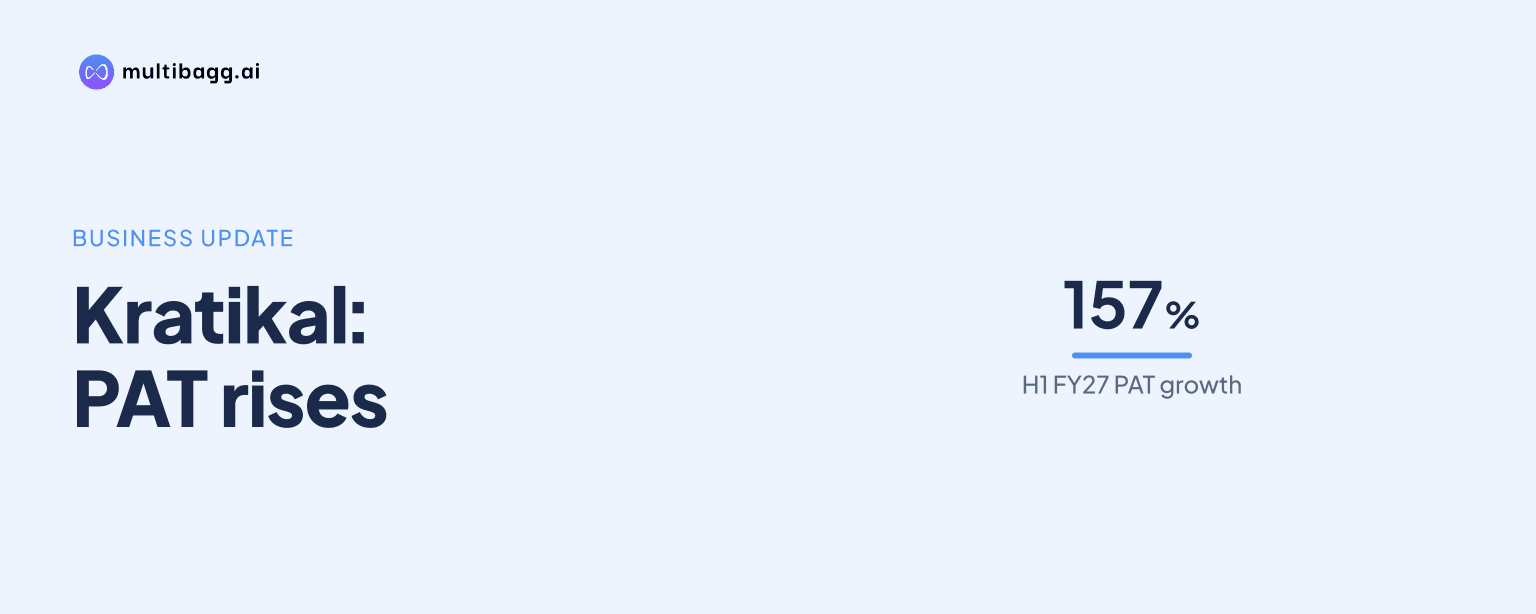
KRATIKAL reported profit after tax of ₹2.80 crore in H1 FY27, up 156.9% year on year, while its earnings before interest, tax, depreciation and amortisation bridge included ₹97 lakh of growth spending for United States and Dubai entities, sales hiring and a new Nepal market. Reported revenue rose 65.2% to ₹22.32 crore.
Know Kratikal Tech inside out
Results, valuation, peers and who's buying, in one view.
How much did Kratikal’s H1 FY27 profit increase?
Kratikal’s profit after tax, or PAT, increased to ₹2.80 crore in H1 FY27 from ₹1.09 crore in H1 FY26, a 156.9% year-on-year, or YoY, increase. PAT margin rose 440 basis points, where one basis point equals one-hundredth of a percentage point, to 12.5% from 8.1%. Profit before tax grew 137.7% to ₹3.85 crore, while tax expense rose 98.1% to ₹1.05 crore.
The profit gain came alongside revenue growth of ₹8.81 crore over the comparable half-year period. Revenue from operations reached ₹22.32 crore in H1 FY27, versus ₹13.51 crore in H1 FY26. EBITDA, the company’s measure of earnings before interest, tax, depreciation and amortisation, grew 128.5% to ₹4.09 crore from ₹1.79 crore, and its margin increased to 18.3% from 13.3%.
The H1 improvement contrasts with the margin direction over the prior full year. In FY26, revenue rose 76.1% to ₹36.72 crore and PAT increased 51.3% to ₹5.96 crore, but PAT margin declined to 16.2% from 18.9% in FY25. In H1 FY27, the reported PAT margin moved upward from the H1 FY26 level despite the identified growth expenditure.
What expansion spending did Kratikal absorb in H1 FY27?
Kratikal’s EBITDA bridge identifies ₹97 lakh of growth spend in H1 FY27, reducing EBITDA from ₹5.06 crore before that spending to reported EBITDA of ₹4.09 crore. The bridge lists a United States entity, a Dubai entity, two sales hires that brought the team to four, and entry into Nepal as the underlying growth actions.
The disclosed line items assign ₹65 lakh to the United States entity and ₹34 lakh to the Dubai entity. Those two individually stated amounts total ₹99 lakh, while the bridge labels total growth spend as ₹97 lakh; the presentation does not explain the ₹2 lakh difference or allocate spending to the two sales hires and Nepal. The reported 18.3% EBITDA margin was therefore 4.4 percentage points below the 22.7% margin shown before growth spend.
The spending occurred as international bookings expanded. International bookings were ₹8.20 crore, or 30% of the ₹27.80 crore booked in H1 FY27, and were 3.1 times the prior-period level according to the presentation. Middle East bookings reached ₹5.10 crore, three times the prior level, with government, healthcare and logistics cited as customer sectors; United States orders increased to 15 from three.
Got a follow-up? Ask IRIS
What drove Kratikal’s revenue and booking growth?
Kratikal’s H1 FY27 bookings doubled to ₹27.80 crore as its account count rose to 494 from 324 and customer spending increased. Returning customers accounted for ₹16.80 crore, or 60% of bookings, which was 2.7 times the earlier level. New customers contributed ₹11.00 crore from 225 accounts, representing 1.4 times the prior amount.
The company also reported a rise in revenue per client to ₹5.10 lakh in H1 FY27 from ₹2.84 lakh in H1 FY26, or 1.8 times. Average ticket size for its Threatcop product increased 34% to ₹6.37 lakh, while the average ticket for Kratikal services rose 10% to ₹3.20 lakh. These movements indicate that both customer additions and larger average transactions accompanied the 65.2% revenue increase.
Cross-selling rose in both reported operating lines. Kratikal services cross-sell bookings increased to ₹188.0 lakh in H1 FY27 from ₹59.6 lakh in H1 FY26, while Threatcop cross-sell bookings rose to ₹34.1 lakh from ₹7.3 lakh. Total cross-sell bookings consequently grew 3.3 times to ₹222.1 lakh from ₹66.9 lakh, though the presentation does not specify the contribution of cross-selling to recognised H1 revenue.
How did Kratikal’s revenue mix and costs change?
Kratikal reported that recurring revenue represented 72.3% of H1 FY27 revenue, compared with 71.5% in H1 FY26, while one-time revenue fell to 27.7% from 28.5%. Existing customers supplied 48% of H1 FY27 revenue, up from 36% a year earlier, and the new-customer share declined to 52% from 64%. Those shifts are consistent with the reported ₹16.80 crore of bookings from returning customers.
Threatcop accounted for 52% of H1 FY27 revenue and Kratikal services for 48%. This was a modest move toward services from FY26, when Threatcop represented 54% and services 46%, although Threatcop remained the larger component. The company had served 677 clients in FY26, up 60% since FY24, while it reported 438 clients served during the six months of H1 FY27.
Employee benefits expense increased 39.9% to ₹8.98 crore in H1 FY27 from ₹6.42 crore, slower than the 65.2% revenue increase. Employee cost was 40% of revenue in H1 FY27, compared with 41% in FY26 and 48% in FY25. Other expenses, including professional and direct expenses, rose 74.5% to ₹9.25 crore from ₹5.30 crore, a category that grew faster than revenue and includes no separate expansion-spend reconciliation in the income statement.
Conclusion
Kratikal combined revenue growth, higher revenue per client, increased returning-customer bookings and a slightly higher recurring-revenue share to lift H1 FY27 PAT to ₹2.80 crore. The ₹97 lakh EBITDA bridge adjustment means the reported 18.3% EBITDA margin incorporated management’s stated investment in overseas entities, hiring and Nepal, rather than excluding those costs from the reported result.
The next disclosed milestones are deployment of ₹23.10 crore of initial public offering proceeds for United States and United Arab Emirates subsidiaries, including sales and marketing and local hires, and ₹9.20 crore for product development and 49 hires for AutoGRC and the Threatcop email gateway. At 30 September 2026, ₹35.44 crore of the ₹39.70 crore proceeds remained unutilised in fixed deposits and escrow; investors can also watch for clarification of the ₹2 lakh difference between the bridge total and its two stated geographic cost lines.