










Krystal targets Rs 300-350 crore annual city-lighting revenue
Key highlights
- Krystal targets Rs 300-350 crore of annual city-lighting revenue within three to four years.
- Krystal plans about Rs 100 crore for city-lighting engineering, technology platforms and expansion.
- Krystal acquired 100% of Citelum India, including its pre-qualifications and operating team.
- Krystal reported Q2 FY’27 revenue of Rs 414.47 crore, up 46.25% year on year.
powered by IRIS
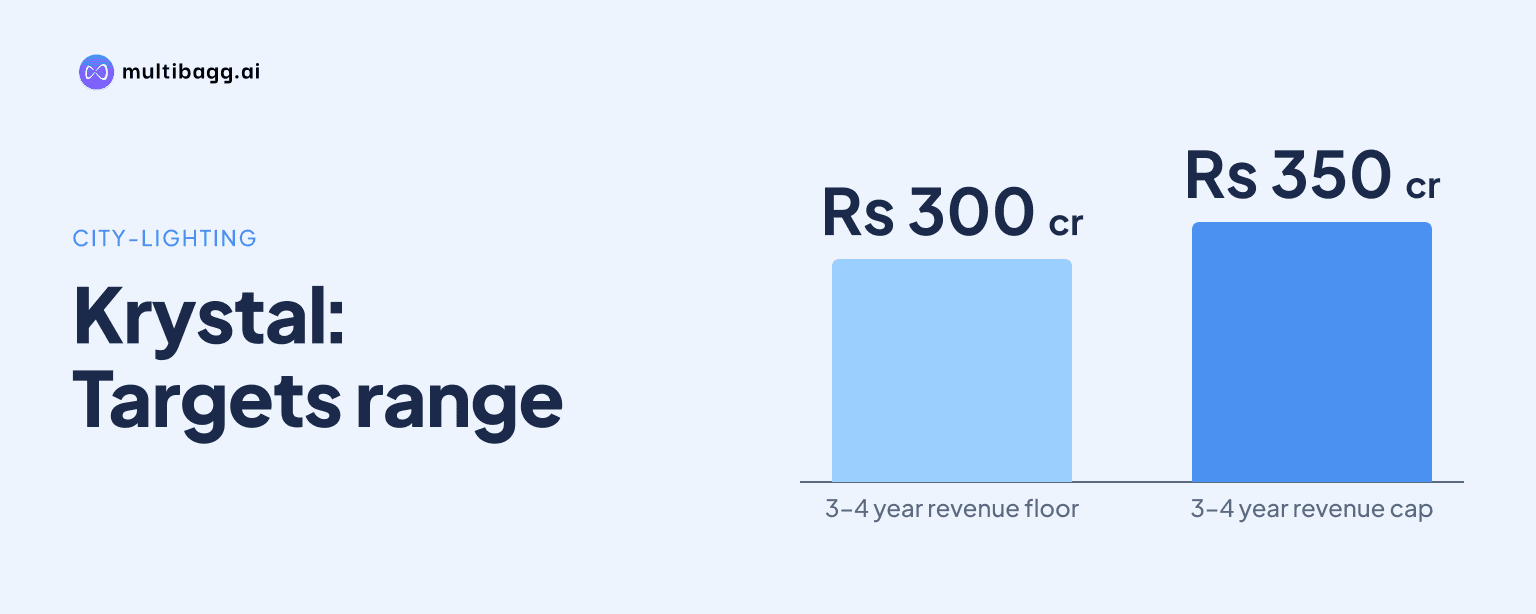
Krystal Integrated Services Limited is targeting Rs 300-350 crore in annual city-lighting revenue over the next three to four years, supported by the 100% acquisition of Citelum India, its existing team and pre-qualifications, and a planned investment of about Rs 100 crore. Krystal has already begun bidding for projects across India.
Know Krystal Integrated Services inside out
Results, valuation, peers and who's buying, in one view.
How will Krystal reach Rs 300-350 crore of city-lighting revenue?
Krystal plans to reach Rs 300-350 crore of annual city-lighting revenue in three to four years by bidding nationally for lighting projects and investing about Rs 100 crore in engineering capabilities, technology platforms and business expansion. Management presented the target as part of Krystal 2.0, its strategy to add infrastructure-led and technology-enabled businesses to integrated facility management and manpower services.
The city-lighting business will cover design, installation, commissioning and operations and maintenance, or O&M. Management said bidding activity has commenced across India, but it did not disclose a current revenue base, awarded contract value, tender pipeline or annual revenue milestones for the Rs 300-350 crore target.
Krystal’s plan depends on converting tenders rather than on a disclosed order book already assigned to city lighting. Across its wider business, Krystal evaluated tenders worth more than Rs 12,000 crore and participated in bids worth about Rs 4,500 crore; management said the historical conversion trend for new tenders was 8% to 10%, while stressing that this was not a committed rate or a city-lighting forecast.
What did Krystal acquire with Citelum India?
Krystal acquired city-lighting capabilities, pre-qualifications, systems and an operating team with Citelum India, according to management. Citelum India had completed city lighting in Ahmedabad, worked on lighting in Noida and other locations, and had a significant presence in Tata and Mahindra projects in special economic zones, or SEZs.
Those qualifications allow Krystal to bid for new lighting design and development, as well as revamping, upgrading and updating existing lighting systems. Management said the same team that worked at Citelum India was retained, including a chief executive with more than 40 years of experience in the lighting business.
Management said the business continued without a pause after the acquisition because its people, processes and systems were already in place. Krystal said it will need to deploy a project team only when it secures a project in a particular location, rather than first building a city-lighting organisation from the ground up.
The acquisition gives Krystal prior project credentials at the start of the expansion, but the call did not disclose the purchase consideration, Citelum India’s revenue, profitability, employee count or number of pre-qualifications. It also did not identify any city-lighting contracts awarded after bidding began.
Is Krystal’s city-lighting model asset-light?
Krystal described the city-lighting operation as an asset-light, project-driven model because it does not expect to invest in its own delivery assets. Management said design, installation, commissioning and O&M form part of the project work, meaning Krystal does not need to own the underlying project assets.
The asset-light description sits alongside the planned Rs 100 crore investment in engineering, technology platforms and business expansion. Management did not split that amount between technology, staffing, bidding costs, working capital or other expenditure, so the call does not establish the timing or allocation of the investment.
The new vertical would diversify a business still led by manpower services. In H1 FY’27, manpower and related services contributed about 91% of Krystal’s revenue, while catering and related services accounted for about 9%; city lighting adds an engineering and technology-oriented service offering outside those two reported segments.
Got a follow-up? Ask IRIS
Will Krystal pursue government and private city-lighting work?
Krystal will pursue both government-led and private-sector city-lighting projects, management said. Its cited experience through Citelum India spans Ahmedabad and Noida city-lighting work alongside Tata and Mahindra projects in SEZs, supporting the stated two-channel approach.
Krystal’s broader revenue mix was about 65% government and 35% corporate, according to management. That represented a shift from the company’s earlier 70:30 government-to-corporate mix after it added more than 177 corporate customers in the previous financial year and corporate business grew by more than 40%.
Management did not provide the expected government-to-private mix for the Rs 300-350 crore city-lighting ambition. It also did not name specific city-lighting tenders, preferred-bidder positions or project awards, leaving the customer mix and contract conversion path unresolved.
Krystal reported Q2 FY’27 revenue of Rs 414.47 crore, up 46.25% year on year from Rs 283.40 crore, while H1 FY’27 revenue rose 27.82% to Rs 775.18 crore from Rs 606.48 crore. The city-lighting target is therefore a future vertical objective rather than reported current revenue, and management gave no date for when it could contribute to quarterly results.
How does the city-lighting expansion fit Krystal’s finances?
Krystal’s planned Rs 100 crore city-lighting investment has not been directly linked by management to a funding plan or a balance-sheet target. As of September 30, 2026, Krystal reported net debt of Rs 63.84 crore, comprising borrowings of Rs 144.64 crore and cash and bank balances of Rs 80.80 crore, while net worth was Rs 539.09 crore.
Q2 FY’27 earnings before interest, tax, depreciation and amortisation, or EBITDA, excluding other income, rose 38.82% to Rs 24.86 crore, but its margin declined to 6.00% from 6.32% a year earlier. Management attributed the 32-basis-point moderation chiefly to employee cost rising to 75.9% of revenue from 72.3%, partly offset by lower material and other expenses as a share of revenue.
Management said technical, O&M and engineering-driven contracts may support its margin profile because they require less manpower, while cautioning that the outcome will take time to establish. It said Krystal aspires to keep EBITDA margin between 6.25% and 7.5% through operational efficiencies, cost rationalisation and cross-selling services to individual customers.
Trade receivable days were about 118 days as of September 30, 2026, unchanged from March 2026 despite higher business volumes. Management did not say whether city-lighting contracts would have different payment cycles, margin terms or working-capital requirements from Krystal’s established service contracts.
Conclusion
Krystal is positioning Citelum India as an operating entry point into city lighting rather than a business that must be assembled from scratch. The acquired pre-qualifications, retained team and previous work in city and SEZ lighting support that position, while the Rs 300-350 crore target depends on project wins that have not yet been disclosed.
The next stated milestone is management’s promised update in the coming couple of months on the progress of city-lighting activity. The key disclosures to watch are project awards, the deployment of the planned Rs 100 crore investment and any detail on how the vertical contributes to revenue, margins and working capital.