










KRYSTAL targets corporate growth to reshape business mix
Key highlights
- KRYSTAL reported H1 FY27 income from operations of Rs 77.5178 crore, up 27.82% year on year.
- KRYSTAL plans to expand waste-management capacity from about 400 TPD to 800-1,000 TPD.
- KRYSTAL served 547 customers across 4,766 locations as of September 30, 2026.
- KRYSTAL's H1 FY27 EBITDA margin was 6.15%, down 32 basis points from H1 FY26.
powered by IRIS
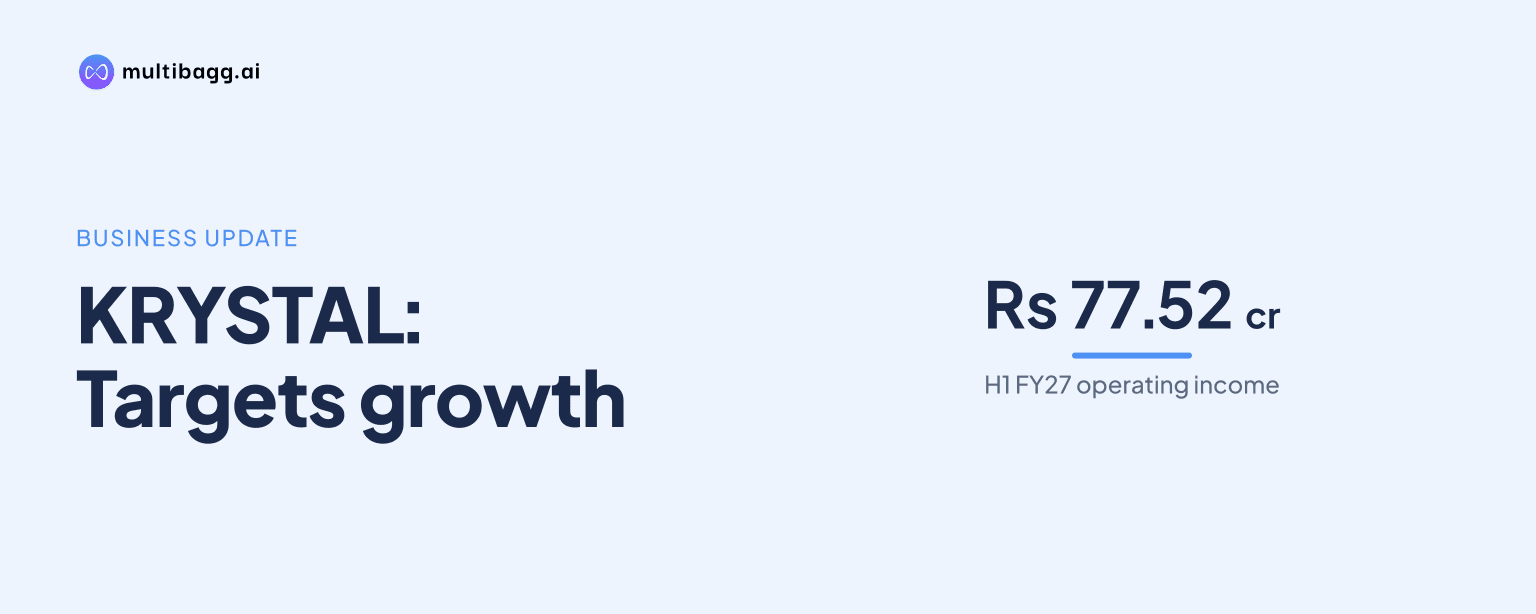
KRYSTAL is shifting toward corporate-led, margin-accretive growth under Krystal 2.0 while selectively bidding for large government contracts, with its clearest operating target being waste-management capacity expansion from about 400 tonnes per day to 800-1,000 tonnes per day. The strategy follows H1 FY27 income from operations of Rs 77.5178 crore.
Know Krystal Integrated Services inside out
Results, valuation, peers and who's buying, in one view.
Why is KRYSTAL changing its growth model?
KRYSTAL says it is moving from volume-driven growth toward margin-accretive corporate business, while retaining selective participation in large government opportunities. The stated objective is to increase the contribution from corporate and private-sector engagements rather than pursue government-contract scale alone. This business-mix rebalancing is part of Krystal 2.0, which management presents as a value-led growth strategy.
The company reported FY26 revenue from operations of Rs 127.73 crore, compared with Rs 121.28 crore in FY25. KRYSTAL does not disclose the revenue split between government, corporate and private-sector customers, so the presentation does not quantify the intended change in client mix. It also does not specify a target date for corporate business to reach any particular share of revenue.
KRYSTAL identifies multinational companies entering India and Indian conglomerates as prospective customers for its integrated-services offering. As of September 30, 2026, the company reported 547 customers, 33 branches and 4,766 locations serviced. Management cites compliance, scale and execution capabilities as the mechanisms through which it seeks to serve multi-location corporate customers.
The sector focus is also changing. KRYSTAL names manufacturing, including pharmaceuticals, automobiles and defence, as well as Global Capability Centers, data centres and logistics, as areas for deeper engagement. The presentation links manufacturing and industrial expansion to rising infrastructure investment, but it gives no sector-level revenue, order-book or profitability figures.
What do KRYSTAL's latest results show?
KRYSTAL reported H1 FY27 income from operations of Rs 77.5178 crore, up 27.82% from Rs 60.6481 crore in H1 FY26. Earnings before interest, tax, depreciation and amortisation, or EBITDA, rose 21.39% to Rs 4.7662 crore, while profit after tax excluding discontinued operations increased 22.09% to Rs 3.6035 crore. These results are the financial starting point for management's margin-led strategy.
Margins, however, declined from the previous year. H1 FY27 EBITDA margin was 6.15%, compared with 6.47% in H1 FY26, a decrease of 32 basis points. Profit-after-tax margin was 4.65%, down 22 basis points from 4.87%; one basis point equals one-hundredth of a percentage point. KRYSTAL does not attribute either movement to Krystal 2.0.
The quarterly comparison also shows revenue growth alongside lower margins. Q2 FY27 income from operations increased 46.25% year on year to Rs 41.4467 crore, and EBITDA rose 38.82% to Rs 2.4864 crore. Yet Q2 EBITDA margin was 6.00%, below both Q2 FY26 and Q1 FY27, when it was 6.32%, making the corporate pivot a stated plan rather than a demonstrated margin improvement in the reported periods.
Got a follow-up? Ask IRIS
How will KRYSTAL increase corporate wallet share?
KRYSTAL plans to increase wallet share through an integrated-services model that bundles facility management, security, waste management, operations and maintenance, or O&M, and renewable services. Management says this approach is intended to create cross-selling opportunities across its client base and shift its role from a single-service vendor to an integrated partner.
The company already lists integrated facility management, staffing and payroll management, private security and manned guarding, food and beverages, technical facility management and waste management among its services. It reported 49,971 on-site employees as of September 30, 2026, supporting delivery across 4,766 locations. The presentation does not disclose how many customers currently use more than one service.
KRYSTAL also reports a 100% contract renewal or extension rate over the last five years for relevant non-government customers. This metric is limited to the specified non-government customer group and does not cover all customers or government contracts. The presentation does not give the number of contracts, their value, or the criteria used to define relevant customers.
The delivery plan includes building a skilled and semi-skilled workforce pipeline, strengthening internal capabilities, standardising processes and using technology platforms. KRYSTAL says these measures are focused on quality, compliance and retention. No technology investment amount, workforce target or timeline is disclosed for this operational programme.
Which adjacencies and sectors will KRYSTAL scale?
KRYSTAL's most specific expansion target is in waste management, where it plans to scale from about 400 tonnes per day, or TPD, to 800-1,000 TPD. The stated plan represents an increase of about 400-600 TPD. The presentation does not provide a completion date, capital expenditure plan, customer pipeline or forecast revenue for the additional capacity.
The company also intends to leverage its client base in renewable, solar and engineering, procurement and construction, or EPC, services. In O&M, KRYSTAL plans to expand into higher-voltage power and substation infrastructure. These are identified as higher-value adjacencies, but no separate revenue, margin, order-book or investment figures are disclosed for solar, EPC, power or substation work.
Manufacturing and industrial sectors are central to the revised growth plan, alongside Global Capability Centers, data centres and logistics. These targets broaden KRYSTAL's existing footprint, which includes healthcare, education, public administration, airports, railways, metro infrastructure, retail and waste management. The presentation describes diversification across India but does not provide geographic expansion targets or a branch-opening schedule.
Balance-sheet figures provide context but do not establish spending on these adjacencies. Borrowings were Rs 14.4642 crore at September 30, 2026, compared with Rs 11.0987 crore at March 31, 2026. Trade receivables rose to Rs 49.7891 crore from Rs 41.2382 crore, while cash and cash equivalents, including other bank balances, increased to Rs 8.0804 crore from Rs 5.9404 crore.
Conclusion
KRYSTAL's Krystal 2.0 plan combines selective government bidding with a greater emphasis on corporate and private-sector clients, integrated cross-selling and industrial-sector expansion. H1 FY27 income, EBITDA and profit after tax increased from H1 FY26, but EBITDA and profit-after-tax margins declined, meaning the reported results have not yet shown the margin improvement management seeks from the revised mix.
The next disclosed markers are progress in corporate-led growth, cross-selling of facility management, security, waste management, O&M and renewable services, and movement toward 800-1,000 TPD of waste-management capacity. Investors can also watch for disclosures on the scale of solar, EPC and higher-voltage O&M activity, because KRYSTAL has outlined those plans without providing financial targets or timelines.