










Krystal targets 800-1,000 TPD waste capacity, adds solar EPC
Key highlights
- Krystal is actively bidding to raise solid-waste processing capacity from about 400 TPD to 800-1,000 TPD.
- Krystal's first disclosed solar EPC contract with DMER has a 15-year term.
- Q2 EBITDA margin was 6.0%, compared with 6.32% in the year-earlier quarter.
- Government and corporate customers accounted for about 65% and 35% of Krystal revenue, respectively.
powered by IRIS
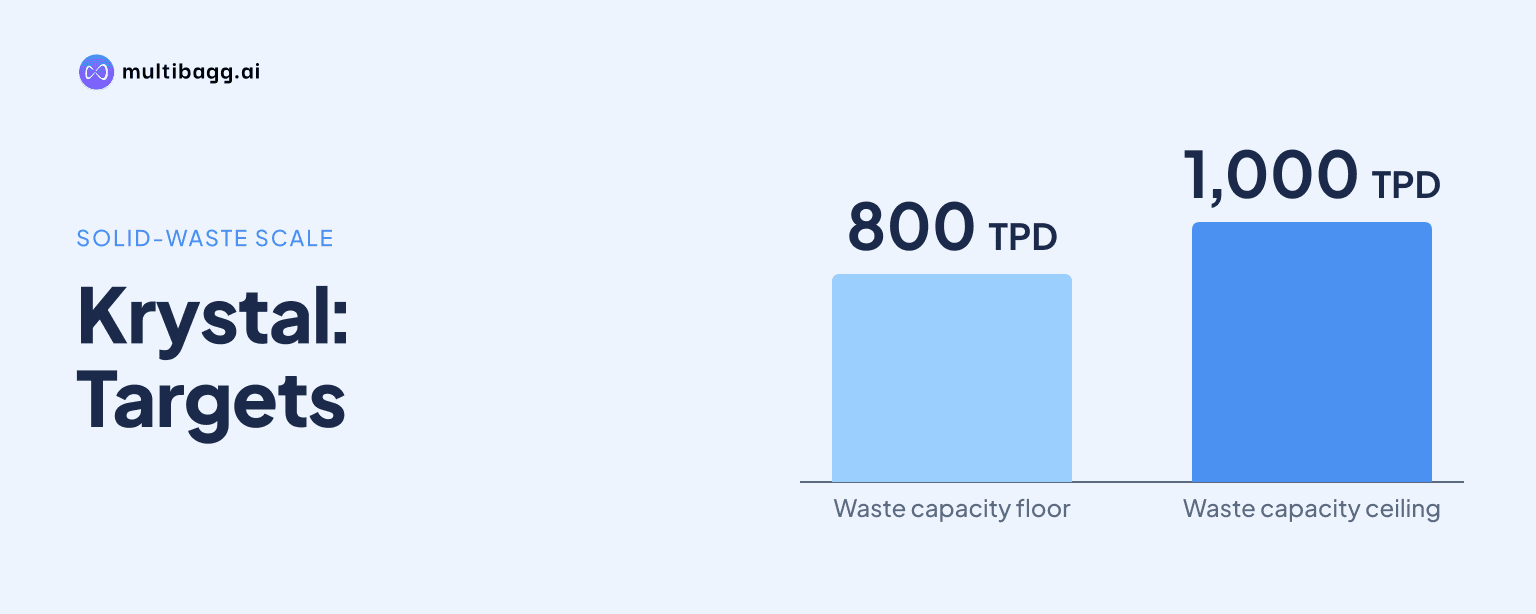
In the first half of FY27, Krystal Integrated Services Limited said it was actively bidding to lift solid-waste processing capacity from about 400 tonnes per day to 800-1,000 tonnes per day, alongside its first disclosed 15-year solar engineering, procurement and construction contract with DMER. Management also identified technical operations and maintenance work as a route to a different service mix.
Know Krystal Integrated Services inside out
Results, valuation, peers and who's buying, in one view.
How will Krystal double its waste-processing capacity?
Krystal intends to double, and potentially more than double, its roughly 400 tonnes per day, or TPD, of solid-waste processing capacity by winning larger-tonnage tenders. Management said the current 400 TPD base includes work with TMC, Vasai-Virar and other contracts. It said this operating qualification has expanded its eligibility to bid for bigger waste-processing assignments, with the planned 800-1,000 TPD scale dependent on the active bidding process.
The plan does not carry a disclosed completion date, project list, contract value or capital-expenditure budget. That distinction matters because the 400 TPD figure is an existing operating base, whereas the additional 400-600 TPD is a target contingent on awards. Krystal also did not provide a segment-wise breakdown of its order book, which management described as Rs 2,980 crore to approximately Rs 3,000 crore flowing over about three to three-and-a-half years depending on contract tenure.
What does Krystal's 15-year solar EPC contract involve?
Krystal's first disclosed solar engineering, procurement and construction, or EPC, contract is a 15-year DMER engagement at premises where it was already providing facility-management services. Management described the assignment as solar-power-enabled infrastructure. It did not disclose the solar capacity, contract value, project start date, revenue-recognition profile or whether the agreement includes recurring operations and maintenance, or O&M, work after installation.
The DMER order extends Krystal's services within an existing client location rather than requiring it to establish a new customer relationship. Management said it is seeking to cross-sell different products to single customers in order to reduce sales-acquisition costs. Solar EPC was cited with solid-waste management, Citelum and technical facility management as additional growth opportunities entering the second half of FY27, but Krystal gave no revenue or margin target for solar.
Krystal has also added city-lighting capability through the acquisition of Citelum India Private Limited. Management said Citelum had completed city-lighting work in Ahmedabad and Noida and had worked on Tata and Mahindra projects in special economic zones. Krystal said it retained the acquired team, systems and pre-qualifications, enabling bids for lighting design, installation, commissioning and O&M for government and private-sector projects without a separate capability-building period.
Got a follow-up? Ask IRIS
Can Krystal's technical O&M services improve margins?
Krystal said technical and engineering-driven O&M contracts could improve its margin profile because they generally require less manpower than some existing service contracts. Management presented this as a strategic objective rather than a financial forecast, saying these lines are intended to support margins, build long-term order-book positions and develop businesses over the next five to eight years. It did not disclose standalone revenue, profit or order-book figures for technical O&M.
The immediate margin comparison shows why management is focusing on the mix. Q2 revenue rose about 46% year on year and earnings before interest, tax, depreciation and amortisation, or EBITDA, increased 38.82%, while EBITDA margin declined to 6.0% from 6.32% in the year-earlier quarter. Management attributed the reduction to start-up spending, working-capital needs and other initial costs incurred when larger contracts begin before their operations stabilise.
Krystal said it added almost 33 customers in Q2 and 59 customers plus government business in H1 FY27, increasing employee costs because new contracts require personnel. Management's stated EBITDA-margin aspiration is 6.25% to 7.5%, supported by operational efficiencies, internal cost rationalisation and cross-selling. It did not give a date for reaching that range, and said the eventual contribution from newer technical lines would depend on how the businesses develop.
How does Krystal's customer mix support diversification?
Krystal reported a revenue mix of about 65% government customers and 35% corporate customers, compared with its traditional mix of roughly 70% government and 30% corporate. The shift reflects a larger corporate sales effort, according to management. It said it added more than 177 corporate customers in the previous financial year and that corporate business grew by more than 40% during that year, although it did not give absolute corporate revenue.
Management said outstanding receivables generally follow the same 65:35 government-to-corporate mix. Trade receivable days were about 118 days at September 30, 2026, in line with March 2026 despite higher business volumes. As of that date, Krystal reported net debt of Rs 63.84 crore, comprising borrowings of Rs 144.64 crore and cash and bank balances of Rs 80.80 crore, while net worth stood at Rs 539.09 crore.
Krystal said its approach to geographic expansion is to enter with customers that have identified and confirmed business, rather than first establishing infrastructure and waiting for work. The company said it operates across states including Maharashtra, Gujarat, Andhra Pradesh, Telangana, Delhi and Tamil Nadu, while describing its national footprint as dynamic rather than concentrated in a fixed region. Management also said it evaluates tender bids through a committee that considers operational capability, working-capital requirements and projected profitability over each contract's tenure.
Conclusion
Krystal's diversification plan combines an existing 400 TPD waste-processing base with active bids for 800-1,000 TPD, a 15-year solar EPC contract at a current client site, and a push into lower-manpower technical O&M work. The 65:35 government-to-corporate revenue mix also marks a change from the earlier 70:30 pattern, while Q2 EBITDA margin moved down 0.32 percentage points to 6.0% during a period of new-contract mobilisation.
The next disclosures to watch are tender awards that could add waste-processing capacity, financial and operating details of the DMER solar contract, and management's promised update on Citelum's progress in the coming couple of months. Krystal also said it was evaluating inorganic opportunities involving national O&M businesses, robotics manufacturing and smaller artificial-intelligence-related startups, without disclosing any transaction timetable or target.