










Laser Power enters transmission with Rs 72.76 crore HTLS order
Key highlights
- Laser Power won its first commercial HTLS conductor order from Power Grid, worth Rs 72.76 crore, in Q2 FY27.
- Laser Power received a Rs 44 crore CESC EPC order including its first 220 kV underground transmission project.
- Laser Power’s order book was approximately Rs 2,543 crore at September 30, 2026, including Rs 1,303 crore in manufacturing and Rs 1,240 crore in EPC.
- Laser Power targets a 25-to-40-day reduction in working-capital days by Q4 FY27 from 166 days at September 30, 2026.
powered by IRIS
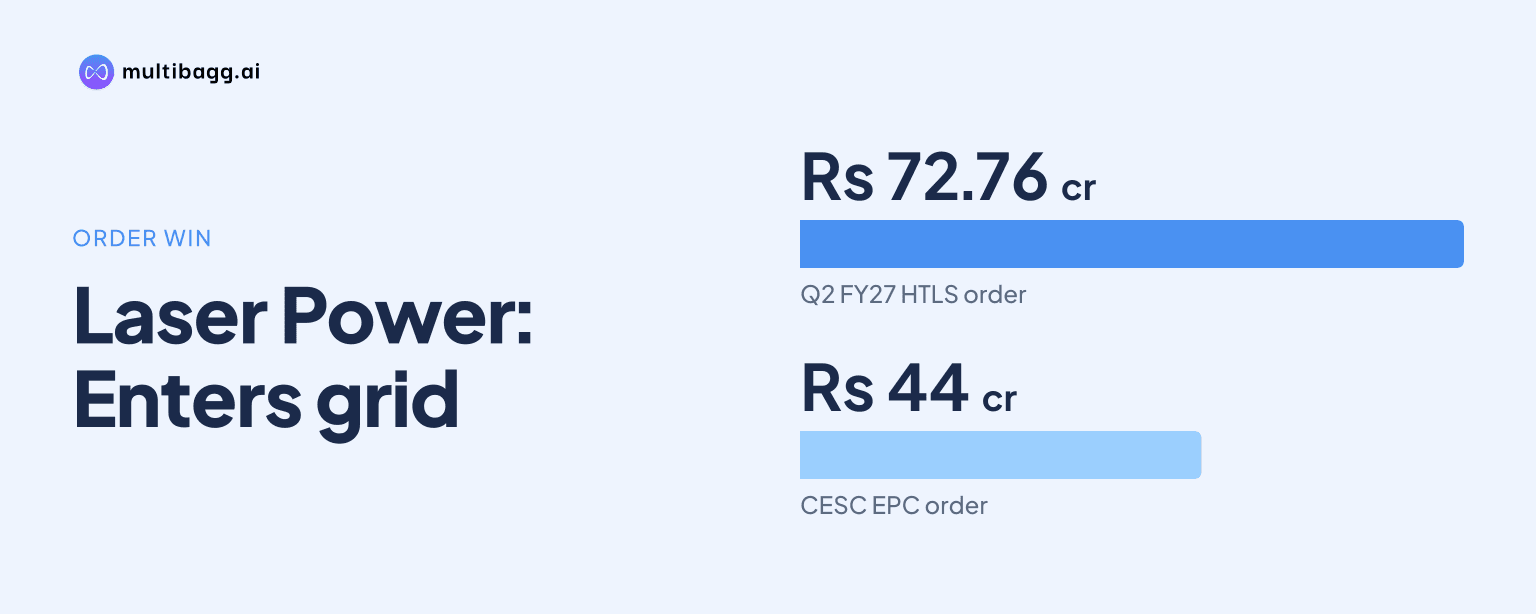
Laser Power & Infra Limited entered high-voltage transmission in Q2 FY27 after winning a Rs 72.76 crore Power Grid HTLS contract, its first commercial advanced-conductor order, and a Rs 44 crore CESC assignment including 220 kV underground cabling. The two awards provide Laser Power’s first stated commercial references in specialised transmission products and engineering, procurement and construction.
Know Laser Power & Infra inside out
Results, valuation, peers and who's buying, in one view.
What are Laser Power’s first high-voltage transmission orders?
Laser Power’s first commercial high-temperature low-sag, or HTLS, conductor order is a Rs 72.76 crore Power Grid contract covering conductor supply and reconductoring of existing transmission lines. Management called the award the most significant development of the quarter ended September 30, 2026, as it moves the advanced-conductor platform from development and qualification to commercial execution.
The Power Grid order follows about 18 months of product testing, qualification and execution-readiness work, according to management. Laser Power accesses the technology through a licensing agreement with TS Conductors USA. Reconductoring replaces conductors on existing lines, and management said HTLS products are designed to increase the amount of power carried through an existing transmission corridor.
Laser Power also received a Rs 44 crore order from CESC Limited for engineering, procurement and construction, or EPC, work involving 33 kilovolt, or kV, and 220 kV underground cabling. This is Laser Power’s first 220 kV underground transmission project. Management said successful completion would establish a specialised execution reference beyond the value of the contract itself.
Why is Laser Power targeting HTLS and underground projects?
Laser Power is targeting HTLS conductors because management cited land availability, right-of-way approvals and long construction timelines as constraints on new transmission corridors. In that setting, the Rs 72.76 crore Power Grid order addresses the need to transfer more electricity over existing routes rather than construct an entirely new line.
Management said utilities may assess advanced conductor technologies using transmission capability, efficiency, life-cycle economics, installation requirements and execution performance. It did not provide an HTLS sales forecast, a tender pipeline figure or a market-share target. Management said wider use of the TS Conductors platform would depend on consistent field demonstration of its expected technical and economic benefits.
The Rs 44 crore CESC project addresses a separate requirement in dense urban areas, where management said overhead expansion can be difficult. Its 33 kV and 220 kV scope gives Laser Power an opportunity to execute supply, installation, testing, commissioning and handover under its EPC model. The transcript does not disclose completion dates or project-level margins for either award.
How does Kharagpur support Laser Power’s transmission plan?
Laser Power received a provisional letter of intent and in-principle approval for roughly 40 acres at Vidyasagar Industrial Park in Kharagpur, West Bengal, during Q2 FY27. The long-term lease site is intended for an integrated power-cable and conductor manufacturing facility that could expand capacity and product range, including higher-value transmission products.
The Kharagpur proposal has no disclosed capital-expenditure amount, funding structure or commissioning timetable. Management said investment would be phased and aligned with demand visibility, product strategy, customer requirements and expected returns. It also said it would consider existing-facility utilisation and the proposed product mix before determining the scale of the project.
The plan sits alongside an order book of about Rs 2,543 crore at September 30, 2026, split between Rs 1,303 crore of manufacturing work and Rs 1,240 crore of EPC work. Laser Power won approximately Rs 357 crore of new orders in Q2 FY27, taking H1 FY27 order inflow to around Rs 449 crore. Management did not disclose how much of the backlog relates to the two new transmission contracts.
Got a follow-up? Ask IRIS
How did Laser Power’s operating mix change in Q2 FY27?
Laser Power reported standalone revenue from operations of Rs 628 crore in Q2 FY27, up 20.5% sequentially and 2.1% year on year. Manufacturing revenue increased 29.9% to Rs 524 crore from Rs 404 crore in Q2 FY26, while EPC revenue declined to Rs 104 crore from Rs 212 crore as heavy rains delayed project execution in relevant areas.
The segment movement changed the revenue mix toward manufacturing during the quarter. For H1 FY27, manufacturing revenue rose 13.8% to Rs 906 crore from Rs 797 crore, while EPC revenue fell 10.7% to Rs 243 crore from Rs 272 crore. Management said deferred EPC revenue could be recovered in coming quarters as installation, certification and billing progress.
Earnings before interest, tax, depreciation and amortisation, or EBITDA, were Rs 76 crore in Q2 FY27, 15.2% above Q1 FY27 but below Rs 80 crore a year earlier. The EBITDA margin was 12.1%, compared with 13.0% in Q2 FY26. Profit after tax was Rs 31 crore, compared with Rs 32 crore in Q2 FY26 and up 44.8% sequentially.
For H1 FY27, revenue was Rs 1,150 crore, EBITDA was Rs 142 crore and the EBITDA margin was 12.3%. Management expects the margin to stabilise in a 12.5% to 13.0% range and expects rain-delayed execution to improve. Those are management expectations, rather than reported outcomes as of September 30, 2026.
What financial milestones must Laser Power deliver next?
Laser Power’s finance cost fell sequentially to about Rs 33 crore in Q2 FY27 from Rs 36 crore in Q1 FY27 after it used around Rs 490 crore of initial public offering proceeds to repay identified borrowings during Q2. Total borrowings were approximately Rs 499 crore on September 30, 2026. Management said the Q2 figure reflected only a partial-period interest benefit.
Working capital increased to approximately Rs 1,159 crore at September 30 from about Rs 1,059 crore at the end of Q1 FY27, although working-capital days fell to 166 from 183. Inventory rose to about Rs 946 crore from Rs 710 crore because of rain-related delays, while trade receivables declined to about Rs 1,382 crore from Rs 1,416 crore.
Management expects operating cash flow to turn positive in FY27 and targets a reduction of roughly 25 to 40 working-capital days by Q4 FY27. Its stated mechanisms are disciplined procurement, improved execution, faster certification, timely billing and stronger collections. The near-term test is whether the Power Grid and CESC work converts specialised credentials into execution, revenue and cash collections.
Conclusion
Laser Power’s Q2 FY27 orders mark its stated transition from distribution-grade products and associated EPC work toward specialised transmission products and projects. The Rs 72.76 crore Power Grid HTLS award supplies its first commercial advanced-conductor reference, while the Rs 44 crore CESC assignment creates its first 220 kV underground-cabling reference, as manufacturing revenue rose 29.9% year on year.
Next, management plans to execute the Power Grid and CESC projects, pursue further transmission opportunities and advance the approximately 40-acre Kharagpur site in phases. The other disclosed measures to watch are its target for positive FY27 operating cash flow, a 25-to-40-day working-capital reduction by Q4 FY27, and the fuller interest-cost effect of the Rs 490 crore borrowing repayment.