










Lupin retains FY27 margin target despite Q2 EBITDA fall
Key highlights
- Lupin's Q2 FY27 EBITDA margin was 25.1%, compared with 31.3% in Q2 FY26.
- Lupin retained FY27 EBITDA-margin guidance of around 24%-25%.
- Lupin's employee-benefit expenses rose 29% year on year to Rs 1,424 crore in Q2 FY27.
- Lupin's Other Developed Markets revenue grew about 46% year on year to Rs 1,182 crore in Q2 FY27.
powered by IRIS
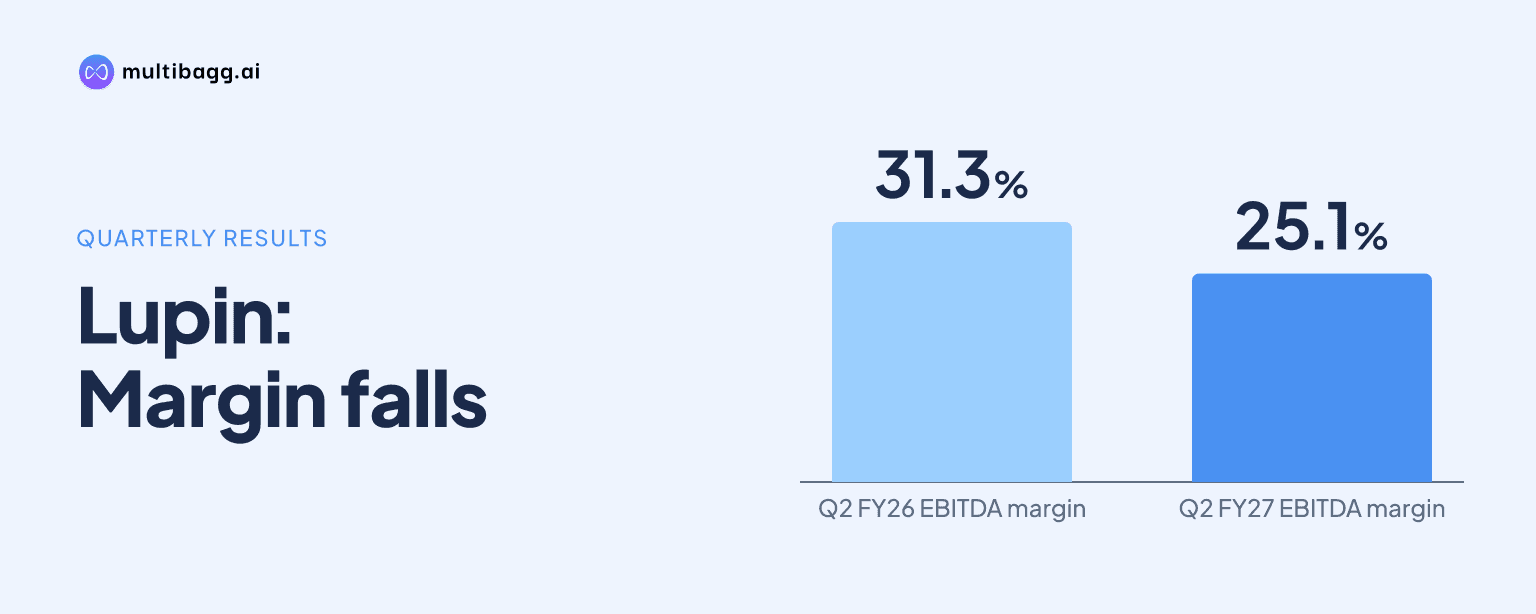
Lupin Limited retained its FY27 earnings before interest, tax, depreciation and amortisation (EBITDA) margin target of 24%-25% after Q2 FY27 margin fell to 25.1% from 31.3% a year earlier. Revenue rose 11% to Rs 7,827 crore, but U.S. competition and higher employee, commercial and research spending reduced profitability.
Know Lupin inside out
Results, valuation, peers and who's buying, in one view.
Why did Lupin's Q2 FY27 EBITDA margin decline?
Lupin's Q2 FY27 EBITDA margin declined because expenses rose faster than revenue, reducing EBITDA to Rs 1,957 crore from Rs 2,138 crore in Q2 FY26. Revenue from operations including other operating income increased 11% year on year to Rs 7,827 crore, while employee-benefit expenses rose 29% to Rs 1,424 crore. Employee costs represented 18.3% of sales, compared with 16.2% a year earlier, reflecting annual increments and business growth, management said.
Manufacturing and other expenses increased 23% to Rs 2,438 crore, or 31.3% of sales, from 29.0% in Q2 FY26. Management attributed the rise to higher volumes, field-force expansion, and licence-fee payments under settlement agreements. Research and development (R&D) expenditure rose to Rs 618 crore, or 7.9% of sales, from Rs 522 crore in the prior-year quarter, as Lupin continued to fund complex and specialty platforms.
How did U.S. competition affect Lupin's profitability?
U.S. competition reduced Lupin's revenue and margin contribution from key products, principally Tolvaptan, after two additional generic players entered in Q2 FY27. U.S. sales declined 13.4% quarter on quarter on a constant-currency basis, while the market's reported year-on-year growth was 9.3%. Management cited increased competition and loss of exclusivity in Tolvaptan and Mirabegron, but clarified that Mirabegron had remained relatively stable and that the larger decline was in Tolvaptan.
Lupin's gross margin was 74.2% in Q2 FY27, above 73.3% in Q2 FY26 but below 74.6% in Q1 FY27. Management said higher volumes, cost initiatives and India profitability partly offset U.S. pricing pressure and geopolitical risks in the Middle East. It also said foreign-exchange tailwinds, following the absence of first-quarter forward-contract effects, limited the sequential decline, while agreeing that the benefit should unwind as the Indian rupee stabilizes.
Why is Lupin retaining its FY27 margin guidance?
Lupin is retaining its FY27 EBITDA-margin target of around 24%-25% because management expects the full-year result to remain within that range despite lower quarterly profitability ahead. Q2 FY27 margin of 25.1% was above the target range, but management said margins are likely to moderate in coming quarters as Tolvaptan competition increases, R&D spending continues and Middle East input costs remain higher.
Management expects growth in the U.S. base business, new injectable launches and Pegfilgrastim to partly offset pressure from key products during FY27. Lupin also expects to commercialize its U.S. biosimilar portfolio this year. Apixaban Oral Suspension received tentative approval through the 505(b)(2) pathway in Q2 FY27, but management expects a Q1 FY28 launch and said revenue should build over subsequent months and quarters as market access develops.
Got a follow-up? Ask IRIS
What investments could keep Lupin's costs elevated?
Lupin expects FY27 R&D expenditure of around 8% of sales after spending Rs 1,226 crore, or 7.7% of sales, in H1 FY27. Its development pipeline includes more than 55 injectable and respiratory products, while it is preparing four to five biosimilar filings for the U.S. over the next few years. Management said it is reviewing R&D expenditure to maximize opportunities without compromising material products, rather than committing to a lower FY28 R&D ratio.
Commercial spending may also rise before the expected Q1 FY28 Apixaban Oral Suspension launch. Management said it plans additional investment over the next couple of quarters in market access, channel expertise and relationships for the differentiated product. It expects the liquid dosage form to retain some share after generic competition arrives in FY29, although that durability is a management expectation rather than a reported result.
Which businesses are offsetting Lupin's U.S. pressure?
Lupin's India and Other Developed Markets businesses are partly offsetting U.S. pressure, although they do not remove the consolidated cost and pricing effects. India grew 14.7% year on year in Q2 FY27, while core prescription sales rose 13.8%. Other Developed Markets grew about 46% to Rs 1,182 crore, supported by Australia, Canada and Europe, and accounted for 15% of revenue compared with 11% in FY26.
India's chronic segment grew 19.5% in H1 FY27, ahead of 17.2% growth in the Indian pharmaceutical market (IPM), and chronic therapies accounted for about 66% of the portfolio versus about 65% in FY26. Lupin launched 12 products in H1 FY27 and plans about 20 launches in FY27. By contrast, Emerging Markets revenue fell 4% in Q2 as lower Brazil sales, following Dapagliflozin competition, outweighed double-digit growth in South Africa, the Philippines and Mexico.
Conclusion
Lupin's Q2 FY27 results show that the 6.2-percentage-point year-on-year EBITDA-margin decline reflected both U.S. product competition and higher employee, commercial and R&D costs. The 11% increase in revenue to Rs 7,827 crore, alongside 14.7% India growth and 46% Other Developed Markets growth, provided diversification but did not fully offset the decline in Tolvaptan contribution.
The next factors to watch are further Tolvaptan competition, U.S. biosimilar commercialization and the planned Q1 FY28 Apixaban Oral Suspension launch. Management also aims to file more than 15 products in FY27 and launch more than 60 U.S. products over the following three years, including about 25 injectable and respiratory products, five biosimilars and two to three 505(b)(2) products.