










Lupin targets 60 US launches as Tolvaptan competition intensifies
Key highlights
- Lupin expects more than 60 US launches over three years, including about 25 injectable and respiratory products.
- Lupin’s US sales were USD 317 million in Q2 FY2027, down 13.4% quarter on quarter on a constant-currency basis.
- Lupin’s revenue from operations including other operating income rose 11% year on year to Rs 7,827 crore in Q2 FY2027.
- Lupin’s Other Developed Markets revenue grew about 46% year on year to Rs 1,182 crore in Q2 FY2027.
powered by IRIS
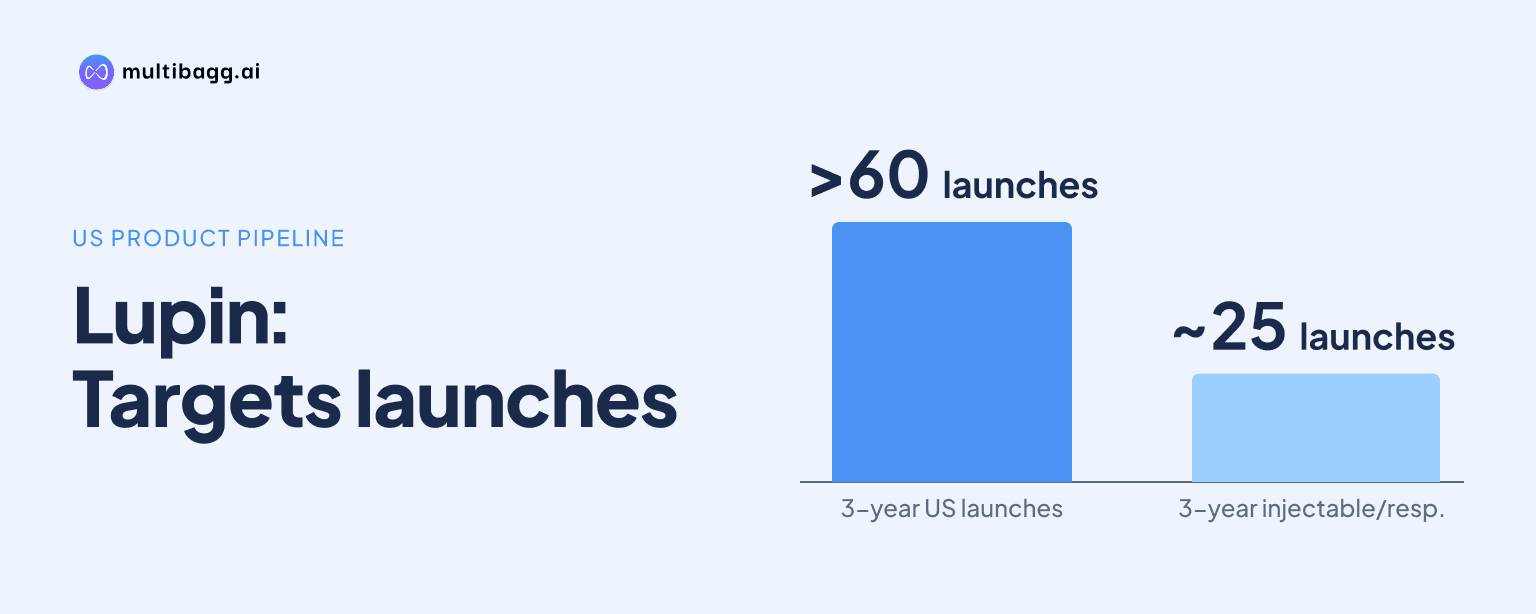
In Q2 FY2027, Lupin Limited said it plans more than 60 US product launches over three years as US sales fell 13.4% quarter on quarter to USD 317 million on a constant-currency basis, primarily reflecting greater Tolvaptan competition. Management expects injectables, respiratory medicines, biosimilars and 505(b)(2) products to reshape the portfolio.
Know Lupin inside out
Results, valuation, peers and who's buying, in one view.
Why is Lupin changing its US product-launch mix?
Lupin is changing its US launch mix because competition in key products reduced US sales sequentially in Q2 FY2027. US sales were USD 317 million, down 13.4% quarter on quarter on a constant-currency basis. Management attributed the decline largely to increased competition and loss of exclusivity in selected products, including Tolvaptan and Mirabegron, before clarifying that Tolvaptan was the primary source of the decline and Mirabegron was relatively stable.
Tolvaptan faced entry by two additional generic competitors during the quarter, and management said further entrants could arrive over coming quarters. Higher volumes in the base portfolio and seasonal-product contributions partly offset pricing pressure. Lupin retained its fiscal 2027 US revenue expectation of USD 1.1 billion to USD 1.2 billion, with base-business growth, new injectable launches and Pegfilgrastim expected to offset pressure in key products.
The US competition affected profitability despite consolidated revenue growth. Revenue from operations including other operating income increased 11% year on year to Rs 7,827 crore in Q2 FY2027 from Rs 7,048 crore in Q2 FY2026. Earnings before interest, tax, depreciation and amortisation, or EBITDA, excluding foreign exchange and other income declined to Rs 1,957 crore from Rs 2,138 crore, and the margin fell to 25.1% from 31.3%.
How will Lupin’s US launch plan address competition?
Lupin plans more than 60 US launches in three years, including about 25 injectable and respiratory products, five biosimilars and two to three products through the 505(b)(2) pathway. Management said the mix supports its objective of doubling complex products’ share of the US portfolio. The 505(b)(2) route is a US regulatory pathway that can partly rely on existing evidence for an approved medicine.
Lupin is on track to file more than 15 products in FY2027 and has more than 55 injectable and respiratory products under active development. It is also preparing to file four to five biosimilars for the US over the next few years. Management did not provide product-level sales forecasts, but said the planned launches would reduce reliance on products now exposed to generic price competition.
The 505(b)(2) programme is another component of the plan. Lupin received tentative approval for Apixaban Oral Suspension in Q2 FY2027 and expects 505(b)(2) launches to begin during the current fiscal year. Management identified a potential Apixaban Oral Suspension launch in FY2028, while noting that such differentiated products need incremental market-access work because they are not substituted like standard generics.
Lupin said its commercial team has been building channel expertise and relationships to gain share for differentiated products, but did not specify a reimbursement timetable or initial revenue for Apixaban Oral Suspension. Management also expects commercial launches from the US biosimilar portfolio in FY2027. These products, alongside complex injectables and respiratory medicines, are the stated mechanisms for countering short-term erosion in established products.
Got a follow-up? Ask IRIS
What did Lupin’s Q2 FY2027 performance show across markets?
Lupin’s Q2 FY2027 growth was led by India, Other Developed Markets and active pharmaceutical ingredients, while US competition and lower Brazil sales weighed on other regions. India revenue grew 14.7% year on year, Other Developed Markets grew about 46%, and the active pharmaceutical ingredient business grew about 20%. Other Emerging Markets declined 4%, as lower Brazil sales offset double-digit growth in South Africa, the Philippines and Mexico.
Other Developed Markets produced Rs 1,182 crore of revenue in Q2 FY2027 and accounted for 15% of Lupin’s revenue, versus 11% in FY2026 and 14% in Q1 FY2027. The segment includes Europe, Canada and Australia, and management cited strong sales in all three markets. European revenue rose 45% year on year, while Lupin entered an exclusive European licensing partnership with Tenpoint Therapeutics for Yuvezzi, a once-daily dual-agent eye drop for presbyopia.
India’s core prescription business grew 13.8% in Q2 FY2027 and 14.4% in the first half, compared with 14.3% growth for the Indian Pharmaceutical Market, or IPM, in the first half. The chronic portfolio grew 19.5% against 17.2% for the IPM, lifting chronic therapies to about 66% of the portfolio from about 65% in FY2026. Lupin said Diabetes grew more than 25% year on year for a third consecutive quarter, supported by Huminsulin and the Semaglutide injection launch.
What spending and margin targets support Lupin’s strategy?
Lupin spent Rs 618 crore on research and development in Q2 FY2027, equal to 7.9% of sales, compared with Rs 522 crore a year earlier. First-half research and development spending was Rs 1,226 crore, or 7.7% of sales. Management expects the full-year ratio to be around 8%, with spending focused on complex and specialty platforms including injectables, respiratory medicines, biosimilars and 505(b)(2) products.
Management maintained fiscal 2027 EBITDA-margin guidance of about 24% to 25%, while saying margins are likely to moderate in coming quarters. Gross margin was 74.2% in Q2 FY2027, compared with 73.3% a year earlier and 74.6% in Q1 FY2027. Management cited sales mix in other regions and foreign-exchange tailwinds as offsets to US product pressure, alongside higher input costs associated with conditions in the Middle East.
Costs also increased with investment and business expansion. Employee benefit expense rose 29% year on year to Rs 1,424 crore, or 18.3% of sales, from 16.2% a year earlier. Manufacturing and other expenses rose 23% to Rs 2,438 crore, or 31.3% of sales, with management citing higher volumes, field-force expansion, selling and general expenses, and licence-fee payments under settlement agreements.
Conclusion
Lupin is responding to Tolvaptan-led US pricing pressure by broadening its development and launch mix rather than relying on a limited group of established products. The plan for more than 60 US launches combines injectables, respiratory medicines, five biosimilars and two to three 505(b)(2) products, while India grew 14.7% and Other Developed Markets grew about 46% in Q2 FY2027.
The next measures to watch are the more than 15 product filings planned for FY2027, the start of US biosimilar commercial launches in the current fiscal year and the potential FY2028 Apixaban Oral Suspension launch. Management also expects possible additional Tolvaptan entrants while retaining US revenue guidance of USD 1.1 billion to USD 1.2 billion and EBITDA-margin guidance of about 24% to 25%.