










Lupin Limited India revenue rises 14.7% in Q2 FY27 results
Key highlights
- Lupin's India revenue rose 14.7% year on year to ₹2,383.6 crore in Q2 FY27.
- Core prescription business growth was 13.8% year on year, supported by 6.1% volume growth.
- Lupin's diabetes segment grew more than 25% year on year for the third consecutive quarter.
- The chronic segment grew 19.5% in H1 FY27 and accounted for about 66% of the India portfolio.
powered by IRIS
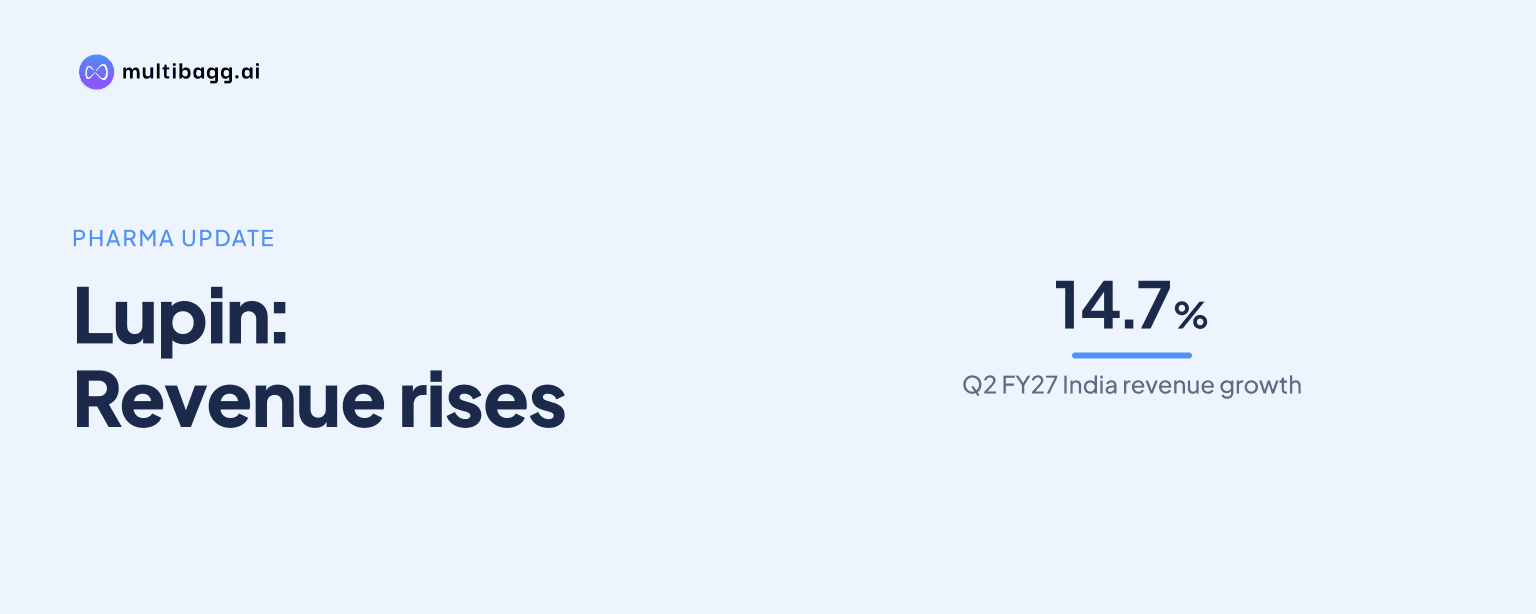
Lupin Limited reported 14.7% year-on-year growth in its India business in Q2 FY27, with domestic revenue reaching ₹2,383.6 crore and diabetes sales rising more than 25%. The performance kept India among Lupin's faster-growing businesses despite a slower respiratory portfolio and some moderation in cardiac therapies.
Know Lupin inside out
Results, valuation, peers and who's buying, in one view.
What drove Lupin's India business growth in Q2 FY27?
Lupin's India business grew 14.7% year on year during the quarter ended September 30, 2026. Its core prescription business rose 13.8%, supported by 6.1% volume growth. The company reported India sales of ₹2,383.6 crore, compared with ₹2,077.7 crore in the corresponding quarter of the previous year.
The domestic business contributed to Lupin's consolidated revenue growth of 11% for the quarter. Total revenue from operations including other income stood at ₹7,827 crore, against ₹7,048 crore a year earlier. Management said India and other developed markets supported double-digit organic growth across the company.
The quarterly result came amid differing growth rates across therapy areas. Chief Financial Officer Ramesh Swaminathan said the respiratory portfolio, referred to as the Restfree segment in the call discussion, remained slow. He also pointed to a slight slowdown in cardiac therapies, which affected the pace of prescription-business expansion.
Why did the prescription business trail Lupin's earlier market-outperformance goal?
The prescription business grew at roughly 1.1 times the Indian Pharmaceutical Market in the first half, below Lupin's stated 1.2 times to 1.3 times target. Management attributed the gap primarily to weak respiratory demand and a modest slowdown in cardiac, rather than broad weakness across the India portfolio.
For the first half of FY27, the core prescription business expanded 14.4%. This was still ahead of the reported India market growth reference of 17.2% for the chronic segment comparison, but it did not meet the company's intended relative growth range for its prescription portfolio. The performance shows how a few large therapy areas can influence the overall domestic growth rate even when selected categories remain strong.
Management expects a better second half, citing the typical seasonal strength of H2 and planned product launches. Swaminathan reiterated the company's objective of growing 20% to 30% ahead of the market over time. That outlook remains management guidance, while the reported Q2 result reflected slower respiratory and cardiac demand.
Which therapy segments supported Lupin's domestic performance?
Chronic therapies and diabetes were the principal sources of strength in Lupin's India portfolio. The India chronic segment grew 19.5% in H1 FY27, exceeding the 17.2% growth cited for the Indian Pharmaceutical Market's chronic segment over the same period.
Chronic therapies accounted for about 66% of Lupin's domestic portfolio in H1, compared with 65% in FY26. The higher share indicates that the company is becoming more weighted towards recurring-treatment categories, where prescriptions are generally linked to longer-duration conditions.
Diabetes was the standout therapy area during Q2. Sales in the segment increased more than 25% year on year, marking the third consecutive quarter in which growth exceeded 20%. This momentum helped offset the weaker respiratory portfolio and slower cardiac growth cited by management.
Got a follow-up? Ask IRIS
How did India compare with Lupin's other Q2 FY27 markets?
India outgrew Lupin's consolidated revenue base in Q2 FY27, expanding 14.7% against 11% growth in total revenue from operations including other income. The United States business grew 9.3%, while other developed markets increased around 46% and the active pharmaceutical ingredients business rose about 20%.
Emerging markets declined 4% year on year, highlighting the value of the domestic business as a relatively steady contributor to the company's diversified revenue base. Lupin said it is continuing to invest in building scale in India while also pursuing specialty capabilities in Europe and biosimilar opportunities in the United States.
Profitability was affected by competitive pressure in some key US products. EBITDA stood at ₹1,957.4 crore, representing a 25.1% margin, while net profit was ₹1,155.3 crore, lower than ₹1,484.8 crore a year earlier. Other operating income declined 81% to ₹42 crore, which the company linked mainly to lower export benefits under production-linked incentive schemes.
What does the Q2 result mean for Lupin investors and the India pharmaceutical market?
The Q2 result shows that Lupin's domestic growth remains supported by volume expansion and a rising mix of chronic therapies, particularly diabetes. India revenue growth of 14.7% exceeded the company's consolidated growth rate, making the market an important operational anchor while parts of the international business faced competition or lower demand.
For investors, the key issue is whether respiratory recovery, cardiac improvement and new launches allow the prescription business to return to the 1.2 times to 1.3 times Indian Pharmaceutical Market growth objective. The second-half outlook is based on management's expectation of seasonal strength and launch-led support, not on a confirmed acceleration in the reported Q2 numbers.
The broader industry context remains competitive. Lupin said it is investing in India capabilities even as it faces additional competition in US products and lower PLI-linked export benefits. Its ability to sustain growth in chronic therapies while addressing slower acute and cardiac categories will remain relevant to the domestic business mix.
Conclusion
Lupin's Q2 FY27 India performance was led by chronic therapies and diabetes, with domestic revenue rising 14.7% to ₹2,383.6 crore. Core prescription growth of 13.8% and volume growth of 6.1% showed continued expansion, although respiratory weakness and softer cardiac growth kept the business below its targeted market outperformance range in H1.
The next points to watch are the recovery of the respiratory and cardiac portfolios, the contribution from planned launches, and progress towards the company's 1.2 times to 1.3 times Indian Pharmaceutical Market growth objective. Management has also indicated that H2 is typically stronger and expects around 20% organic growth excluding the US market.