










Metropolis expects FY27 growth and margin momentum to persist
Key highlights
- Metropolis reported H1 FY27 revenue growth of 16.2% and EBITDA margin expansion of 190 basis points to 26.2%.
- Q2 FY27 EBITDA was Rs 135 crore and profit after tax was Rs 75 crore, up 24% and 43% year on year, respectively.
- Specialty and TruHealth each grew around 20% in Q2 FY27, versus 16% total revenue growth.
- Metropolis added 116 collection centres in Q2 FY27, taking net additions to 700 over 24 months.
powered by IRIS
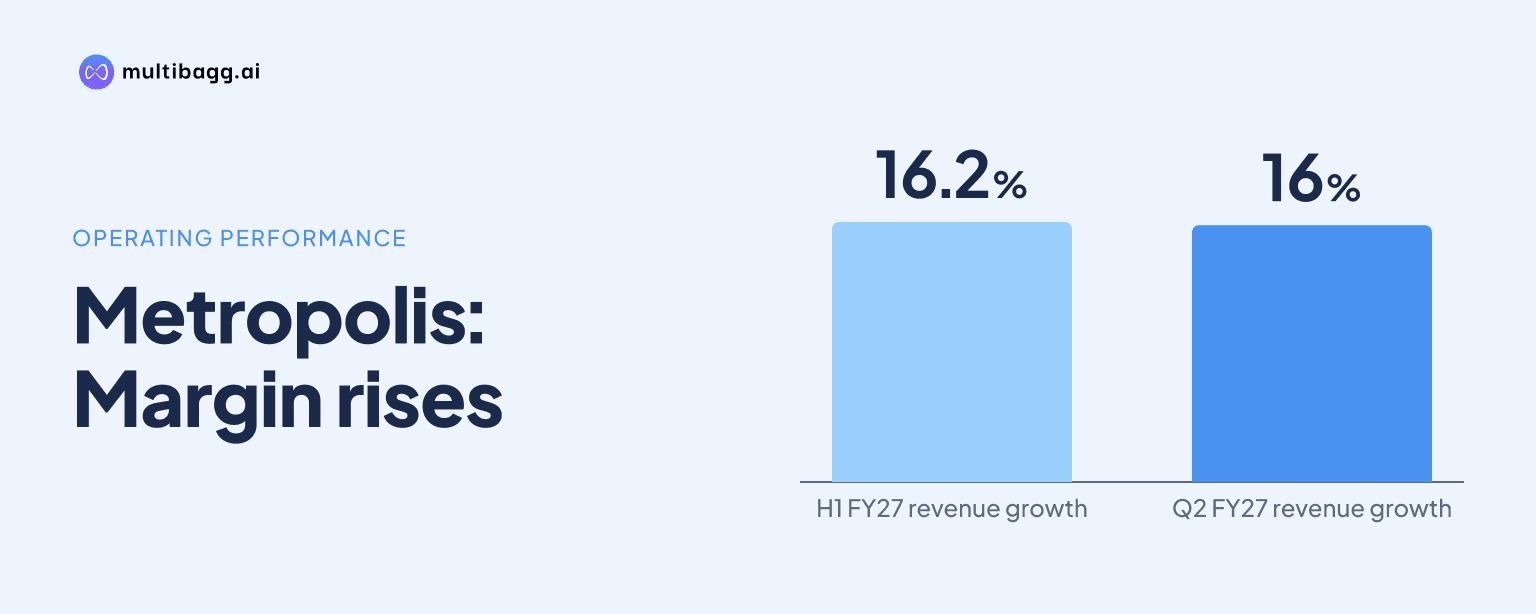
In the first half (H1) of financial year 2027 (FY27), Metropolis Healthcare Limited said it expects growth and margin momentum to persist after revenue rose 16.2% and earnings before interest, tax, depreciation and amortisation (EBITDA) margin expanded 190 basis points to 26.2%, despite monsoon rainfall being about 13% below normal.
Know Metropolis Healthcare inside out
Results, valuation, peers and who's buying, in one view.
What supports Metropolis’s FY27 growth outlook?
Metropolis’s outlook rests on a faster underlying growth rate, with H1 FY27 revenue growth of 16.2% exceeding its stated guidance and improving on the 12% to 13% organic annual growth delivered in each of the prior two years. Management said growth had increased to about 15% to 16% over the past four to six quarters through a denser collection-centre network, a richer mix of Specialty and TruHealth services, laboratory standardisation and technology upgrades.
The H1 performance was achieved without a price increase during the year and in a weak seasonal-disease environment. Management said monsoon rainfall was about 13% below normal and uneven across regions, resulting in sporadic demand for dengue, malaria, typhoid and viral-fever tests; Metropolis nevertheless reported growth of around 16%. Management said chronic-disease management, preventive care, specialty testing and network expansion increasingly support growth alongside seasonal testing.
Management expects similar revenue and margin trends through the second half rather than treating the second-quarter (Q2) outcome as a one-off. Its plan includes adding collection centres around existing laboratories, expanding business-to-business partnerships, improving retail productivity and extending basic radiology and other allied services. Metropolis added 116 collection centres in Q2 FY27, taking net additions to 700 over the past 24 months, while continuing to operate in 750 towns rather than add new laboratory locations.
Which businesses are driving Metropolis’s faster growth?
Metropolis’s business-to-consumer (B2C) channel and specialty-led offerings are the main reported growth drivers, while business-to-business (B2B) activity also expanded. B2C revenue rose 17% in both Q2 and H1 FY27, and B2B revenue increased 15% in Q2 FY27. Overall Q2 patient volumes grew 10% and test volumes 11%, with management attributing the balance of revenue growth to a richer test mix and better realisation rather than a tariff increase.
Specialty and TruHealth each grew around 20% in Q2 FY27, compared with 16% total revenue growth, making them faster-growing parts of the mix. Specialty accounted for 40% of Q2 revenue and TruHealth, Metropolis’s preventive-health franchise, contributed 17%. Metropolis added 43 specialty and super-specialty tests in H1 FY27, while packages combining radiology with doctor consultations, vital checks or electrocardiograms (ECGs) were gaining traction in TruHealth.
The North and smaller-town networks are another source of the reported broad-based performance. Tier 3 and rural centres grew revenue by around 20% and accounted for 26% of domestic revenue, while North India contributed around 17% following the Core Diagnostics, DAPIC and Scientific acquisitions. Management said DAPIC in Dehradun and Scientific in Agra were growing in line with the company average and delivering margins above the overall company margin, though it did not disclose their individual financial results.
Core Diagnostics has increased Metropolis’s access to oncology and genomics testing and is being used to cross-sell specialised tests across the wider network. Core was at breakeven when acquired about 1.5 years earlier and was delivering near-double-digit margins by the call date, according to management. Management estimated an internal rate of return (IRR) of about 13% on Core over the past year after including the acceleration in genomics, and said the return should rise in H2 as revenue and margins expand.
Got a follow-up? Ask IRIS
How does Metropolis plan to extend its margin expansion?
Metropolis plans to extend margins through volume-led operating leverage, laboratory-platform standardisation, network density and a more premium business mix. Q2 FY27 EBITDA was Rs 135 crore, up 24% year on year, and the EBITDA margin rose 180 basis points to 27.2%, ahead of management’s guidance range of 125 to 170 basis points. Profit after tax was Rs 75 crore, up 43%, with its margin increasing 290 basis points to 15.2%.
Management said employee numbers have remained broadly stable for several quarters while test volumes rose around 10% to 11% year on year, increasing productivity per employee. It also said samples processed per laboratory per day had increased, spreading fixed costs over more tests. The laboratory-platform transition, which standardises the test menu, equipment, reagents and turnaround times and consolidates vendors, is scheduled for completion in Q3 FY27 and is expected by management to support gross margins.
Network design is central to the operating-leverage plan. Metropolis aims to increase its collection-centre-to-laboratory ratio from 24:1 towards 30:1 and then 35:1 over the next two years, adding spokes around established labs rather than duplicating laboratory fixed costs. Management also cited Specialty, genomics and TruHealth as growing shares of revenue that can support mix, while B2B test volumes increased 11% against 7% patient-volume growth, indicating more tests per referred patient.
Technology projects are part of the second-half productivity programme. Metropolis plans to roll out a customer relationship management platform, dynamic-pricing engine, field-sales application and enhanced smart laboratory information management system (SLIMS) integrations in H2 FY27. It is also deploying artificial intelligence in sample logistics, laboratory operations, report validation, customer engagement and quality processes, although management did not quantify expected savings from these initiatives.
Conclusion
Metropolis’s H1 FY27 result combined 16.2% revenue growth with a 190-basis-point EBITDA-margin expansion to 26.2%, compared with its earlier 12% to 13% organic annual growth range. The reported acceleration came from both B2C and B2B channels, with Specialty and TruHealth each growing around 20%, and was delivered without a price increase or a broad seasonal-disease surge.
The next markers are execution milestones management set for H2 FY27: completion of the laboratory-platform transition in Q3, continued collection-centre additions towards a 30:1 centre-to-lab ratio, and a possible calibrated price revision in Q4 for part of the business. Management said any revision would be determined by micro-market competition, market share, brand equity and higher transport, logistics and service costs.