










Metropolis targets 35:1 network density without new labs
Key highlights
- Metropolis added 116 collection centres in Q2 FY27, taking net additions to 700 over 24 months.
- Metropolis aims to lift its collection-centre-to-lab ratio from 24:1 to about 30:1 by FY27-end.
- Metropolis has stopped adding laboratories and is operating across 750 towns.
- Metropolis reported Q2 FY27 EBITDA margin of 27.2%, up 180 basis points year on year.
powered by IRIS
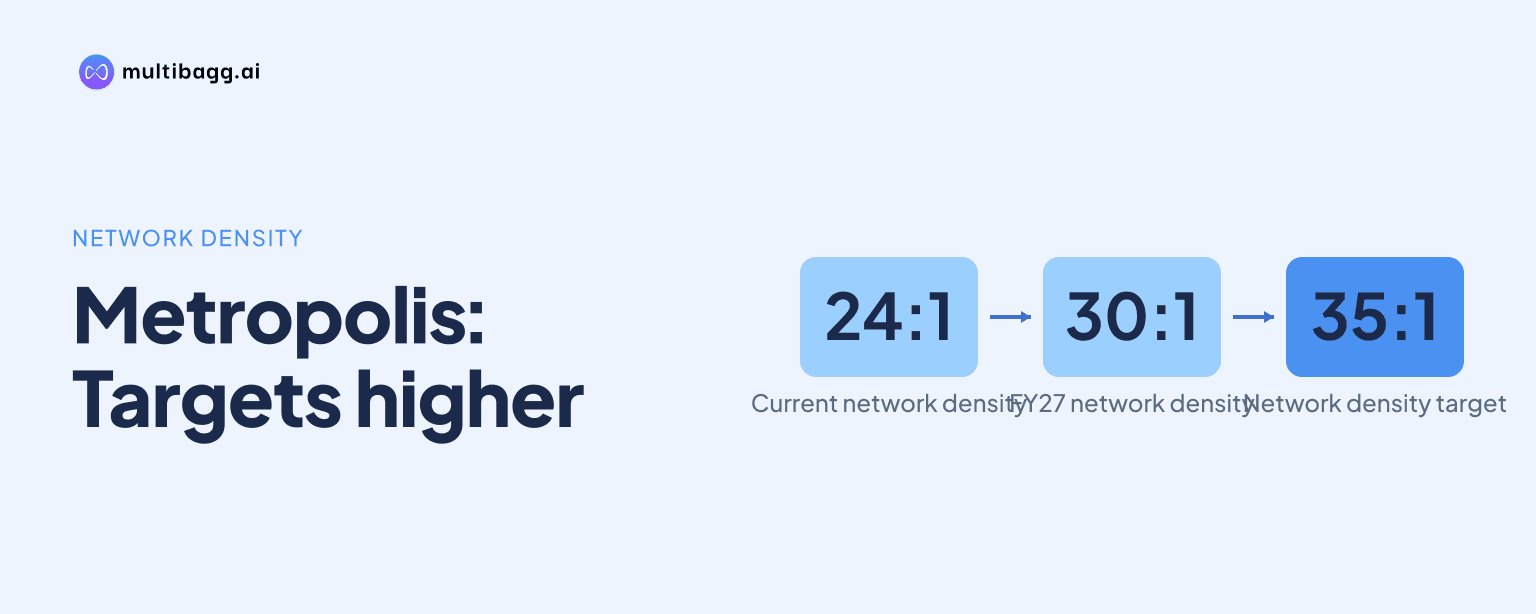
Metropolis is targeting a collection-centre-to-lab ratio of about 30:1 by FY27-end and 30:1 to 35:1 by the end of the following year, while adding no new laboratories or towns. Management said the plan builds sample throughput within its existing 750-town network, after 116 collection-centre additions in Q2 FY27.
Know Metropolis Healthcare inside out
Results, valuation, peers and who's buying, in one view.
Why is Metropolis not adding new labs?
Metropolis has stopped adding laboratories and will instead add collection centres within the 750 towns where it already operates. Management said this holds the number of labs constant while increasing the number of collection points, lifting the collection-centre-to-lab ratio each quarter without entering further markets.
The company added 116 collection centres in Q2 FY27, taking net additions to 700 over the preceding 24 months. Labs established in FY25 and FY26 are gaining traction, according to management, and additional collection spokes are intended to send more samples to those facilities rather than require separate labs.
The second-half plan combines centre additions around newer labs with coverage of peripheral areas, mini hubs, basic radiology and allied services. Management linked these measures to faster business-to-business, or B2B, partner additions, higher retail productivity and better turnaround times, which is the time taken to deliver a test result.
How quickly is Metropolis raising its centre-to-lab ratio?
Metropolis is targeting a move from 24:1 currently to close to 30:1 by FY27-end, followed by a 30:1 to 35:1 range by the end of the following year. Management described the target as a density programme within existing markets, rather than a disclosed plan to add labs or expand beyond 750 towns.
Existing centres delivered 10% same-store growth in Q2 FY27, while newer centres continued to ramp up. The company is therefore seeking growth from both additional collection points and higher activity at established locations, which can increase sample volumes through its laboratory base.
The 35:1 level is not an immediate target under management's timetable. The nearer milestone is approximately 30:1 by FY27-end, and progress depends on continued additions in current geographies as well as the retention of collection and B2B partners.
How does MetLink help Metropolis retain collection partners?
MetLink supports Metropolis's density strategy by helping retain partners that operate within its collection network. Management said partner churn had fallen to low single digits after about 18 months of the programme, compared with close to double digits in the past.
The MetLink portal provides partners with the test menu, prices, account statements, daily numbers, target-versus-actual performance and information on incentives. Management also cited quarterly and annual partner engagement, describing the programme as a way to improve ease of doing business and help partners remain in the network.
Metropolis's B2B partner network crossed 9,000 in Q2 FY27. B2B revenue rose 15%, while patient volume grew 7% and test volume increased 11%, indicating that partners sent more tests per patient during the quarter, according to management.
Higher partner retention and greater testing per patient can support laboratory utilisation without geographical expansion. Management specifically linked stable partners and rising volumes in Tier 2 and Tier 3 markets to improvement in the centre-to-lab ratio and the wider collection network.
Got a follow-up? Ask IRIS
What operating leverage is Metropolis seeking from density?
Metropolis expects network density to increase samples processed per lab and spread fixed laboratory costs over higher volumes. Management said daily samples processed per lab have increased while the manpower base has remained broadly stable for several quarters, despite 10% to 11% year-on-year test-volume growth.
Q2 FY27 revenue increased 16% year on year, while earnings before interest, tax, depreciation and amortisation, or EBITDA, margin expanded 180 basis points to 27.2%. Management attributed the change to volume-led operating leverage, cost management and productivity measures, rather than to a price increase.
For H1 FY27, revenue grew 16.2% and EBITDA margin expanded 190 basis points to 26.2%. Management contrasted that revenue growth with the 12% to 13% delivered in recent years, saying the improvement reflected operating leverage as volumes rose across the network.
Density is one part of the margin plan. Management said its laboratory platform transition, covering common test menus, equipment, reagents, turnaround times and vendor consolidation, would be completed in Q3, while Specialty, genomics and TruHealth are expected to contribute to a richer test mix.
Which demand segments are filling Metropolis's existing labs?
Metropolis is relying on Tier 3 and rural centres, B2B partnerships, Specialty testing and TruHealth preventive care to increase utilisation of its existing labs. Tier 3 and rural centres generated about 20% revenue growth in Q2 FY27 and accounted for 26% of domestic revenue.
Specialty revenue grew about 20% in Q2 FY27, supported by advanced-test adoption, clinician engagement and cross-selling of Core's oncology portfolio. Metropolis added 43 specialty and super-specialty tests in H1 FY27, providing a larger test menu for its network of centres and partners.
TruHealth also grew 20% in Q2 FY27 and contributed 17% of revenue. Management said radiology-inclusive packages, doctor consultations, vital checks and electrocardiogram add-ons are intended to improve prescription completion at its own centres and mature franchisee network.
B2C revenue rose 17% and B2B revenue increased 15% in Q2 FY27, while patient volumes grew 10% and test volumes rose 11%. Management said the balance of revenue growth came from richer mix and better realisation, and noted that the last price increase was in January 2025.
Conclusion
Metropolis is shifting network expansion from new towns and laboratories to denser collection coverage around its current lab base. The plan is supported by 700 net collection-centre additions over 24 months, 10% same-store growth in Q2 FY27, lower partner churn and rising samples processed per lab, all of which management associates with operating leverage.
The next measures to watch are the approximately 30:1 ratio targeted by FY27-end, completion of the laboratory platform transition in Q3 and the proposed calibrated B2C price revision in Q4 for part of the business. Management will also need to sustain collection-centre additions and low-single-digit partner churn to approach the 30:1 to 35:1 range in the following year.