










Metropolis Insta60 fulfils almost all Mumbai 60-minute visits
Key highlights
- Metropolis said Insta60 fulfilled requested 60-minute Mumbai visits in almost 100% of cases.
- Metropolis reported equal enthusiasm for Insta60 following its Chennai launch.
- Metropolis plans to launch Insta60 in Bengaluru in the first week of November.
- Metropolis operates in 750 towns and targets a centre-to-lab ratio of close to 30 by year-end.
powered by IRIS
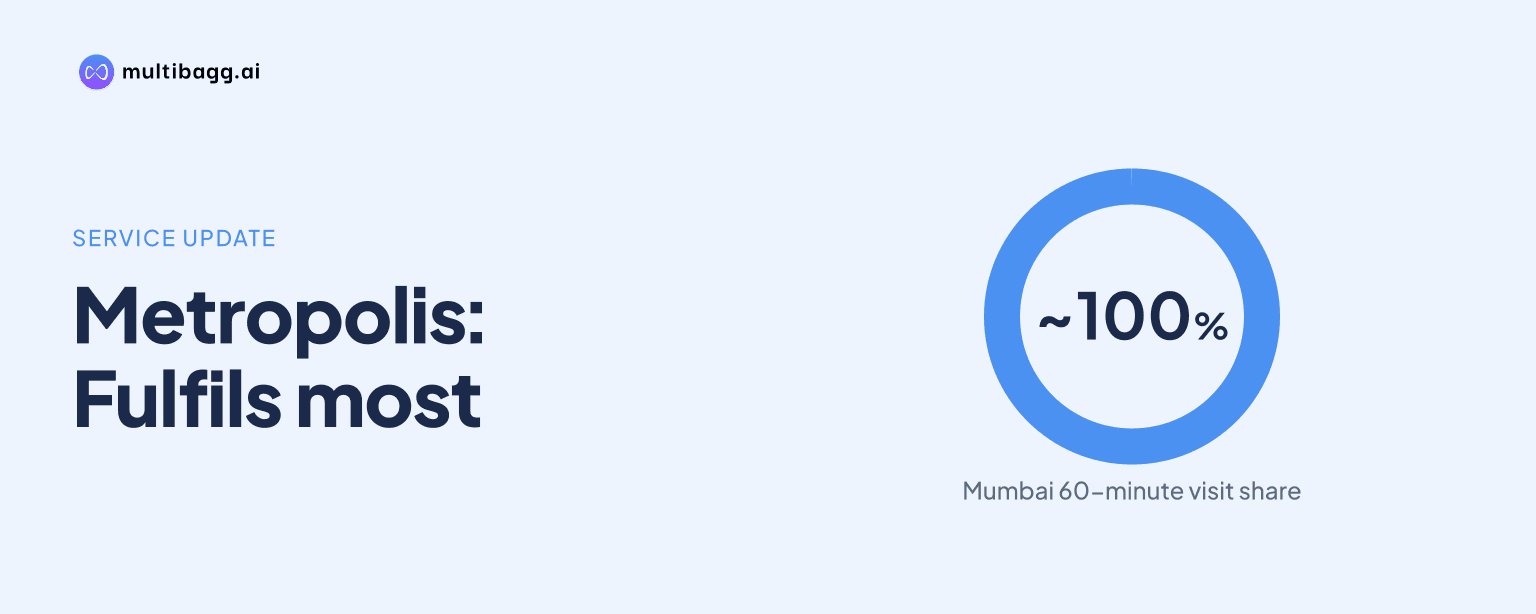
Metropolis said its Insta60 home-sample collection service fulfilled requested 60-minute visits in almost 100% of Mumbai cases, found equal enthusiasm after launching in Chennai, and planned a Bengaluru rollout in the first week of November. Management said its physical-centre network could support the faster service without necessarily raising costs.
Know Metropolis Healthcare inside out
Results, valuation, peers and who's buying, in one view.
How is Metropolis Insta60 performing in Mumbai and Chennai?
Metropolis said Insta60 has received good traction in Mumbai, its first launch market, and that it could meet the requested 60-minute home-visit commitment in almost 100% of cases. Management said it had initially expected health services to be planned a day in advance, but found that customers also wanted a faster home-collection option. The service is designed to arrange a sample-collection visit within 60 minutes of a request.
Metropolis launched Insta60 in Chennai after Mumbai and said the response showed equal enthusiasm. The company did not disclose booking volumes, tests collected, revenue, customer counts or city-level fulfilment data for Chennai. The comparison is therefore qualitative: Mumbai has the disclosed almost-100% fulfilment outcome, while Chennai has management’s statement of a similarly positive customer response.
The Mumbai result describes service availability rather than financial contribution. A 60-minute home visit requires an available collection slot, a collector, a customer location and an application that can handle an immediate request. Metropolis said its operations could serve nearly all Mumbai requests at the current scale, but did not provide the average arrival time, cancellations, failed bookings or performance during peak-demand periods.
Management’s reference to quick commerce explained the demand pattern it observed after launch. It said customers appeared to value rapid service in diagnostics as well as in other consumer categories. However, Metropolis did not say whether Insta60 customers purchased more tests, paid a different price or shifted bookings from its standard home-collection service.
When will Metropolis launch Insta60 in Bengaluru?
Metropolis said it would launch Insta60 in Bengaluru in the first week of November. Bengaluru will follow Mumbai and Chennai in the service’s disclosed city sequence. Management did not give a specific launch date, define the Bengaluru service area or set a target for bookings, collection staff or revenue from the new city.
The planned rollout is a city-by-city expansion, not a disclosed nationwide timetable. Metropolis said the service was gaining visibility after the Mumbai and Chennai launches, but it did not forecast the pace of further additions. The immediate milestone is therefore the Bengaluru launch, while the subsequent test will be whether the service can sustain fulfilment and demand outside Mumbai.
Metropolis linked the operating model to its wider network. It said it had stopped adding laboratories and was operating in 750 towns, while continuing to add collection centres in those existing markets. This approach raises the number of centres while the number of laboratories remains unchanged, which management said was lifting the centre-to-lab ratio each quarter.
Management said it aimed to take the centre-to-lab ratio to close to 30 by the end of the year and to a 30:1 to 35:1 range by the end of the next year. These targets apply to the broader collection network rather than specifically to Insta60 or Bengaluru. Still, the network strategy provides the context for management’s view that urgent home collection can draw on an established physical footprint.
Got a follow-up? Ask IRIS
Can Metropolis operate Insta60 without higher costs?
Metropolis said Insta60 is not necessarily more costly than its earlier one-day home-collection model because it can use resources across branches, brick-and-mortar centres and home services. Management said the service depends on reserving suitable slots, planning routes and configuring applications for immediate customer requests. It did not disclose per-visit costs, incremental capital expenditure or a direct margin comparison.
Management contrasted its omnichannel model with a pure home-visit model. It said a provider limited to home visits may need to add people whenever it expands a route, whereas Metropolis can deploy resources through multiple channels. This was management’s explanation of the cost mechanism, not a reported saving or a quantified improvement in unit economics.
Metropolis also agreed that the service could improve productivity per resource. The potential comes from using the same physical network and collection resources for conventional appointments as well as rapid bookings. Management did not provide collection-agent headcount, visits per employee, staff utilisation or a productivity target, so the possible benefit remains an expectation.
The service’s almost-100% Mumbai fulfilment rate shows that slots were generally available for requested urgent visits. It does not establish whether those available slots carried idle-time costs or whether Insta60 has higher, lower or unchanged profitability. Future disclosures on fulfilment outside Mumbai, booking density and costs would be needed to measure the economics of the model.
Does Metropolis Insta60 create new customer growth?
Metropolis said most current Insta60 users are existing customers seeking superior service, but it is also finding new customers. Management said it expected the programme to bring more new customers as it continued. It did not disclose the proportion of new users, repeat-booking rates, acquisition costs or the share of bookings transferred from standard home collection.
The current evidence points to two uses for Insta60: a faster option for the existing customer base and a potential acquisition channel. The first is supported by management’s statement that most users are existing customers; the second rests on its observation that new customers are already using the service. The company did not quantify how much of the resulting demand is incremental.
Metropolis is also pursuing network productivity through its MetLink partner programme. After 18 months of implementation, management said partner churn had fallen to low single digits from close to double digits in the past. MetLink allows partners to view test menus, prices, account statements, daily performance, targets and incentive programmes.
The MetLink result concerns franchise and collection-centre partners rather than Insta60, but it illustrates a separate method for retaining access points in existing markets. Management said greater partner retention, more centres and growing volumes in Tier 2 and Tier 3 markets were supporting volume growth. Insta60 adds a rapid home-service format to that broader access strategy, with its financial effect still undisclosed.
Conclusion
Metropolis has reported early operating traction for Insta60 rather than quantified financial impact. Its clearest indicator is the ability to meet requested 60-minute Mumbai visits in almost 100% of cases, alongside equal enthusiasm in Chennai. Management’s thesis is that an omnichannel network can deliver rapid home collection while sharing people and physical infrastructure across branches, centres and home services.
The next disclosed event is the Bengaluru launch in the first week of November. Management has not set booking, revenue or profitability targets for Insta60, so the key matters to watch are fulfilment in Bengaluru, the mix of new versus existing customers, resource productivity and whether the wider 750-town network moves toward its targeted centre-to-lab ratio of close to 30 by year-end.