










Metropolis says NMC advisory can speed Tier-3 expansion
Key highlights
- Metropolis said Tier-3 and rural centers grew revenue by about 20% in Q2 FY27 and contributed 26% of domestic revenue.
- Metropolis reported H1 FY27 revenue growth of 16.2% and EBITDA margin expansion of 190 basis points to 26.2%.
- Metropolis added 116 collection centers in Q2 FY27, taking net additions to 700 over the preceding 24 months.
- Specialty revenue grew about 20% in H1 FY27, and Metropolis added 43 specialty and super-specialty tests.
powered by IRIS
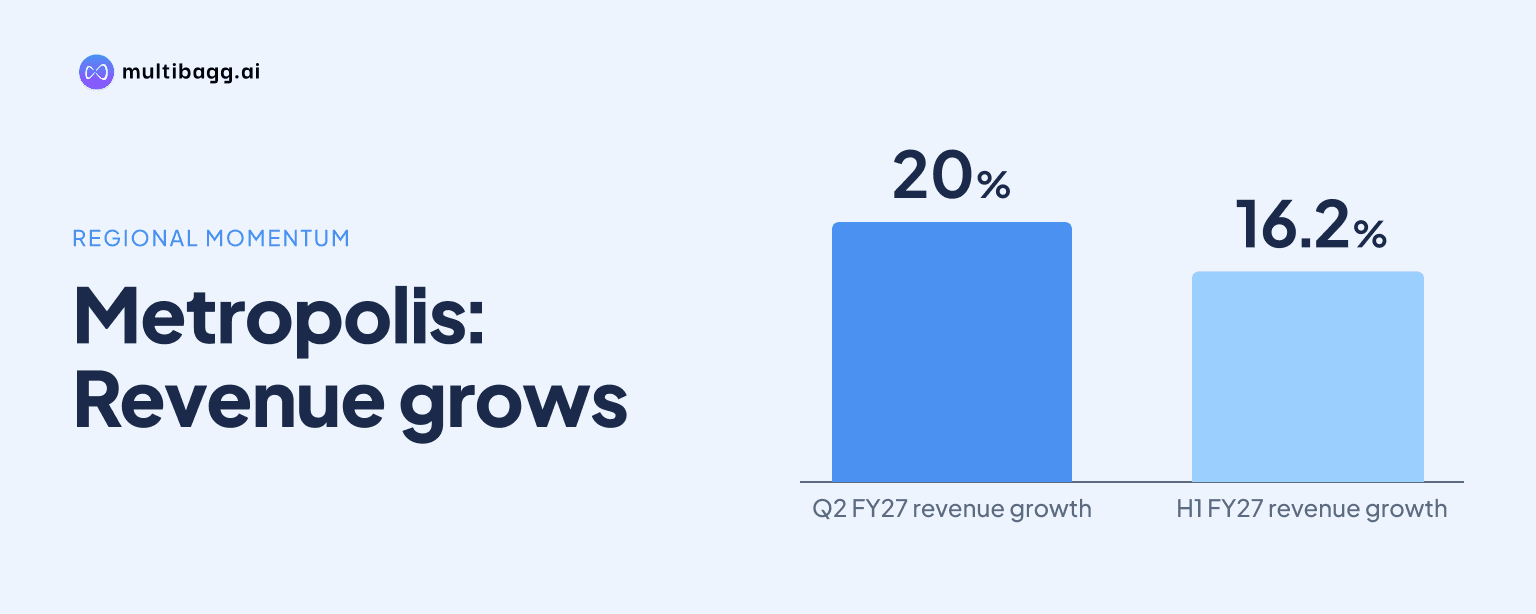
Metropolis Healthcare Limited said the National Medical Council Commission, or NMC, advisory allowing remote digital authorization of reports could speed mini-lab expansion in smaller towns, where its Tier-3 and rural centers grew revenue by about 20% in Q2 FY27 and accounted for 26% of domestic revenue.
Know Metropolis Healthcare inside out
Results, valuation, peers and who's buying, in one view.
What did the NMC advisory change for Metropolis?
The NMC advisory clarified that a registered medical practitioner can remotely review and authenticate laboratory and pathology reports with a recognized digital signature, subject to safeguards, according to Metropolis. Management said this permits a qualified pathologist to exercise independent professional judgment without being physically located at every smaller-town laboratory.
Metropolis said its laboratory information systems retain complete audit trails, authentication logs, timestamps and signing credentials for every report. Management said those records allow the company to route a case to an appropriate specialist in its network rather than rely only on the professional available at the local processing site.
How could remote authorization support diagnostic quality?
Remote authorization could allow Metropolis to direct complex reports to centrally located specialists while maintaining qualified-pathologist review of every report. Management said a complex hematology or oncology case from a small town could be reviewed at its Bombay reference laboratory with the same stated rigor as a case processed there.
The model centralizes specialist talent rather than removing professional oversight, management said. This matters to Metropolis’s Specialty segment, which grew about 20% in H1 FY27, supported by advanced-test adoption, clinician engagement and cross-selling of Core’s oncology portfolio across its network.
Management also said central specialist support could improve turnaround time, or TAT, and enable round-the-clock reporting at mini labs. The transcript did not disclose a current TAT, target TAT, planned implementation date or the number of locations expected to use remote authorization.
Why does the NMC advisory matter for Tier-3 expansion?
The advisory matters because access to qualified pathologists on site has constrained diagnostic expansion in smaller towns, Metropolis said. Management said remote authorization could help it establish mini labs faster in rural and Tier-3 markets by supporting them through a central pool of pathologists.
The company already has material exposure to these locations. Tier-3 and rural centers led Metropolis’s geographic performance with about 20% revenue growth in Q2 FY27 and contributed 26% of domestic revenue, while business-to-consumer, or B2C, revenue grew 17% in both Q2 and H1 FY27.
Metropolis is also extending the collection network that feeds its laboratories. It added 116 collection centers in Q2 FY27, taking net additions to 700 over the preceding 24 months. Its stated H2 FY27 priorities include faster center additions around newer labs, deeper coverage in existing markets, mini hubs closer to patients and business-to-business, or B2B, partner additions focused on specialty testing.
Got a follow-up? Ask IRIS
What operating performance supports Metropolis’s expansion plan?
Metropolis reported H1 FY27 revenue growth of 16.2%, compared with organic annual growth of about 12% to 13% over the prior two years. Earnings before interest, tax, depreciation and amortization, or EBITDA, margin expanded by 190 basis points to 26.2% in H1 FY27, which management said occurred without a price increase during the year.
In Q2 FY27, patient volumes rose 10% and test volumes increased about 11%, with the balance of revenue growth coming from richer test mix and better realization, according to management. The company said the mix shift reflects growth in chronic disease management, preventive care and specialty testing rather than dependence on seasonal infectious-disease demand.
Metropolis’s B2B revenue grew 15% in Q2 FY27, while its B2B partner network exceeded 9,000 partners. Within B2B, patient volume rose 7% and test volume increased 11%, which management said meant partners were sending more tests per patient and using a broader part of its test menu.
Does the advisory change Metropolis’s pricing outlook?
The NMC advisory does not change diagnostic pricing, and Metropolis said hospital drug and consumable price-control discussions do not apply to its diagnostics business. Management said there was no move toward diagnostic price caps or price parity discussed on the November 4, 2026 earnings call.
Metropolis said its H1 FY27 revenue growth of 16.2% was achieved without a price increase. It also supported requirements to display rates at centers, saying patients already receive prices before service delivery and that the measure could reduce information gaps among providers.
Management characterized the wider regulatory setting as supportive of organized and compliant diagnostic providers because of its focus on quality, transparency and access. That is management’s assessment, and the transcript did not provide a quantified estimate of the NMC advisory’s revenue, market-share, margin or cost effect.
Conclusion
Taken together, the NMC advisory gives Metropolis a regulatory basis for using centrally located pathologists to support specialty reporting at smaller-market mini labs. That operating model aligns with the company’s existing digital audit controls and with Tier-3 and rural centers that generated about 20% revenue growth in Q2 FY27 while contributing 26% of domestic revenue.
The next disclosures to watch are Metropolis’s H2 FY27 plans for accelerated center additions, mini hubs, peripheral coverage around newer laboratories and specialty-focused B2B partnerships. Management has not disclosed how many locations will use remote authorization, a rollout timetable, or a TAT and productivity measure for the model.