










Monte Carlo cotton holds 63% of H1 FY27 product sales mix
Key highlights
- Monte Carlo reported cotton at 63% of its H1 FY27 product-sales portfolio, versus 15% for woollen.
- Monte Carlo’s cotton share rose to 63% in H1 FY27 from 55% in FY26.
- Monte Carlo’s footwear share increased to 2% in H1 FY27 from 1% in FY26.
- Monte Carlo’s H1 FY27 revenue rose 6.3% to Rs 411.4 crore while operating EBITDA fell 56.8% to Rs 15.42 crore.
powered by IRIS
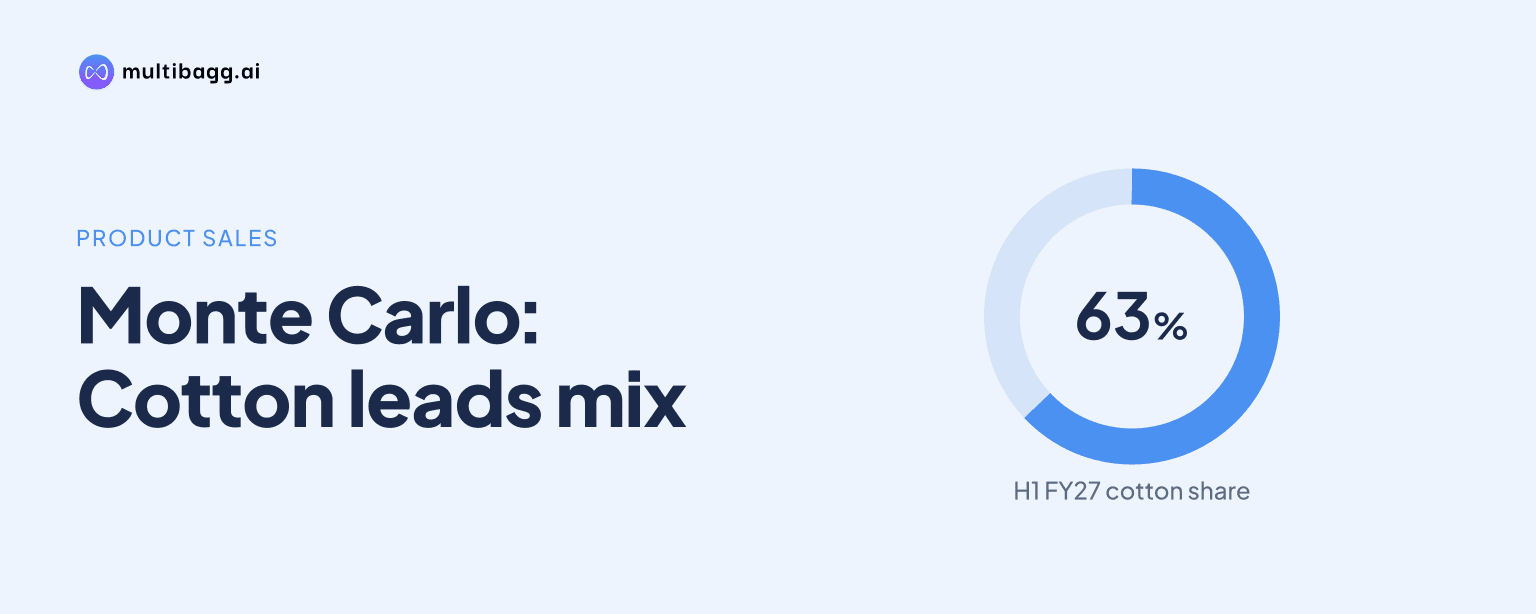
Monte Carlo Fashions Ltd reported cotton at 63% of its H1 FY27 product-sales portfolio, compared with 15% for woollen, making cotton its largest disclosed category. Cotton’s share was 55% in FY26, while woollen accounted for 28%, although the presentation provides shares rather than category sales values.
Know Monte Carlo Fashions inside out
Results, valuation, peers and who's buying, in one view.
How has Monte Carlo’s product mix changed?
Monte Carlo’s H1 FY27 product-sales mix shows cotton at 63%, followed by woollen and home textiles at 15% each, kids at 5% and footwear at 2%. Compared with FY26, cotton gained 8 percentage points, home textiles gained 5 points and footwear gained 1 point, while woollen declined by 13 points and kids declined by 1 point.
Monte Carlo has identified cotton as its largest reported category since FY22, so its prominence is not presented as a newly created business line. Cotton represented 55% of the mix in FY22 and FY24 and 59% in FY20, whereas woollen was 24% in FY22, 28% in FY24 and 28% in FY26. The H1 FY27 figures are a half-year snapshot, while the earlier comparisons are full financial years.
The disclosed change is a movement in portfolio shares, not evidence that woollen sales revenue fell. Monte Carlo does not provide category sales values for H1 FY27 or FY26, nor does it disclose volumes by category. A 15% woollen share in H1 FY27 therefore establishes a lower contribution to mix than FY26’s 28%, but cannot establish the direction of woollen revenue.
What products sit within Monte Carlo’s cotton category?
Monte Carlo classifies shirts, T-shirts, thermals, trousers, jackets and track-suits as cotton products, while woollen comprises sweaters, pullovers and cardigans. The 63% cotton figure consequently covers more than conventional summer apparel, because thermals and jackets can serve winter demand.
Home textiles, which represented 15% of the H1 FY27 portfolio, include bedsheets, towels, blankets and quilts. Monte Carlo explicitly says its categories do not measure summer and winter demand because cotton includes jackets and home textiles include blankets and quilts. Adding the 15% woollen share alone would therefore understate the product range connected with cold-weather purchases.
Monte Carlo sells its assortment through five brands and collections: Monte Carlo, Rock.it, Cloak & Decker, Luxuria and Monte Carlo Home. The core Monte Carlo label covers men’s, women’s and kids collections; Rock.it covers athleisure and casual clothing; Cloak & Decker is value clothing; Luxuria is a premium-tier collection; and Monte Carlo Home includes blankets and quilts.
Why is cotton the largest category despite Monte Carlo’s winterwear heritage?
Monte Carlo’s brand began in 1984 through Oswal Woollen Mills’ move into branded knitwear, and its woollen heritage remains part of its identity. The company expanded into summer wear in 2002, opened its first exclusive Monte Carlo store in 2005 and introduced home textiles and kids in 2012, establishing a broader range before H1 FY27.
The company says the same brand, retail relationships and textile capabilities now support apparel and home products beyond winterwear. Its 506 exclusive brand outlets, or EBOs, provide the retail network for that wider assortment, while an agent-led order and prebooking process connects collections with dealers and franchise relationships.
Cotton’s reported share has remained around the mid-50s for several years before reaching 63% in H1 FY27. The increase from 55% in FY26 is therefore a shift within an established cotton-led portfolio rather than proof that the company has moved away from its woollen origins. Monte Carlo’s presentation gives no category-level revenue or margin data to identify the financial contribution of each category.
Got a follow-up? Ask IRIS
What did Monte Carlo report for H1 FY27 financial performance?
Monte Carlo reported H1 FY27 revenue of Rs 411.4 crore, up 6.3% from Rs 387.2 crore in H1 FY26, while operating EBITDA fell 56.8% to Rs 15.42 crore from Rs 35.66 crore. EBITDA means earnings before interest, tax, depreciation and amortisation. Management attributed the decline in operating profitability to higher material and employee costs.
Monte Carlo recorded a net loss of Rs 22.3 crore in H1 FY27 and said lower other income added to earnings pressure. The company notes that the first half includes stock preparation and retailer dispatches ahead of winter, meaning the H1 revenue increase occurred during a period shaped by seasonal inventory and dispatch activity.
In Q2 FY27, revenue was Rs 262.4 crore, up 5.5% from Rs 248.7 crore in Q2 FY26. Operating EBITDA was Rs 28.4 crore, compared with Rs 41.5 crore a year earlier, and the operating EBITDA margin was 10.80% versus 16.70%. The quarterly and half-year figures both show revenue growth alongside lower operating EBITDA.
What should readers watch after H1 FY27?
Monte Carlo said retailer returns were processed early in Q1 FY27 and had expected the effect to reverse over the next two quarters. Its H1 FY27 update said Q2 returns were lower, neutralising the higher Q1 returns, and that returns for H1 FY27 were similar year on year. Subsequent disclosures can show whether this return pattern continues.
Management said agreements with Big Basket had been signed and sales would commence in Q3 FY27. Monte Carlo was already live on Blinkit, Swiggy and Zepto when it gave the update. The presentation does not state a sales target, revenue contribution or profitability forecast for quick commerce.
Monte Carlo’s stated next stage is to grow within its existing range and reach more customers, rather than launch a newly disclosed category. Footwear’s share rose from 1% in FY26 to 2% in H1 FY27, but the company supplies no standalone footwear sales value, volume or growth rate. Further expansion across regions is described as an opportunity from the 506-EBO base.
Conclusion
Monte Carlo’s H1 FY27 mix identifies cotton as the main reported category at 63%, ahead of woollen and home textiles at 15% each. The comparison with FY26 shows cotton’s share rising by 8 percentage points and woollen’s share falling by 13 points, but the absence of category sales values means the data do not demonstrate a decline in woollen revenue. At the company level, H1 revenue rose 6.3% to Rs 411.4 crore while operating EBITDA fell 56.8% to Rs 15.42 crore.
The next disclosed event is the commencement of Big Basket sales in Q3 FY27, alongside management’s plan to extend reach within the existing range. Readers can also watch future updates on retailer returns after the early-Q1 FY27 processing effect, as well as whether the larger cotton mix and small footwear category translate into disclosed revenue or profitability changes.