










Monte Carlo net debt rose to Rs 30.20 crore in H1 FY27
Key highlights
- Monte Carlo’s net debt excluding leases rose to Rs 30.20 crore at Sep-26 from Rs 7.42 crore at Mar-26.
- H1 FY27 working-capital outflow was Rs 20.069 crore, Rs 52.4 lakh below H1 FY26.
- Inventory outflow increased by Rs 2.877 crore in H1 FY27, offset by receivables and payables movements.
- FY26 year-end working-capital days fell to 146 from 176 in FY25.
powered by IRIS
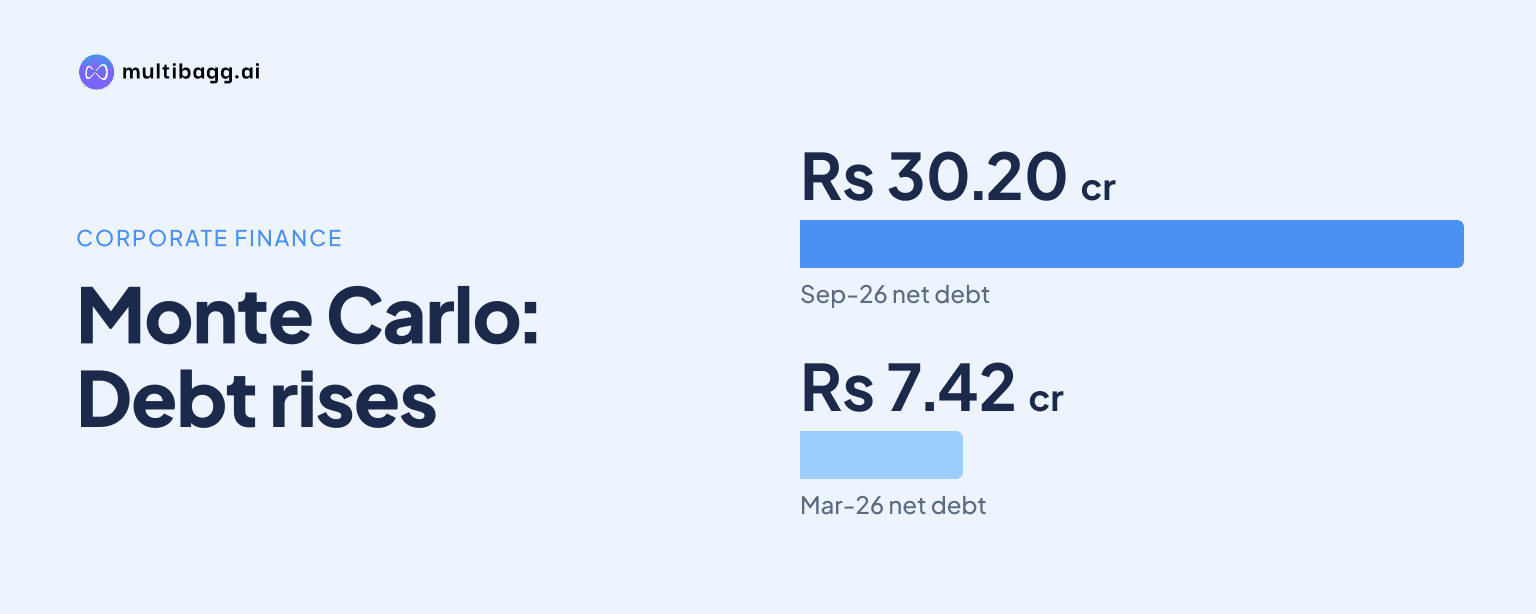
Monte Carlo reported net debt excluding leases of Rs 30.20 crore at Sep-26, up from Rs 7.42 crore at Mar-26, as H1 FY27, the first half of FY27, absorbed Rs 20.069 crore in seasonal working capital. Management attributed the increase to the stock build before winter demand and expects second-half collections to moderate debt.
Know Monte Carlo Fashions inside out
Results, valuation, peers and who's buying, in one view.
Why did Monte Carlo’s net debt rise in H1 FY27?
Monte Carlo’s net debt rose because seasonal working-capital requirements increased before the winter selling period. Net debt excluding leases increased by Rs 22.78 crore from Rs 7.42 crore at Mar-26 to Rs 30.20 crore at Sep-26. Management specifically attributed the Sep-26 balance to seasonal working-capital build-up rather than identifying a separate driver for the increase.
The Sep-26 balance was also higher at the same point a year earlier. Net debt excluding leases stood at Rs 22.12 crore at Sep-25, making the Sep-26 figure Rs 8.08 crore higher year on year. The presentation also shows net debt of Rs 58 lakh at Mar-25, followed by the Sep-25 seasonal rise and a reduction by Mar-26.
The sequence indicates that debt increased during the first half in both years, then reduced by the following March in the FY26 cycle. That historical movement provides context for management’s stated expectation that H2 collections will moderate the Sep-26 balance, although the presentation gives no numerical H2 FY27 debt target.
How did Monte Carlo’s H1 FY27 working-capital outflow compare with last year?
Monte Carlo’s H1 FY27 working-capital outflow was Rs 20.069 crore, Rs 52.4 lakh lower than the Rs 20.593 crore outflow in H1 FY26. The year-on-year reduction means aggregate seasonal cash absorption was lower even though net debt at Sep-26 exceeded the prior September balance by Rs 8.08 crore.
Inventory was the offsetting component in the comparison. Monte Carlo said inventory outflow increased by Rs 2.877 crore in H1 FY27, while stronger movements in receivables and payables offset this increase. The presentation does not provide either the total H1 FY27 inventory outflow or individual receivables and payables amounts.
The disclosed cash-flow comparison and the debt comparison measure different points in the cycle. Working-capital outflow covers H1 activity, while net debt is a Sep-26 balance. Monte Carlo does not provide a reconciliation connecting the Rs 20.069 crore outflow to the Rs 30.20 crore net-debt figure or allocating the balance among inventory, other working capital and capital expenditure.
Why does Monte Carlo build working capital before winter?
Monte Carlo builds stock ahead of a winter-led sales period in which Q3 accounted for 47% of FY26 revenue, compared with 45% in FY25. The October-to-December quarter therefore represented the largest disclosed quarterly share of annual revenue in FY26, and the presentation describes winter as contributing nearly half of annual sales.
The seasonal timeline places winter order booking, production and stock build before consumer sell-through, with retailer dispatches occurring before the main winter demand period. This operating sequence explains the H1 inventory cash requirement and management’s expectation that collections in H2, after winter sales, will reduce the Sep-26 debt build.
Monte Carlo reported an approximate 47:53 seasonal revenue split in FY26, with 47% in Q3 and 53% across the rest of the year. Management stated an ambition to move towards a 50:50 split in two to three years. That ambition is a stated management objective, not a forecast of FY27 revenue or collections.
Got a follow-up? Ask IRIS
What other capital uses did Monte Carlo disclose?
Monte Carlo disclosed about Rs 3.316 crore of H1 capital expenditure, primarily for warehousing and plant upgrades. The presentation lists this expenditure separately from seasonal working capital, and does not state that it was spent on the 13 exclusive brand outlet additions disclosed for Q2 FY27.
The company also identified about Rs 15 crore for a solar special-purpose vehicle subsidiary, with an estimated capacity of about 50 megawatts direct current. This is a disclosed capital-allocation item, but the presentation does not specify its funding source, timing of expenditure, project completion date or effect on future net debt.
At Sep-26, Monte Carlo reported treasury investments of Rs 30.94 crore. It also reported an FY26 dividend of Rs 20 per share, equivalent to about 37% of profit after tax. These figures sit alongside the Rs 30.20 crore net-debt measure, but the presentation does not provide a consolidated cash-flow bridge across treasury, dividends, capital expenditure and working capital.
Has Monte Carlo improved working-capital efficiency and store productivity?
Monte Carlo reported 146 working-capital days at FY26 year-end, down 30 days from 176 in FY25. The FY26 result also improved on 169 days in FY23 and 158 days in FY24, reaching the lowest level in the four financial years shown in the presentation.
This year-end measure should be distinguished from the Rs 20.069 crore H1 FY27 outflow. Working-capital days describe the year-end position, while the H1 outflow reflects cash absorbed before the winter selling period. The FY26 reduction therefore does not remove the seasonal need to fund inventory and receivables during H1 FY27.
Monte Carlo expanded its exclusive brand outlet network to 497 stores in FY26, from 471 in FY25 and 406 in FY24. Annual weighted average gross revenue per store rose to Rs 14.2 lakh in FY26 from Rs 12.5 lakh in FY25, returning to the Rs 14.2 lakh reported in FY24. The network reached 506 stores after 13 additions in Q2 FY27.
Conclusion
Monte Carlo entered the key winter sales period with net debt excluding leases of Rs 30.20 crore at Sep-26, compared with Rs 7.42 crore at Mar-26 and Rs 22.12 crore a year earlier. Its H1 FY27 working-capital outflow fell by Rs 52.4 lakh year on year, but inventory outflow increased by Rs 2.877 crore and was offset by receivables and payables movements.
The next disclosed factor to watch is H2 collections, which management expects to moderate seasonal debt after winter sales. Investors can also monitor progress towards management’s two-to-three-year ambition for a 50:50 seasonal revenue split, against Q3’s 47% contribution to FY26 revenue and the 146 working-capital days reported at FY26 year-end.