










Monte Carlo expects year-on-year Q3 lift from winter sales
Key highlights
- Monte Carlo said November and December normally generate 80% to 85% of winter-season revenue.
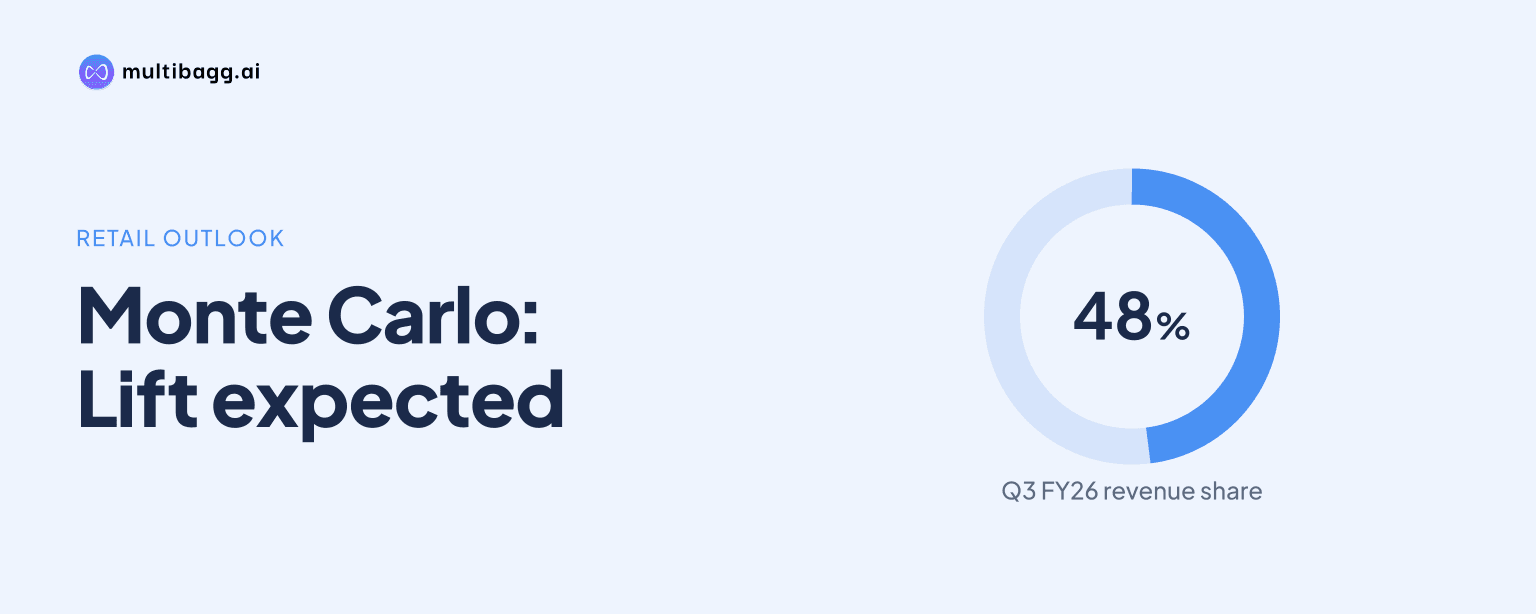
- Q3 contributed approximately 48% of Monte Carlo’s FY26 revenue.
- H1 FY27 revenue rose 6.25% to Rs 411 crore, while loss after tax was Rs 22.25 crore.
- Monte Carlo maintained low double-digit FY27 revenue-growth guidance and a target of 40 to 45 new EBOs.
powered by IRIS
Monte Carlo Fashions Limited expects Q3 FY27 to improve year on year, as November and December normally account for 80% to 85% of its winter-season revenue. Management said the later festive calendar shifted part of Q2 demand into Q3 and maintained its low double-digit FY27 revenue-growth guidance despite a Rs 22.25 crore H1 loss.
Know Monte Carlo Fashions inside out
Results, valuation, peers and who's buying, in one view.
Why does Monte Carlo’s FY27 depend on Q3?
Monte Carlo’s FY27 outcome depends heavily on Q3 because the company said Q3 contributed approximately 48% of FY26 revenue, while November and December usually generate 80% to 85% of winter-season revenue. Management described the September half as a period for production, inventory build and dispatches before the principal winter selling period, rather than a complete measure of annual demand.
The seasonal timing was more pronounced in FY27 because Diwali shifted from October in the prior year to November, according to management. Monte Carlo said some consumer sales and dispatches consequently moved from Q2 into Q3, although it could not quantify the amount. Executive Director Rishabh Oswal clarified that management’s Q3 outlook referred to year-on-year performance, and said Q3 FY27 should be better than Q3 FY26.
Management therefore asked investors to assess H1 alongside the seasonally important second half. Revenue from operations increased 6.25% to Rs 411 crore in H1 FY27 from Rs 387 crore in H1 FY26, but the period recorded a Rs 22.25 crore loss after tax. Monte Carlo said actual consumer sell-through and collections in the winter season would determine the full-year outcome.
What did Monte Carlo report in H1 FY27?
Monte Carlo reported Rs 411 crore of revenue from operations in H1 FY27, up from Rs 387 crore in H1 FY26, while operating earnings before interest, tax, depreciation and amortisation, or EBITDA, were Rs 15.42 crore at a 3.7% margin. Management attributed the lower profitability despite revenue growth to higher material costs, lower other income and increased employee costs.
Q2 showed revenue growth but limited profit conversion. Revenue from operations reached Rs 262 crore, up 5.51% from Rs 248 crore a year earlier, while operating EBITDA was Rs 28.35 crore at a 10.80% margin and profit after tax was Rs 1.17 crore. The difference between Q2 profit and the H1 loss reflects the first-half cost base, inventory preparation and the business’s winter-season concentration.
Returns and discounts remain relevant to reported revenue through the selling cycle. Monte Carlo’s Q2 return ratio declined to 16.17% from 23.18% a year earlier, but its H1 return ratio increased to 30.70% from 29.47% in H1 FY26. Management said it makes provisions for expected returns each quarter, though additional returns can affect individual quarterly results.
Got a follow-up? Ask IRIS
Which Monte Carlo categories and channels grew in H1?
Monte Carlo’s cotton category remained its largest reported product line, contributing approximately 63% of H1 FY27 gross product sales, and gross sales increased to Rs 390 crore from Rs 326 crore. Management said these figures are gross category sales before returns and other adjustments, rather than reported net revenue.
Home-textile gross sales rose to Rs 91.6 crore from Rs 83 crore, kids-wear sales increased to Rs 34.5 crore from Rs 30 crore, and footwear sales reached Rs 9.3 crore from Rs 4.9 crore. Woollen gross sales, in contrast, declined to approximately Rs 94 crore from approximately Rs 106 crore. The H1 mix therefore shifted toward cotton, home textiles, kids wear and footwear, even though winter demand remains important to annual earnings.
Monte Carlo’s outlet network changed across channels as of September 26. Exclusive brand outlets, or EBOs, increased to 506 from 497 a year earlier, while shop-in-shop locations rose to 632 from 578. Multi-brand outlets declined to 1,413 from 1,615 and national chain stores fell to 846 from 891, concentrating network additions in EBOs and shop-in-shop formats.
Management said like-to-like growth at existing EBOs was 9% in H1 FY27 after around 10% in the prior year, and it expects about 9% to 10% for FY27. It maintained a target of 40 to 45 EBO openings during FY27, with West and South among the focus regions. Those two regions represented approximately 9.7% of gross sales, although Monte Carlo said online and certain other sales are not allocated to individual states.
What could determine Monte Carlo’s Q3 result?
Monte Carlo said it raised winter-wear prices by around 8% to 9% to address raw-material costs, and management said the increase should provide protection in Q3. Management also said pure-wool raw-material prices had increased by almost 20% from the previous year. The effect of the price increase on winter sell-through and margins will be visible during the concentrated November and December sales period.
Discounting and inventory liquidation affected H1 profitability. Rebates and discounts increased to Rs 54 crore in H1 FY27 from Rs 35 crore a year earlier, while management said their ratio to revenue was 12% compared with 9%. It cited an early and prolonged end-of-season sale, macroeconomic conditions and clearance of a higher volume of older merchandise as reasons for the increase.
Management said Monte Carlo has created a standard operating procedure to clear old inventory within a set period rather than hold it for longer. It also said working-capital days improved to 146 in FY26 from 176 in FY25, although seasonal inventory accumulation makes funding requirements higher around September. These factors make Q3 collections and net revenue, rather than gross dispatches alone, material to the FY27 result.
Monte Carlo maintained guidance for low double-digit FY27 revenue growth and 20% growth in home textiles. On profitability, management said EBITDA margin could vary by plus or minus 100 basis points from FY26, depending on Q3 performance. A basis point is one-hundredth of a percentage point, leaving the annual margin outcome tied to winter sales, price realisation and discounting.
Conclusion
Monte Carlo’s H1 FY27 results show 6.25% revenue growth to Rs 411 crore alongside a Rs 22.25 crore loss after tax, making the first half an incomplete indicator of the full year under its seasonal model. Q3 supplied approximately 48% of FY26 revenue, while November and December normally account for 80% to 85% of winter-season revenue. Growth in cotton, home textiles, kids wear and footwear partly offset lower woollen sales, but winter sell-through remains the central factor.
The next event to watch is the Q3 FY27 result, when management’s expectation of year-on-year improvement will be tested. Management has retained low double-digit FY27 revenue-growth guidance, 20% home-textile growth and its 40 to 45 EBO opening target, while saying EBITDA margin may vary by 100 basis points from FY26 depending on Q3 performance.