










Monte Carlo says returns persist as inventory clearance accelerates
Key highlights
- Monte Carlo’s H1 FY ’27 return ratio was 30.70%, compared with 29.47% in H1 FY ’26.
- H1 rebates and discounts increased to Rs 54 crore from Rs 35 crore a year earlier.
- Monte Carlo reported H1 FY ’27 revenue of Rs 411 crore and a loss after tax of Rs 22.25 crore.
- Q3 contributed about 48% of FY ’26 revenue, making winter sell-through central to annual results.
powered by IRIS
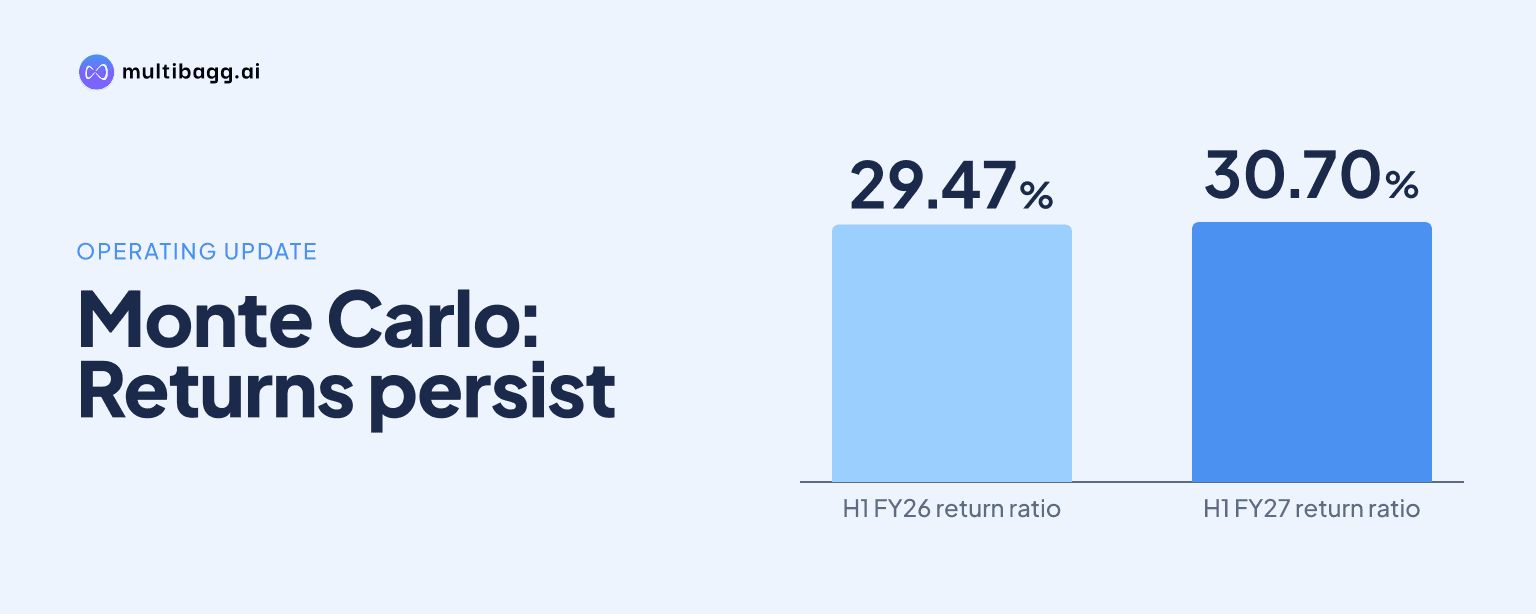
Monte Carlo said its seasonal wholesale model will continue to create a gap between Q3 dispatches and later sales returns, while it is using heavier discounts to liquidate older inventory: H1 FY ’27 rebates and discounts reached Rs 54 crore, versus Rs 35 crore a year earlier, and the H1 return ratio was 30.70%.
Know Monte Carlo Fashions inside out
Results, valuation, peers and who's buying, in one view.
Why can Monte Carlo’s revenue differ from its wholesale dispatches?
Monte Carlo said reported net revenue cannot be assessed from gross dispatches alone because dispatches are subsequently adjusted for returns, rebates and provisions. Its model dispatches heavily during Q3, before the winter selling season, with retailer returns arriving in later quarters. Management said this chronology will continue as long as the sales mix retains this seasonal pattern.
The seasonal concentration is material: Q3 contributed about 48% of FY ’26 revenue, while the September half is used for production, inventory building and distribution ahead of winter. Management also said the later festive season shifted a meaningful portion of consumer demand and winter sell-through into Q3 in FY ’27, making H1 less representative of the full year.
Monte Carlo reported Q2 revenue from operations of Rs 262 crore, up 5.51% from Rs 248 crore a year earlier. H1 revenue was Rs 411 crore, up 6.25% from Rs 387 crore in H1 FY ’26. The company said actual consumer sell-through and collections during the second half, rather than dispatches alone, will determine the annual outcome.
Are sales returns properly provided for in Monte Carlo’s accounts?
Monte Carlo said it makes an adequate provision for expected returns in every quarter, rather than booking the entire sale first and recognising all returns in the following quarter. R. K. Sharma said additional returns can occasionally exceed the provision, but described their effect on quarterly results as marginal.
The reported ratios show a mixed comparison. The Q2 return ratio declined to 16.17% from 23.18% a year earlier, a 7.01-percentage-point reduction. On an H1 basis, however, returns rose to 30.70% from 29.47%, a 1.23-percentage-point increase, showing why management asked investors to read gross category sales alongside returns and other adjustments.
Management linked the pattern to the timing of Q3 wholesale shipments rather than to a one-off accounting practice. It said returns processed earlier in Q1 had been expected to reverse as a timing effect over the following two quarters. The company also said that as other quarters gain a larger contribution to overall sales, the visible imbalance between Q3 dispatches and later returns could reduce.
Why did Monte Carlo raise discounts to clear inventory?
Monte Carlo said discounts increased because end-of-season sales began early and lasted longer amid an unfavourable low season, macroeconomic conditions and geopolitical developments. Management said these factors required early discounts to improve sell-through, and added that it sold substantially more older merchandise in FY ’27 than in the prior year.
The effect was evident in H1 rebates and discounts, which increased to Rs 54 crore from Rs 35 crore a year earlier. R. K. Sharma said that represented 12% of revenue, compared with 9% in the previous H1. The company said its purpose was to liquidate inventory built up over the past few years, with older products carrying heavier discounts.
Management gave two differently framed annual reference points. R. K. Sharma said rebates and discounts for the full year were expected to remain up to 10% of the total, while Sandeep Jain said the annual benchmark for rebates and discounts should be around 3% to 4% and that the H1 figure should not be treated as a run rate. The transcript does not reconcile those two ranges.
Got a follow-up? Ask IRIS
What does faster inventory liquidation mean for profit and cash conversion?
Monte Carlo’s inventory liquidation programme coincided with H1 FY ’27 operating earnings before interest, tax, depreciation and amortisation, or EBITDA, of Rs 15.42 crore at a 3.7% margin. The company reported a loss after tax of Rs 22.25 crore despite revenue from operations of Rs 411 crore for the six-month period.
For Q2 alone, operating EBITDA was Rs 28.35 crore and the operating EBITDA margin was 10.80%, while profit after tax was Rs 1.17 crore. Management attributed the H1 profitability outcome to higher material costs, lower other income and increased employee costs. It said a price increase of about 8% to 9% had been taken for winter wear to address higher raw-material costs.
Cash conversion is part of the stated rationale for reducing old stock. Management said reported working-capital days improved to 146 in FY ’26 from 176 in FY ’25, while seasonal inventory accumulation still creates a high funding requirement around 30 September. R. K. Sharma said the debt position should instead be assessed on 31 March, when permanent working-capital requirement was expected to be about Rs 200 crore.
How is Monte Carlo balancing clearance with growth plans?
Monte Carlo maintained its guidance for low double-digit revenue growth in FY ’27, 20% home-textile growth and 40 to 45 new exclusive brand outlets, or EBOs, focused on West and South. Management said these targets depend on consumer sell-through, productive retail expansion and cash conversion during the second half, especially the November and December winter period.
The company’s category data are gross sales before returns and other adjustments, reinforcing the difference from reported revenue. Cotton gross sales increased to Rs 390 crore in H1 FY ’27 from Rs 326 crore, home textiles rose to Rs 91.6 crore from Rs 83 crore, kids wear rose to Rs 34.5 crore from Rs 30 crore and footwear rose to Rs 9.3 crore from Rs 4.9 crore. Woollen gross sales declined to about Rs 94 crore from about Rs 106 crore.
Monte Carlo had 506 EBOs as of 26 September, compared with 497 a year earlier, while shop-in-shop outlets rose to 632 from 578. In contrast, multi-brand outlets declined to 1,413 from 1,615 and National Chain Stores declined to 846 from 891. Management said outlet decisions are assessed by store profitability and return potential, not outlet count alone.
Conclusion
Monte Carlo’s H1 FY ’27 figures show why dispatch-led sales need to be separated from reported revenue: the H1 return ratio was 30.70%, and rebates and discounts rose to Rs 54 crore as the company cleared older merchandise. The disclosed H1 outcome was operating EBITDA of Rs 15.42 crore and a loss after tax of Rs 22.25 crore.
The next test is Q3, which represented about 48% of FY ’26 revenue and includes the November and December months that management said normally generate 80% to 85% of winter-season revenue. Investors will be able to assess whether consumer sell-through supports Monte Carlo’s low double-digit FY ’27 revenue-growth guidance and its stated margin range of plus or minus 100 basis points versus the prior year.