










Monte Carlo Q3 held 47% of FY26 revenue despite ambition
Key highlights
- Q3 accounted for 47% of Monte Carlo’s FY26 revenue, compared with 45% in FY25.
- Monte Carlo reported H1 FY27 net sales of Rs 410.9 crore, up from Rs 386.8 crore in H1 FY26.
- H1 FY27 seasonal working-capital outflow was Rs 200.69 crore, versus Rs 205.93 crore a year earlier.
- Net debt excluding leases was Rs 302 crore at September 2026, compared with Rs 74.2 crore at March 2026.
powered by IRIS
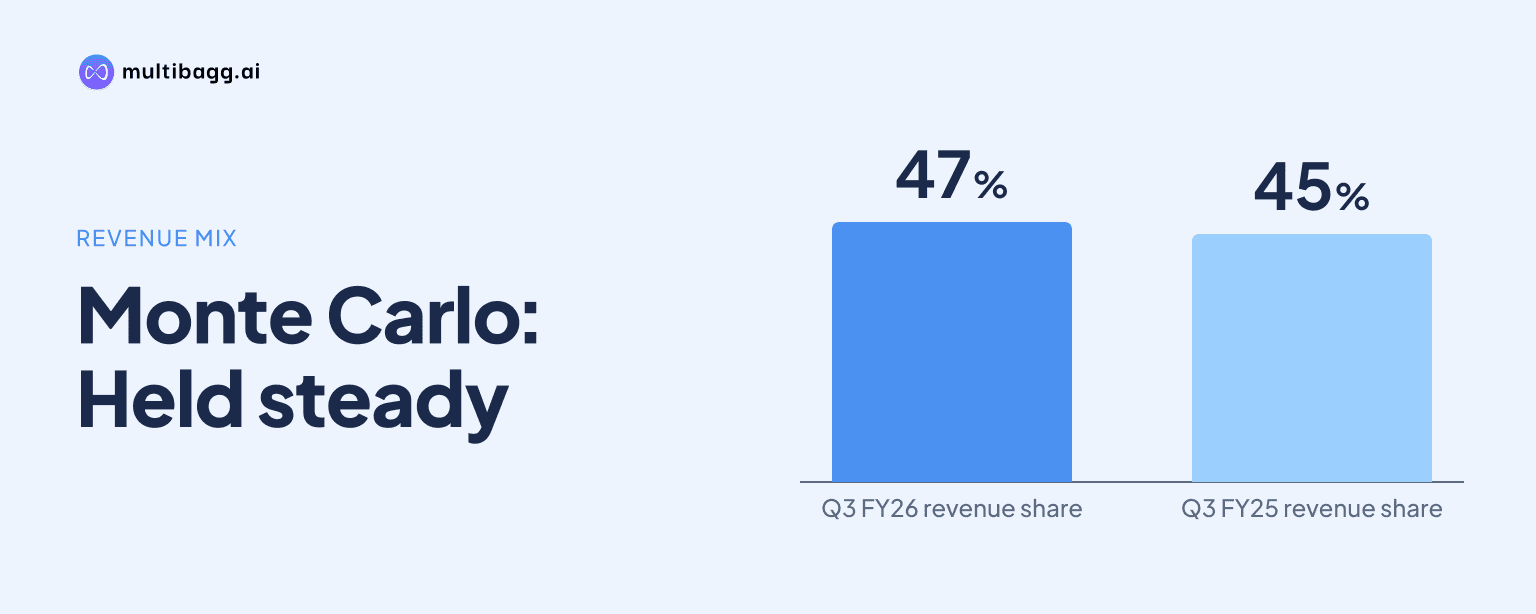
Monte Carlo generated 47% of FY26 revenue in Q3, up from 45% in FY25, so the October-to-December winter quarter still supplied nearly half of annual sales despite management’s ambition for a roughly 50:50 seasonal split within two to three years. Monte Carlo also reported an approximately 47:53 FY26 season split.
Know Monte Carlo Fashions inside out
Results, valuation, peers and who's buying, in one view.
Why does Monte Carlo remain dependent on Q3?
Monte Carlo remains dependent on Q3 because it reported that the October-to-December quarter accounted for 47% of FY26 revenue. The company describes winter as central to its business, making the Q3 consumer selling period the largest disclosed concentration of annual revenue in one quarter.
The concentration has reduced from the 56% Q3 share reported in FY20, but it increased in the latest comparison. Q3 represented 45% of annual revenue in both FY24 and FY25 before rising by 2 percentage points to 47% in FY26. FY26 was therefore 9 percentage points below FY20 but 2 percentage points above FY25.
Monte Carlo’s seasonal calendar covers order booking, production and stock build, retailer dispatches, consumer sell-through, end-of-season sale activity and returns for its winter and summer seasons. While the presentation does not assign revenue amounts to each step, the 47% Q3 contribution shows that the winter selling cycle remains material to the annual outcome.
How has Monte Carlo’s seasonality changed over time?
Monte Carlo’s FY26 season split was approximately 47:53, and management has stated an ambition to reach 50:50 seasonality in two to three years. The presentation does not give a specific financial-year deadline, interim milestones or a quantified operational plan for reaching that split.
The reported trend is not a straight move toward a more even quarterly revenue mix. Q3’s share fell from 56% in FY20 to 45% in FY24, remained at 45% in FY25 and then rose to 47% in FY26. The 47:53 split identifies a more balanced result than the FY20 Q3 concentration, but Q3 still represented nearly half of FY26 revenue.
The stated 50:50 ambition is management’s forward-looking objective rather than a reported result. Monte Carlo has not disclosed separate annual revenue values for winter and summer, nor has it disclosed whether the intended balance will be achieved through higher non-winter sales, a lower relative Q3 share or both.
What do Monte Carlo’s first-half sales show before Q3?
Monte Carlo reported H1 FY27 net sales of Rs 410.9 crore, compared with Rs 386.8 crore in H1 FY26, while gross sales increased to Rs 629.8 crore from Rs 553.7 crore. The difference between the Rs 76.1 crore gross-sales increase and the Rs 24.1 crore net-sales increase reflects returns, rebates and net provisions in the gross-to-net bridge.
Returns rose to Rs 193.8 crore in H1 FY27 from Rs 163.2 crore in H1 FY26, while rebates increased to Rs 54.2 crore from Rs 35 crore. Net provisions were Rs 29 crore in H1 FY27, compared with Rs 31.3 crore in H1 FY26. These deductions and adjustments matter when comparing first-half dispatch-linked gross sales with recognised net sales ahead of the historically important Q3.
In Q2 FY27, Monte Carlo reported gross sales of Rs 383.6 crore and net sales of Rs 262.2 crore, versus Rs 356.7 crore and Rs 248.5 crore, respectively, in Q2 FY26. Returns declined to Rs 62 crore from Rs 82.7 crore, and returns as a share of gross sales fell to 16% from 23%. Rebates, however, increased to Rs 38.9 crore from Rs 21.3 crore.
Got a follow-up? Ask IRIS
How does Monte Carlo’s seasonality affect working capital and debt?
Monte Carlo’s seasonal working-capital outflow was Rs 200.69 crore in H1 FY27, compared with Rs 205.93 crore in H1 FY26. The Rs 5.24 crore improvement occurred despite inventory outflow increasing by Rs 28.77 crore, as receivables and payables movements were stronger, according to the presentation.
Net debt excluding leases rose to Rs 302 crore at September 2026 from Rs 74.2 crore at March 2026 and Rs 221.2 crore at September 2025. Monte Carlo attributed the September 2026 balance to seasonal working-capital build-up and said it expects H2 collections to moderate net debt. That is management’s expectation, rather than a reported reduction.
Year-end working-capital days fell to 146 in FY26 from 176 in FY25, reversing the previous year’s increase. The FY26 result was also below 158 days in FY24 and 169 days in FY23, making it the lowest of the four year-end figures shown. This year-end measure differs from the H1 cash outflow and debt build-up during the seasonal cycle.
What operating changes could affect Monte Carlo’s revenue timing?
Monte Carlo’s exclusive brand outlet network reached 497 stores in FY26, up 5.5% from 471 in FY25 and 22.4% from 406 in FY24. Weighted average gross revenue per store was Rs 1.42 crore in FY26, up from Rs 1.25 crore in FY25 and equal to the FY24 level. The presentation does not disclose the Q3 share of outlet revenue.
The Q2 FY27 presentation showed 506 stores after 13 additions during the quarter: two company-owned company-operated stores, one company-owned franchise-operated store and 10 franchise-owned franchise-operated stores. North and East each received five additions, while Central received three. Monte Carlo does not link these openings directly to the 50:50 seasonality ambition.
Regional mix also shifted in H1 FY27. North accounted for 45.94% of sales, down from 50.62% in H1 FY26, while East increased to 23.08% from 20.40% and online rose to 12.16% from 11.74%. Total H1 sales across regions and online increased 13.79% year on year, but Monte Carlo has not disclosed whether these channel and regional changes alter the winter-led quarterly pattern.
Conclusion
Monte Carlo’s disclosed FY26 revenue pattern remained concentrated in Q3, which contributed 47% of annual revenue compared with 45% in FY25. H1 FY27 net sales increased to Rs 410.9 crore, but the gross-to-net bridge, Rs 200.69 crore working-capital outflow and September 2026 net debt of Rs 302 crore show how sales timing and cash requirements are connected to the winter cycle.
The next disclosures to watch are Q3’s share of FY27 revenue, the collection-led moderation in net debt that management expects in H2, and any milestones for the two-to-three-year 50:50 seasonality ambition. Monte Carlo has also not disclosed whether the 506-store network or the rising East and online sales mix changes the timing of annual revenue.