










Oswal Pumps builds 143 MW EPC book amid PM-KUSUM delay
Key highlights
- Oswal Pumps reported an approximately 143 MW solar EPC order book and a further 168 MW pipeline in Q2 FY27.
- Oswal Pumps' solar-pump order book stood at 9,487 pumps, with an approximately 10,000-pump near-term pipeline.
- Q2 FY27 revenue was Rs 506.3 crore, up 6.9% quarter on quarter, while operating EBITDA margin was 11.3%.
- Oswal Pumps proposed a Rs 455.85 crore, 1.2 GW solar-cell plant with commercial operations expected in April 2028.
powered by IRIS
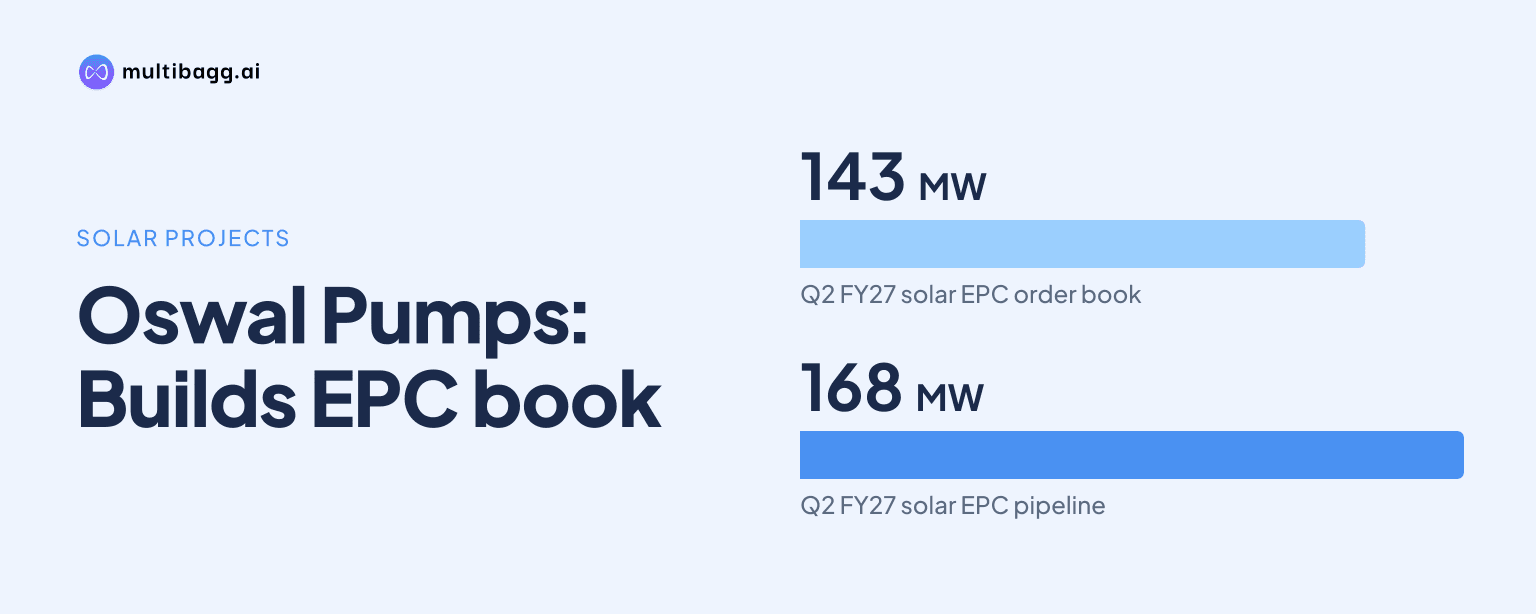
Oswal Pumps Limited said in the second quarter of financial year 2027 (Q2 FY27) that it had an approximately 143 megawatt (MW) solar engineering, procurement and construction (EPC) order book as PM-KUSUM 2.0 was delayed, diversifying alongside its 9,487-pump order book and 168 MW EPC pipeline.
Know Oswal Pumps inside out
Results, valuation, peers and who's buying, in one view.
Why is Oswal Pumps diversifying beyond solar pumps?
Oswal Pumps is diversifying because PM-KUSUM 2.0 had not yet been rolled out, leaving uncertainty over the timing of its government-led solar-irrigation business. The company said it is expanding into rooftop solar, utility-scale solar and commercial and industrial solar EPC while retaining a solar-pump order book of 9,487 pumps and a near-term pipeline of about 10,000 pumps.
The approximately 10,000-pump pipeline includes direct PM-KUSUM opportunities, the Magel Tyala scheme, indirect PM-KUSUM business and exports. Management said Magel Tyala was nearing its end and expected PM-KUSUM 2.0 to launch within calendar year 2026, based on ministry assurances and public statements cited on the November 13, 2026 call. That timing remains management's expectation rather than a confirmed programme date.
What is in Oswal Pumps' solar EPC order book?
Oswal Pumps' combined solar EPC order book is approximately 143 MW, with a further 168 MW pipeline across rooftop, utility-scale, and commercial and industrial projects. The company did not disclose revenue value, project count, customer mix or a separate capacity split among the three EPC categories during the Q2 FY27 call.
Management said it had secured new orders in Rajasthan, Andhra Pradesh and Telangana, but that execution in new states takes time. It said the company was proceeding cautiously rather than rushing revenue, citing the need to avoid project-delivery errors or delayed payment collection. Management said the revenue visibility previously indicated remained in the order book, with execution pushed somewhat into the future.
The 143 MW EPC order book is an additional source of work alongside the 9,487-pump solar-pump order book, not a replacement for the solar-irrigation business. Oswal Pumps said the new segments are intended to broaden its addressable markets and revenue base while PM-KUSUM 2.0 remains pending, although it gave no schedule for converting the 143 MW book into reported revenue.
How did Oswal Pumps' Q2 FY27 profitability and working capital change?
Oswal Pumps reported revenue from operations of Rs 506.3 crore in Q2 FY27, up 6.9% quarter on quarter, while its operating earnings before interest, tax, depreciation and amortisation (EBITDA) margin declined 437 basis points sequentially to 11.3%. Operating EBITDA was Rs 57.5 crore and profit after tax (PAT) was Rs 39.6 crore, resulting in a PAT margin of 7.7%, down 343 basis points quarter on quarter.
Management attributed approximately 210 basis points of the EBITDA-margin decline to higher aluminium-frame, glass and copper prices, as well as higher zinc and steel costs at subsidiary Walso Solar Solutions Private Limited. It linked those subsidiary costs to orders secured at earlier input-cost levels. The remaining 227 basis points came from employee costs for scaling solar EPC, project-related operating expenses and higher debtor provisioning under the applicable accounting standard.
The cash-conversion cycle increased to 257 days on September 30, 2026, from 244 days on June 30, 2026. Inventory days rose to 56 from 43, while receivable days remained at 229. Oswal Pumps said it received approximately Rs 208 crore against outstanding receivables in early October 2026 and that all receivables were from government and government-backed counterparties.
Got a follow-up? Ask IRIS
How is Oswal Pumps changing its solar manufacturing plan?
Oswal Pumps has proposed a 1.2 gigawatt (GW) TOPCon solar-cell manufacturing facility at Karnal through wholly owned subsidiary Oswal Solar Energy Private Limited, with estimated investment of Rs 455.85 crore. The plan proposes using Rs 159.85 crore of unutilised initial public offering (IPO) proceeds, subject to shareholder approval, and Rs 296 crore of term debt, for which management said it had received in-principle sanction.
Management expects commercial operations at the proposed cell facility to begin in April 2028 and said it should meet about 75% of Oswal Pumps' overall solar-cell requirement once operational. The company said the investment is intended to improve access to domestically manufactured cells, reduce dependence on external suppliers and support domestic-content-requirement (DCR) module demand under government-backed programmes including PM-KUSUM and PM Surya Ghar.
The cell project reprioritises earlier expansion plans. Oswal Pumps has approximately 570 MW of existing solar-module capacity and 1,000 MW under implementation, which management said would support near-term requirements and allow it to defer the remaining 500 MW of planned module expansion. It also plans to proceed with 1,200 MW of an originally proposed 1,500 MW encapsulant capacity, leaving 300 MW unpursued, while reallocating proposed aluminium-frame investment because frames can be sourced externally.
Conclusion
Oswal Pumps' approximately 143 MW solar EPC order book adds a diversification route while PM-KUSUM 2.0 remains pending, alongside 9,487 solar pumps on order and an approximately 10,000-pump near-term pipeline. The expansion coincided with Q2 FY27 revenue growth of 6.9% quarter on quarter, but EBITDA margin fell 437 basis points to 11.3% as higher material prices and EPC scale-up costs affected profitability.
The next disclosed milestones are management's expected PM-KUSUM 2.0 rollout within calendar year 2026, execution of EPC orders in Rajasthan, Andhra Pradesh and Telangana, and shareholder approval for the Rs 159.85 crore IPO-proceeds reallocation. Management has targeted April 2028 for commercial operations at the proposed 1.2 GW solar-cell facility, which it expects to meet about 75% of its solar-cell requirement.