










Oswal Pumps scheme revenue reached Rs 1,573.8 crore in FY26
Key highlights
- Oswal Pumps reported Rs 1,573.8 crore of scheme-related revenue in FY26, up from Rs 1,079.6 crore in FY25.
- Direct PM-KUSUM turnkey revenue was Rs 534.7 crore in FY26, down from Rs 961.1 crore in FY25.
- Other government schemes generated Rs 963.8 crore in FY26 and Rs 502.8 crore in H1 FY27.
- Oswal Pumps listed 9,487 systems in awards, empanelments and orders yet to be executed as of October 31, 2026.
powered by IRIS
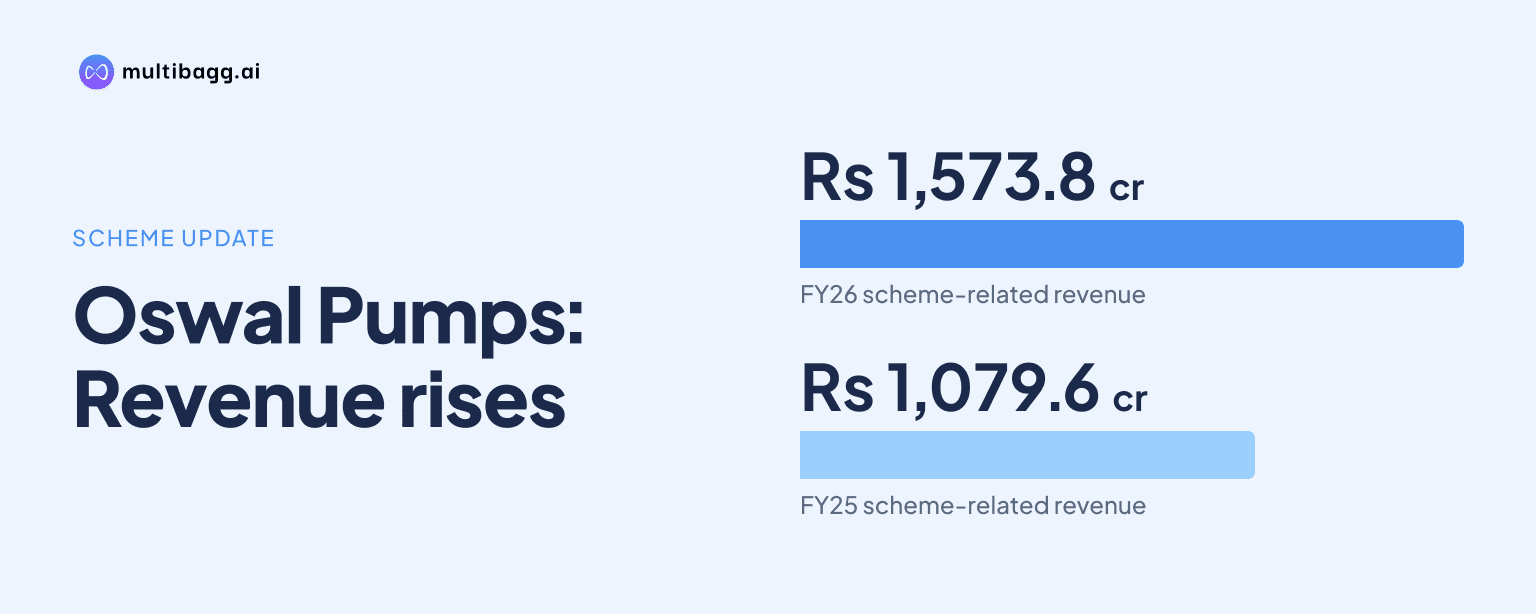
Oswal Pumps reported Rs 1,573.8 crore of revenue from PM-KUSUM and other government schemes in FY26, up from Rs 1,079.6 crore in FY25, while direct PM-KUSUM turnkey installations were 2,518 in H1 FY27 against 18,604 in FY26. The revenue mix shifted toward Maharashtra’s Magel Tyala and other schemes.
Know Oswal Pumps inside out
Results, valuation, peers and who's buying, in one view.
How important were government schemes to Oswal Pumps' FY26 revenue?
Government-scheme and related PM-KUSUM revenue was Rs 1,573.8 crore for Oswal Pumps in FY26, compared with total disclosed revenue of Rs 1,964.9 crore on the presentation’s stated basis. That total excludes traded-goods sales and other operating revenue, while adding back discounts and incentives.
The scheme-related total increased from Rs 633.3 crore in FY24 and Rs 1,079.6 crore in FY25 to Rs 1,573.8 crore in FY26. Revenue outside PM-KUSUM and other government schemes also rose, from Rs 98 crore in FY24 to Rs 241.5 crore in FY25 and Rs 391.1 crore in FY26, but was lower than scheme-related revenue in each of those years.
The composition changed in FY26. Revenue from turnkey solar pumping systems supplied directly under PM-KUSUM declined to Rs 534.7 crore from Rs 961.1 crore in FY25, while revenue from other government schemes rose to Rs 963.8 crore from Rs 23 crore. Oswal Pumps says the latter category includes turnkey systems supplied under Maharashtra’s Magel Tyala scheme as well as other government schemes.
Revenue from solar pumps, modules, structures and balance-of-system kits supplied without installation to PM-KUSUM participants fell from Rs 95.5 crore in FY25 to Rs 75.4 crore in FY26. Revenue from turnkey systems supplied to PM-KUSUM participants was Rs 21,000 in FY26, following no reported revenue in FY25.
Why were direct PM-KUSUM installations lower in H1 FY27?
Direct PM-KUSUM turnkey installations were 2,518 pumps in H1 FY27, compared with 18,604 pumps in FY26 and 36,046 pumps in FY25. H1 FY27 is a six-month period, so its volume is not directly comparable with either full-year figure, but the disclosed count is materially below the preceding annual totals.
The direct channel had already contracted during FY26, when installations declined by 17,442 pumps from FY25. Direct PM-KUSUM turnkey revenue likewise declined from Rs 961.1 crore in FY25 to Rs 534.7 crore in FY26, before reaching Rs 72.2 crore in H1 FY27.
By contrast, solar pumps supplied in the category other than direct PM-KUSUM turnkey systems and the two PM-KUSUM participant categories rose to 45,609 in FY26 from 5,551 in FY25. This category included turnkey systems supplied under Magel Tyala and other government schemes, and Oswal Pumps supplied 27,151 pumps in it during H1 FY27.
Solar-pump supply without installation to PM-KUSUM participants was 6,887 pumps in H1 FY27, compared with 23,107 in FY26. Total solar-pump supply was 36,556 units in H1 FY27, while non-solar agricultural and non-agricultural pump supply totalled 37,748 units, taking total pump supply to 74,304 units.
Where are Oswal Pumps' government-scheme installations concentrated?
Maharashtra is the largest disclosed state exposure, with 67,193 solar pumping systems supplied under Magel Tyala and 27,223 supplied to the Government of Maharashtra under PM-KUSUM as of October 31, 2026. These two Maharashtra lines total 94,416 systems within the listed 133,701 directly executed systems.
Haryana was the next-largest listed PM-KUSUM state, with 24,851 systems as of October 31, 2026. Karnataka accounted for 3,633 systems, Rajasthan for 3,447 and Uttar Pradesh for 2,392, leaving Maharashtra and Haryana as the two largest disclosed installation bases.
At the programme level, Maharashtra represented 47% of the 1,197,145 pumps installed under Component B of PM-KUSUM as of October 31, 2026, according to the presentation. Haryana represented 16% and Rajasthan 11%; Oswal Pumps also reported 66,508 agri-solar pumps supplied directly and indirectly under PM-KUSUM, excluding Magel Tyala.
Oswal Pumps listed 9,487 systems in letters of empanelment, letters of award and other orders yet to be executed as of October 31, 2026. The maximum included 3,500 export pump-only orders, 2,750 indirect orders, 2,000 Magel Tyala systems, 707 Karnataka systems and 443 Madhya Pradesh systems.
Got a follow-up? Ask IRIS
How can PM-KUSUM milestones affect revenue timing?
The disclosed PM-KUSUM process releases 90% of payment after installation, submission of a Joint Commissioning Report and invoicing, with the remaining payment released after performance validation. System performance is monitored through real-time monitoring system data on the Ministry of New and Renewable Energy portal for 90 to 120 days.
The payment structure shown in the presentation comprises a 30% Central Government contribution, a 30% to 60% state-government contribution and a 10% to 40% farmer contribution. In specified North Eastern states, Sikkim, Jammu and Kashmir, Himachal Pradesh, Uttarakhand, Lakshadweep and Andaman and Nicobar Islands, the Central Government share is 50%.
Suppliers must provide a five-year annual maintenance contract, real-time monitoring, helpline support and grievance-redressal arrangements after commissioning. Those requirements mean supply, installation, commissioning and final payment validation can occur at different stages, which is relevant when comparing pump volumes and revenue across FY26 and H1 FY27.
What is Oswal Pumps pursuing beyond direct PM-KUSUM work?
Oswal Pumps says it plans to participate in tenders and expand its distributor network in Karnataka, Ladakh, Kargil and Madhya Pradesh. Its unexecuted maximum orders and empanelments include 707 systems in Karnataka, 443 in Madhya Pradesh, 81 in Uttarakhand and six in Ladakh.
The company entered rooftop solar through its first PM Surya Ghar: Muft Bijli Yojana order in FY26. It disclosed 1,029 megawatts of open and upcoming tenders, 200 megawatts of tenders participated in, a 168-megawatt pipeline and a 143-megawatt current order book across rooftop, utility and commercial and industrial solar projects.
Oswal Solar Energy Private Limited holds a 60% stake in Oswal Doon Baran Bundi Solar Projects Limited, a special purpose vehicle formed with Doon Infrapower Projects Private Limited. The vehicle was established for rooftop photovoltaic projects on Rajasthan state-government buildings under the Hybrid Annuity Mode.
Conclusion
Oswal Pumps’ FY26 disclosures show that scheme-related revenue increased even as direct PM-KUSUM turnkey revenue and installations declined from FY25 levels. The increase came primarily from the other-government-schemes category, which includes Maharashtra’s Magel Tyala programme, making the reported revenue base more reliant on that category during FY26 and H1 FY27.
The next disclosed markers are execution of the 9,487-system award, empanelment and order pipeline, including 2,000 Magel Tyala systems, and movement in the 143-megawatt solar order book. The presentation also identifies planned bidding and distributor expansion in Karnataka, Ladakh, Kargil and Madhya Pradesh as areas to watch.