










Oswal Pumps expects 6-7 point EBITDA margin lift from cells
Key highlights
- Oswal Pumps expects captive solar cells to improve EBITDA margin by 6% to 7% on overall sales.
- The solar-cell facility requires Rs 455 crore of capex and is planned at 1,200 MW capacity.
- Oswal Pumps expects Rs 800 crore to Rs 900 crore of internal solar-cell output without standalone revenue.
- Oswal Pumps' cash conversion cycle increased to 257 days on September 30, 2026, from 244 days on June 30, 2026.
powered by IRIS
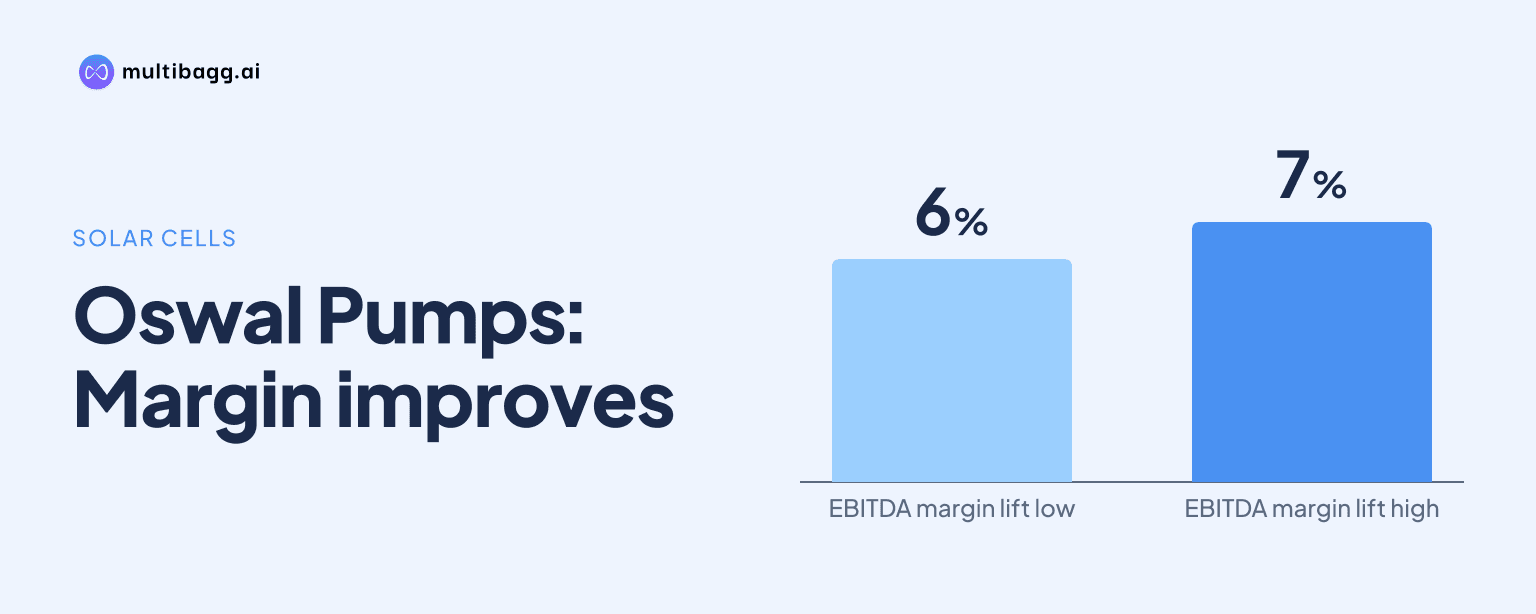
In its Q2 and H1 FY27 call, Oswal Pumps said captive solar-cell production could raise earnings before interest, tax, depreciation and amortisation (EBITDA) margin by 6% to 7% on overall sales, based on supplier agreements for the following year. Management expects Rs 800 crore to Rs 900 crore of internally consumed cell output, rather than standalone plant revenue.
Know Oswal Pumps inside out
Results, valuation, peers and who's buying, in one view.
How much EBITDA margin improvement does Oswal Pumps expect from solar cells?
Oswal Pumps expects solar-cell integration to improve EBITDA margin by 6% to 7% on overall sales. Vivek Gupta said the estimate is based on agreements with external cell suppliers covering prices one year ahead, rather than on operating results from the proposed facility or a disclosed current EBITDA margin.
Management said solar-cell suppliers in India currently command high prices amid availability constraints. By producing cells for its own requirements, Oswal Pumps expects the cost benefit to flow directly to its bottom line. The company did not disclose a margin bridge, a production start date or a separate estimate for the solar module business.
The forecast is conditional on cell-market conditions. Gupta said EBITDA margin could soften slightly if solar-cell supply rises substantially over the next year, but management still expects an absolute margin improvement because captive output would reduce external cell purchases. The 6% to 7% figure is therefore management's expectation, not a reported profitability outcome.
Why will Oswal Pumps' solar-cell plant not generate standalone revenue?
Oswal Pumps said the planned plant will not generate direct top-line revenue because the cells are intended for internal consumption. Management expects to manufacture Rs 800 crore to Rs 900 crore worth of solar cells for its own requirements, making the expected benefit a lower input cost and higher EBITDA rather than sales to outside customers.
Gupta said internally produced cells should cover about 75% to 80% of module-capacity requirements. In its earlier explanation of the revised plan, management described the proposed facility as covering about 75% of overall solar-cell requirements. The two estimates describe a plant primarily designed to reduce reliance on third-party suppliers.
Management also expects captive manufacturing to improve availability of domestic content requirement (DCR)-compliant cells, quality control and flexibility in fulfilling large orders. Oswal Pumps linked those factors to government-backed solar programmes, but did not quantify revenue that could result from improved supply availability or DCR compliance.
What is Oswal Pumps spending on the solar-cell facility?
Oswal Pumps has set total capital expenditure at Rs 455 crore for the solar-cell facility. Management said it is proceeding with 1,200 megawatts (MW) of capacity, which it expects to largely meet internal demand, while the remaining 300 MW in the earlier plan will not be pursued.
The company said it proposed reallocating investment previously earmarked for aluminium manufacturing facilities because those components can be sourced externally. Management's stated reason for the revised allocation was that solar-cell backward integration offered greater strategic value and potential financial benefits than producing aluminium components internally.
The investment comes alongside reported net debt of Rs 531 crore as of September 30, 2026. Oswal Pumps reported net debt-to-equity of 0.30 times and annualised net debt-to-operating EBITDA of 2.02 times at that date, but management did not provide a post-project debt target or say how the Rs 455 crore capex would be funded.
Got a follow-up? Ask IRIS
How do working capital and solar projects compare across Oswal Pumps' business?
Oswal Pumps' cash conversion cycle increased to 257 days at September 30, 2026, from 244 days at June 30, 2026. Receivable days remained at 229, while inventory days increased to 56 from 43, lengthening the overall cycle as the company prepares to expand solar activity and undertake Rs 455 crore of cell-plant capex.
Oswal Pumps received about Rs 208 crore from the Maharashtra government in early October 2026. Management said all receivables were from government or government-backed counterparties and expected debtor days, described later in the call as 225 to 226 days, to decline to around 150 to 160 days by the end of the fourth quarter.
The margin and payment profiles of newer solar projects differ by location. Management expects EBITDA margin of about 13% to 15% for Telangana, compared with 10% to 13% for upcoming Rajasthan orders, subject to execution and supply visibility. For Bihar, which combines renewable energy service company and capital-expenditure models, management expects no first-year profitability and returns over the following five years; rooftop-solar payment cycles are expected at 90 to 120 days.
What could determine whether Oswal Pumps achieves the margin benefit?
Solar-cell supply, prices and execution of the 1,200 MW facility are the principal disclosed variables. Management's 6% to 7% EBITDA-margin expectation uses supplier-price agreements for one year ahead, and Gupta said a substantial expansion of cell supply could reduce margins even though Oswal Pumps expects captive production to preserve an absolute cost benefit.
Order execution also remains relevant to the wider solar business. Management said revenue visibility remained in the order book but execution in newer states had been pushed forward as the company expanded beyond PM-KUSUM pumping systems into rooftop solar and engineering, procurement and construction activity. It said Telangana, Rajasthan and Andhra Pradesh orders would take time to execute without creating payment-collection issues.
Management expects implementation of PM-KUSUM 2.0 to ramp up significantly in the first quarter of the next financial year, following an anticipated launch by the end of the calendar year. That timing was based on management's information from government departments, including reported preparations by tendering agencies, and was not an announced implementation date.
Conclusion
Oswal Pumps' proposed cell plant is a cost and supply-chain integration project, not a new external sales line. Management expects Rs 800 crore to Rs 900 crore of captive output from a Rs 455 crore, 1,200 MW facility to lift EBITDA margin by 6% to 7% on overall sales, while supplying about 75% to 80% of module-capacity cell needs.
The next indicators are execution and funding of the Rs 455 crore project, solar-cell supply and pricing over the coming year, and management's target to reduce debtor days to 150 to 160 by the end of the fourth quarter. Management also expects PM-KUSUM 2.0 activity to ramp up in the first quarter of the next financial year after an anticipated calendar-year-end launch.