










Oswal Pumps integrates solar systems from panels to pumps
Key highlights
- Walso Solar Solutions Private Limited was recorded as a 51.0% subsidiary from June 08, 2026.
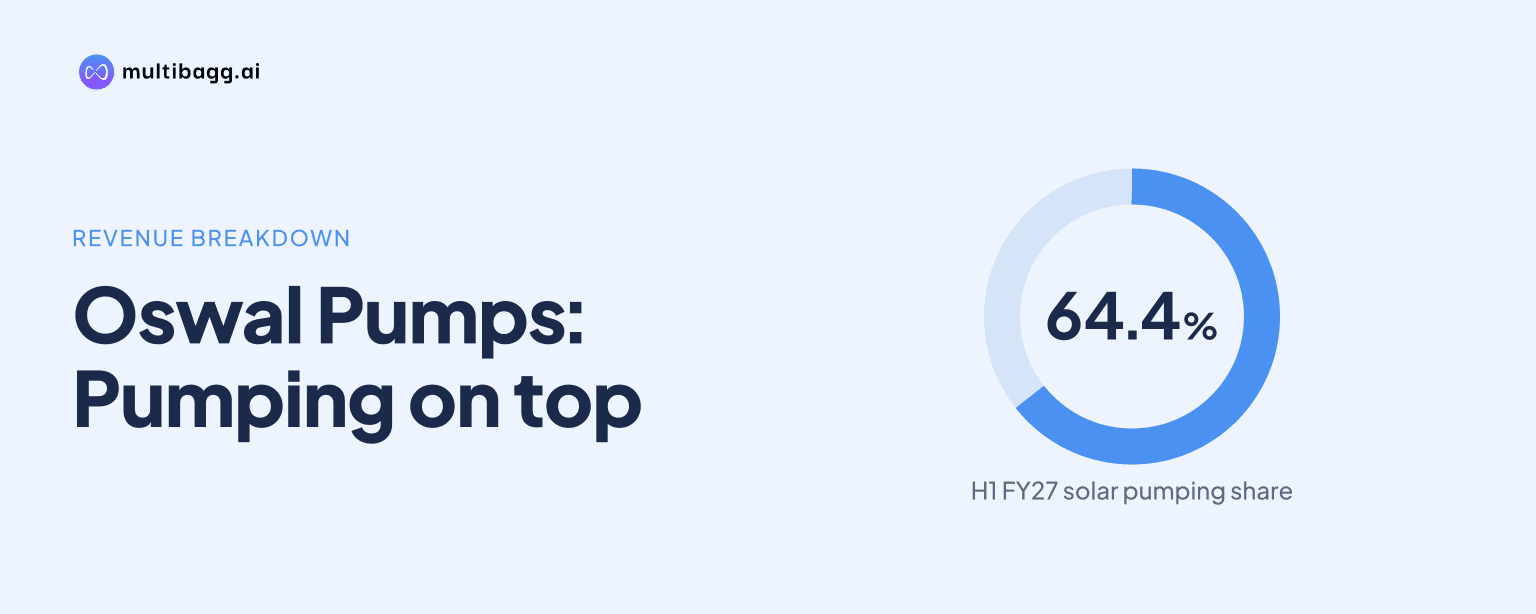
- Turnkey solar pumping systems using submersible pumps represented 64.4% of the stated revenue measure in H1 FY27.
- Solar PV modules increased from 9.4% of the stated revenue measure in FY25 to 20.3% in H1 FY27.
- Agriculture accounted for 73.9% of the stated revenue measure in H1 FY27, while residential accounted for 25.1%.
powered by IRIS
Oswal Pumps Limited has assembled a solar-pumping chain spanning panels, structures, balance-of-system kits, controllers, motors and submersible pumps, while its value-chain diagram records a 51.0% subsidiary stake in Walso Solar Solutions Private Limited from June 08, 2026. The presentation also describes Oswal Solar Energy Private Limited as wholly owned and identifies in-house module assembly, controller work, installation and commissioning.
Know Oswal Pumps inside out
Results, valuation, peers and who's buying, in one view.
How does Oswal Pumps cover the solar-pump value chain?
Oswal Pumps covers the stated solar-pumping value chain through its pump operations and two solar-focused entities. The presentation assigns solar panels to Oswal Solar Energy Private Limited, a wholly owned subsidiary, and assigns ground-level structures and balance-of-system, or BOS, kits to Walso Solar Solutions Private Limited. It places pump controllers, motors and submersible pumps with Oswal Pumps, creating a stated chain across the main equipment used in a solar pumping system.
The model extends beyond equipment supply to project execution. Oswal Pumps commenced manufacturing solar pumps in 2019 and began offering engineering, procurement and construction, or EPC, services in 2020 in collaboration with other players including Tata Power Solar Systems. It started participating directly in government tenders for solar EPC operations in 2023, when it won contracts with Haryana and Rajasthan nodal agencies, followed by Maharashtra nodal-agency contracts in 2024.
Which solar-pump manufacturing steps does Oswal Pumps keep in-house?
Oswal Pumps states that its pump stream includes component manufacturing, casting, assembly, quality testing and in-house packaging. Its disclosed activities include stator and rotor manufacturing for motors, production of copper-wire, impeller, bearing and coupling components, casting, motor and pump assembly, painting and visual inspection. The company began backward integration at its Karnal, Haryana facility in 2011 for cast-iron casting, automatic motor winding and lacing.
For panels, Oswal Pumps says it acquires solar cells from domestic vendors and then conducts laser cell cutting, cell-string connection and inspection, automated bussing, lamination, trimming, framing, testing and packaging. Automated bussing is the soldering of interconnections between solar-cell strings. In controllers, the stated activities include printed circuit board, or PCB, manufacturing, component assembly, application programming interface, or API, and chip integration, testing, database design and user-interface design.
How did Oswal Pumps build its solar integration over time?
Oswal Pumps developed conventional pump capabilities before entering solar equipment. Its timeline records incorporation in 2003, a Karnal manufacturing plant for pumps and electric motors in 2010, and stainless-steel fabricated pump development in 2012. Between 2013 and 2016, the presentation lists plastic moulding, submersible wires, aluminium die casting, thrust-bearing, packaging and casting divisions, expanding its in-house pump-component processes.
The solar phase began with solar pumps in 2019, followed by solar EPC services in 2020 and solar photovoltaic, or PV, module manufacturing and solar structures and BOS from 2021 onward. Oswal Solar Structure Private Limited was incorporated in 2022 for solar PV module backward integration and was subsequently renamed Oswal Solar Energy Private Limited. The 2024 timeline names Walso Solar Solution Private Limited as an associate for structures and BOS kits, while the June 08, 2026 value-chain page names Walso Solar Solutions Private Limited as a 51.0% subsidiary.
Management says it intends to increase in-house pump-component manufacturing and automate press, winding and computer numerical control, or CNC, operations. The presentation also identifies no-bake casting and aluminium heat-sink die casting for integration and describes acquisitions as a possible route to strengthen capabilities. These are disclosed plans and opportunities rather than completed capacity additions or quantified savings.
Got a follow-up? Ask IRIS
What does Oswal Pumps’ revenue mix indicate about solar integration?
Oswal Pumps’ revenue mix shows turnkey systems using submersible pumps remained its largest named product category through H1 FY27, while solar PV modules increased in share. Turnkey Solar Pumping Systems using submersible pumps rose from 49.5% of the stated revenue measure in FY24 to 69.7% in FY26, before easing to 64.4% in H1 FY27. Solar PV modules were not reported in FY24, then accounted for 9.4% in FY25, 13.0% in FY26 and 20.3% in H1 FY27.
The submersible turnkey-system share increased by 20.2 percentage points from FY24 to H1 FY27, whereas the monoblock turnkey-system share fell by 11.0 percentage points over the same period. The presentation defines the revenue measure as excluding sales of traded goods and other operating revenue, while adding back discounts and incentives. This means the disclosed mix tracks the company’s specified operating revenue measure rather than total reported revenue.
Agriculture remained the largest customer segment but declined as residential revenue grew. Agriculture represented 97.0% of the stated revenue measure in FY25, 83.6% in FY26 and 73.9% in H1 FY27; residential rose from 1.8% in FY25 to 25.1% in H1 FY27. Oswal Pumps also plans to introduce industrial pumps and motors, including helical rotor, progressive cavity, centrifugal, pressure and reciprocating pumps for sectors such as food processing, wastewater treatment, power generation and oil and gas.
Conclusion
Oswal Pumps’ integration strategy combines its established pump manufacturing operations with module assembly, structures, BOS kits, controllers and EPC delivery. The stated value chain reaches from domestically sourced solar cells to installed solar pumps, while the revenue mix shows submersible turnkey systems at 64.4% and solar PV modules at 20.3% in H1 FY27.
The next developments to watch are management’s stated plans for additional in-house pump components, automation in press, winding and CNC operations, and possible acquisitions. The presentation also identifies planned industrial-pump introductions and records the 51.0% Walso Solar Solutions Private Limited subsidiary status from June 08, 2026, but does not disclose capacity, project economics or financial contributions from these initiatives.