










Oswal Pumps Limited targets 150-160 receivable days by FY27 end
Key highlights
- Oswal Pumps reported a 257-day cash-conversion cycle at September 30, 2026, up from 244 days at June 30, 2026.
- Oswal Pumps reported 229 receivable days at September 30, 2026, unchanged from June 30, 2026.
- Oswal Pumps collected approximately Rs 208 crore from the Maharashtra Government in early October 2026.
- Management targets debtor days of about 150 to 160 by the end of FY27.
powered by IRIS
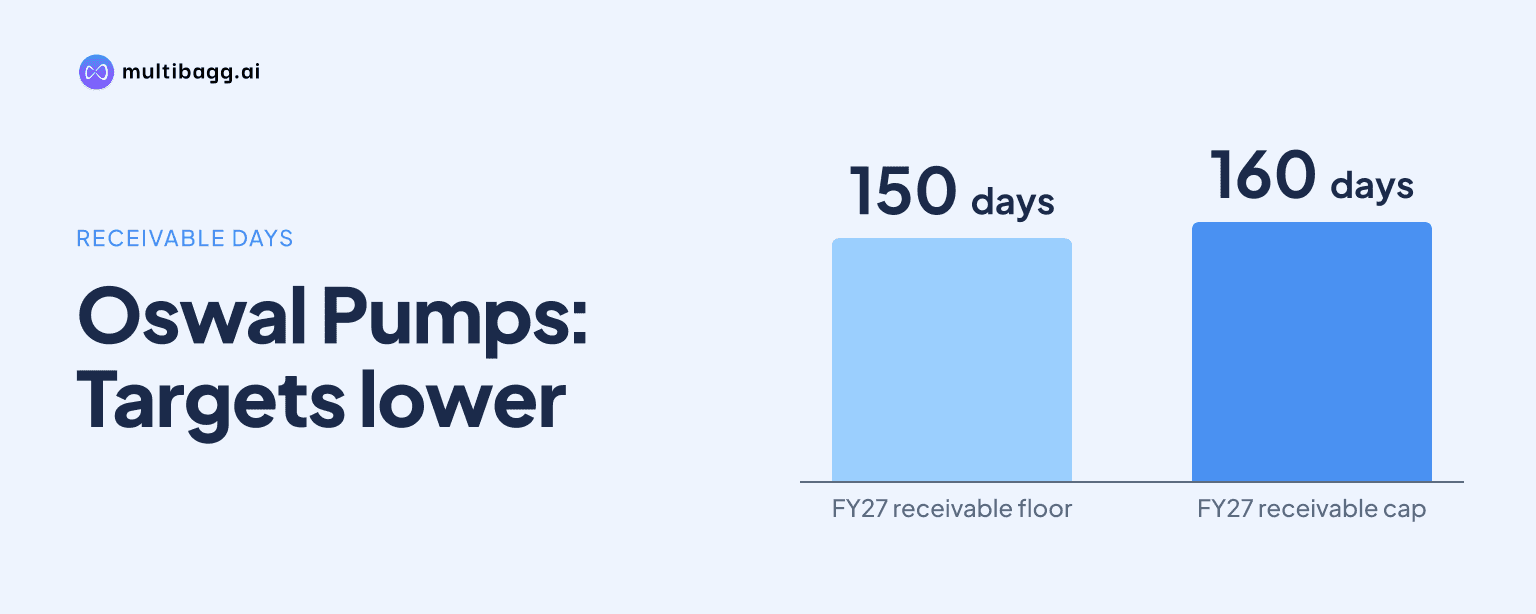
Oswal Pumps Limited is targeting debtor days of 150 to 160 by FY27-end after collecting Rs 208 crore from the Maharashtra Government in early October 2026, against 229 reported receivable days at September 30, 2026. The target depends on further state-government collections and would reduce the reported collection period by 69 to 79 days.
Know Oswal Pumps inside out
Results, valuation, peers and who's buying, in one view.
What was Oswal Pumps' working-capital position at September 30, 2026?
Oswal Pumps reported a 257-day cash-conversion cycle at September 30, 2026, compared with 244 days at June 30, 2026. The 13-day increase came from inventory days, which rose to 56 from 43, while receivable days remained at 229 on both reporting dates.
Oswal Pumps' 229 receivable days were the largest component of its 257-day cash-conversion cycle at September 30, 2026. Chief Financial Officer Vijay Kumar Yadav said all receivables were from government and government-backed counterparties, which management said gave it visibility on recoverability, but the reported collection period had not improved by the reporting date.
The balance-sheet position also reflected the funding requirement associated with the working-capital cycle. Net debt stood at Rs 531 crore at September 30, 2026, equivalent to net debt-to-equity of 0.30 times and annualised net debt-to-operating EBITDA of 2.02 times. EBITDA means earnings before interest, tax, depreciation and amortisation.
How much did Oswal Pumps collect from Maharashtra?
Oswal Pumps collected approximately Rs 208 crore from the Maharashtra Government in early October 2026, and management said the entire amount came from Maharashtra. Because the payment arrived after September 30, it was not included in the reported 229 receivable days or the 257-day cash-conversion cycle.
Management said it expected further payments during the then-current quarter from Maharashtra, Haryana and Karnataka. It added that Maharashtra had indicated that a reasonable additional payment could be made during the quarter, but these are management expectations rather than collections reported in the Q2 FY27 results.
The October receipt is material against the company’s reported working-capital data because it follows a quarter in which receivable days were flat at 229 but inventory added 13 days to the cash-conversion cycle. Management did not quantify how much of the Rs 208 crore would be used to repay short-term borrowings or how much finance cost could change.
Why is Oswal Pumps targeting 150-160 debtor days?
Oswal Pumps is targeting debtor days of about 150 to 160 by the end of FY27, based on management’s discussions with government departments. Measured against the reported 229 days at September 30, 2026, the target represents a reduction of 69 to 79 days.
Management later referred to current debtor days of around 225 to 226 days during the call, rather than the CFO’s reported 229 days at September 30. The target is therefore an outlook rather than a reported result, and its achievement rests mainly on payment timing by state-government counterparties rather than a disclosed change in billing terms.
Chairman and Managing Director Vivek Gupta said management had no indication of a specific reason for payment delays and believed states were working to clear older vendor dues before a new scheme. He also said Oswal Pumps expected cash flow to turn positive within FY27, citing the visibility management said it had on government receivable collections.
The company’s expectation is linked to PM-KUSUM 2.0, the proposed next phase of the government solar-pump programme. Management said it expected the programme to launch by December 2026 and that tendering authorities could hold pre-bid meetings within a month of launch, although it expected implementation to ramp up in the first quarter of the following financial year.
Got a follow-up? Ask IRIS
Can solar EPC projects shorten Oswal Pumps' payment cycle?
Oswal Pumps expects rooftop solar schemes to have payment cycles of 90 to 120 days, based on past tenders and industry experience cited by management. That range is shorter than the 229 reported receivable days in the government-linked business at September 30, 2026, though the company did not disclose the share of receivables or revenue associated with rooftop projects.
The company is expanding beyond solar irrigation pumps while PM-KUSUM 2.0 is delayed. Its combined order book across rooftop solar, utility-scale solar and commercial-and-industrial solar engineering, procurement and construction, or EPC, projects was about 143 megawatts, with a further pipeline of 168 megawatts at the Q2 FY27 call.
Payment profiles and profitability differ by project and state. Management expects EBITDA margins of about 13% to 15% for a Telangana project and 10% to 13% for upcoming Rajasthan orders, subject to execution and supply visibility. For Bihar, it said residential energy service company and capital-expenditure models would not generate profitability in the first year, with profitability expected over the following five years.
The potential benefit of the 90-to-120-day rooftop cycle is therefore prospective rather than yet visible in the September 2026 figures. The reported 257-day cash-conversion cycle was still shaped by the existing business, where inventory days rose from 43 to 56 and receivable days remained at 229.
Conclusion
Oswal Pumps' reported data show that the cash-conversion cycle rose by 13 days to 257 days at September 30, 2026, entirely alongside a 13-day rise in inventory days, while receivable days stayed at 229. The Rs 208 crore Maharashtra receipt in early October provides evidence of collection progress, but the 150-to-160-day FY27 target requires substantially more payments than the post-quarter collection disclosed.
The next issue to watch is whether payments expected from Maharashtra, Haryana and Karnataka arrive in time to support management’s expectation of positive cash flow within FY27. The rollout timing and early tender activity of PM-KUSUM 2.0, which management expected by December 2026, may also affect the pace at which states clear older dues and launch new solar-pump procurement.