










Page Industries Limited Q2 margin sets near-term baseline
Key highlights
- Page Industries reported a 20.8% EBITDA margin in Q2 FY27, versus 21.7% in Q2 FY26.
- Page Industries said Q2 FY27 raw-material inflation was about 6.5%-7%, compared with its 2.5% May 2026 price increase.
- Q2 FY27 sales value rose 11.5% to Rs 1,439.61 crore and EBITDA rose 7.4% to Rs 300.14 crore.
- Page Industries retained its double-digit FY27 volume-growth target, requiring about 14% growth in H2 FY27.
powered by IRIS
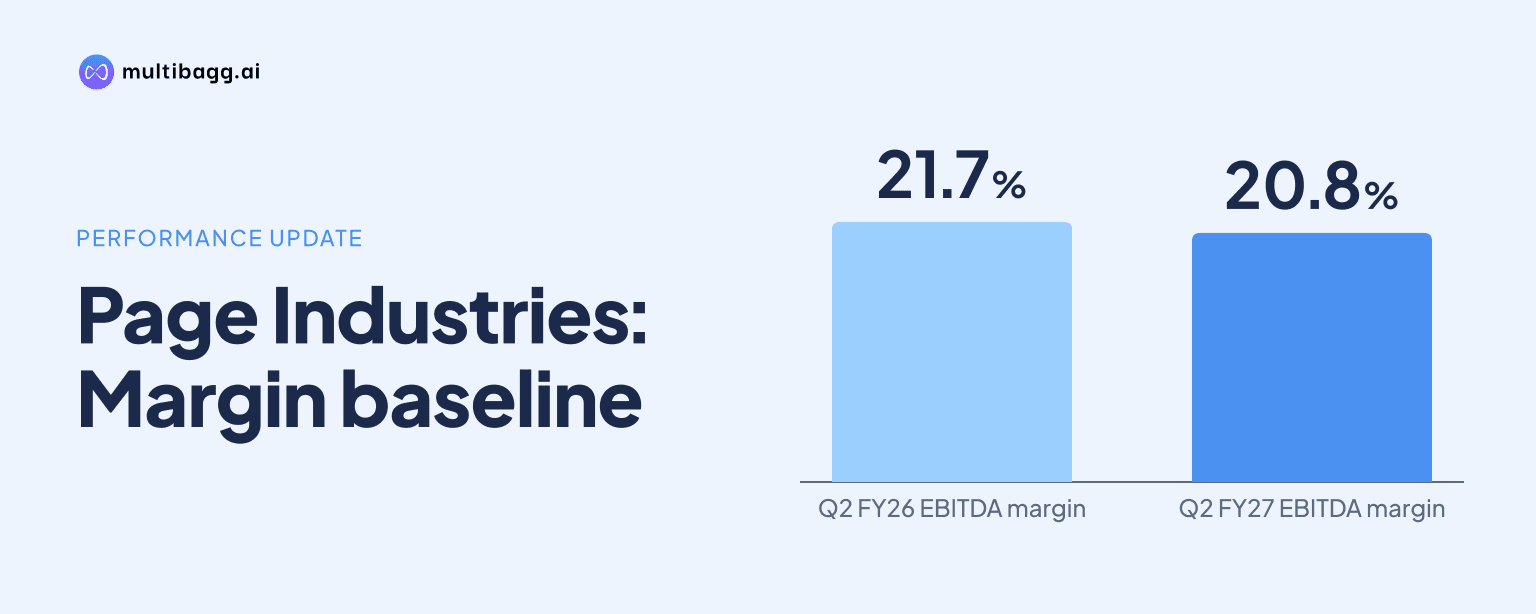
Page Industries said its Q2 FY27 EBITDA margin of 20.8% is the near-term benchmark because the 2.5% May 2026 price increase was fully effective while raw-material costs remained 6.5%-7% above the prior year. Management said margin movement from this level depends on input costs and further operating efficiencies.
Know Page Industries inside out
Results, valuation, peers and who's buying, in one view.
Why is Page Industries using Q2 FY27 as its margin baseline?
Page Industries is using Q2 FY27 as its margin baseline because both the full price increase and the higher raw-material cost base were reflected in the quarter. Chief Executive Officer Karthik Yathindra said Q2 provides a good indication of gross and EBITDA margin going forward, unless input costs change or the company delivers additional operating efficiencies. Q2 EBITDA margin was 20.8%, within management's stated 19%-21% range.
The quarter differed from Q1 FY27 because Page Industries had the benefit of lower-cost inventory in the earlier period. Management said it had pre-positioned raw-material inventory in Q4 FY26 at prices below those prevailing in Q1 FY27, supporting first-quarter gross margin. That benefit was exhausted in Q1, while elevated input costs affected the business from late June and the 2.5% price increase was realised from July.
The year-on-year comparison shows the effect of the changed cost-price balance. Q2 FY27 EBITDA margin declined 0.9 percentage points from 21.7% in Q2 FY26 to 20.8%, while H1 FY27 margin declined 1.4 percentage points from 22.0% to 20.6%. Management attributed the reduction to elevated cotton and crude-linked material costs after deciding to absorb part of the inflation.
Q2 FY27 sales value rose 11.5% to Rs 1,439.61 crore, ahead of EBITDA growth of 7.4% to Rs 300.14 crore. Profit after tax increased 4.0% to Rs 202.54 crore, and sales volume grew 5.5% to 59.8 million pieces. The difference between sales and EBITDA growth indicates that the fully effective price increase did not offset all input-cost pressure.
How far did raw-material costs exceed Page Industries' price increase?
Page Industries said its raw-material basket was inflated by about 6.5%-7% year on year in Q2 FY27, compared with the 2.5% price increase implemented in May 2026. The increase was fully effective in Q2, but management said it only partly cushioned inflation in cotton and crude-oil-based materials. The company had chosen to absorb part of this cost increase.
Input costs had not softened consistently by the November 12, 2026 earnings call. Management saw some easing during September, but said costs rebounded in October to around the Q1 FY27 level. Karthik Yathindra said prevailing raw-material inflation remained in the 6.5%-7% range versus the prior year at the time of the call.
Page Industries had not announced another price increase. Karthik Yathindra said management would balance the 19%-21% EBITDA range with affordability and accessibility for consumers, reviewing the position one month at a time. He said another increase could come at some point, but provided no amount or timing.
Cotton and crude-linked inputs are therefore the main disclosed variables behind a change from the Q2 margin level. Management did not say that the 20.8% EBITDA margin had bottomed. Instead, it said a margin improvement would depend on lower input costs or incremental operational efficiencies beyond those already used to remain within the 19%-21% range.
Got a follow-up? Ask IRIS
What is Page Industries' H2 FY27 margin outlook?
Page Industries expects to remain within its 19%-21% EBITDA margin range in H2 FY27 despite elevated costs. Chief Financial Officer Deepanjan B said management remained confident of operating inside that range, while Karthik Yathindra said Q2 FY27 is the relevant reference point when the full cost and pricing effects are considered.
This is a range outlook rather than a forecast of sequential margin recovery. Q2 FY27 EBITDA margin of 20.8% was 0.2 percentage points above the bottom of management's range and 0.2 percentage points below its midpoint. Management said margin improvement depends largely on raw-material costs and the extent of further efficiency gains.
The H1 FY27 figures capture the cumulative cost effect. Sales value grew 9.7% to Rs 2,860.06 crore and volume rose 5.6% to 121.7 million pieces, but EBITDA increased 2.6% to Rs 589.14 crore. Profit after tax was Rs 395.35 crore, which management described as broadly in line with H1 FY26.
Staffing and plant ramp-up are additional H2 cost considerations disclosed by management. Page Industries said headcount would increase as Odisha operations and K.R. Pete two operations ramp up, following an H1 FY27 ramp-up phase. The company also said garmenting workforce wage increases effective from April were already accounted for in H1 results.
Can volume growth and execution offset Page Industries' margin pressure?
Page Industries is relying on demand recovery, product introductions and factory execution rather than assuming raw-material relief. It retained its full-year FY27 target of double-digit volume growth after reporting 5.6% growth in H1, and management said H2 needs about 14% volume growth to achieve that goal.
Management linked the H2 target to a timing shift in festive demand. Pujo billing moved from September in the previous year to October, while Diwali shifted from October to November; online marketplace festival activity also moved. Page Industries plans to support new Diwali introductions in men's innerwear and bras with campaigns and marketing investment during October and November.
Supply availability constrained some primary orders in Q2 FY27. Page Industries said its historical order-fulfilment level of 98%-99% fell to 96%-97%, mainly in men's innerwear and women's outerwear. Management estimated a 3%-4% primary-order loss from inventory availability, although fulfilment had improved to about 97%-98% by the November 12 call.
Management attributed the availability issue to ramping two new plants rather than logistics disruption. It said the plants' efficiencies were not yet optimum, but the company was working to improve output and meet demand. Inventory days nevertheless declined to 74.0 at the end of Q2 FY27 from 74.8 at the start of the financial year, while net working-capital days improved to 51.3 from 55.9.
Conclusion
Page Industries' Q2 FY27 outcome provides its clearest disclosed view of the current margin equation: a fully effective 2.5% price increase did not fully absorb 6.5%-7% raw-material inflation, leaving EBITDA margin at 20.8% versus 21.7% a year earlier. Sales value still grew 11.5%, but EBITDA grew 7.4%, reflecting the cost burden.
The next points to watch are raw-material price trends, any further pricing decision and progress in raising fulfilment above the 97%-98% level reported at the call. Management also retained its double-digit FY27 volume target, requiring about 14% H2 growth, and plans an S/4HANA go-live in Q4 FY27.