










Page Industries says SKU shortages cut primary orders 3%-4%
Key highlights
- Page Industries said SKU shortages caused about 3%-4% primary-order loss in Q2.
- Primary fulfilment fell to 96%-97% in Q2 from Page Industries' historical 98%-99% range.
- Odisha and K.R. Pete were operating at about 40% of their attainable utilisation level.
- Page Industries said it needs about 14% H2 volume growth to achieve double-digit growth for the year.
powered by IRIS
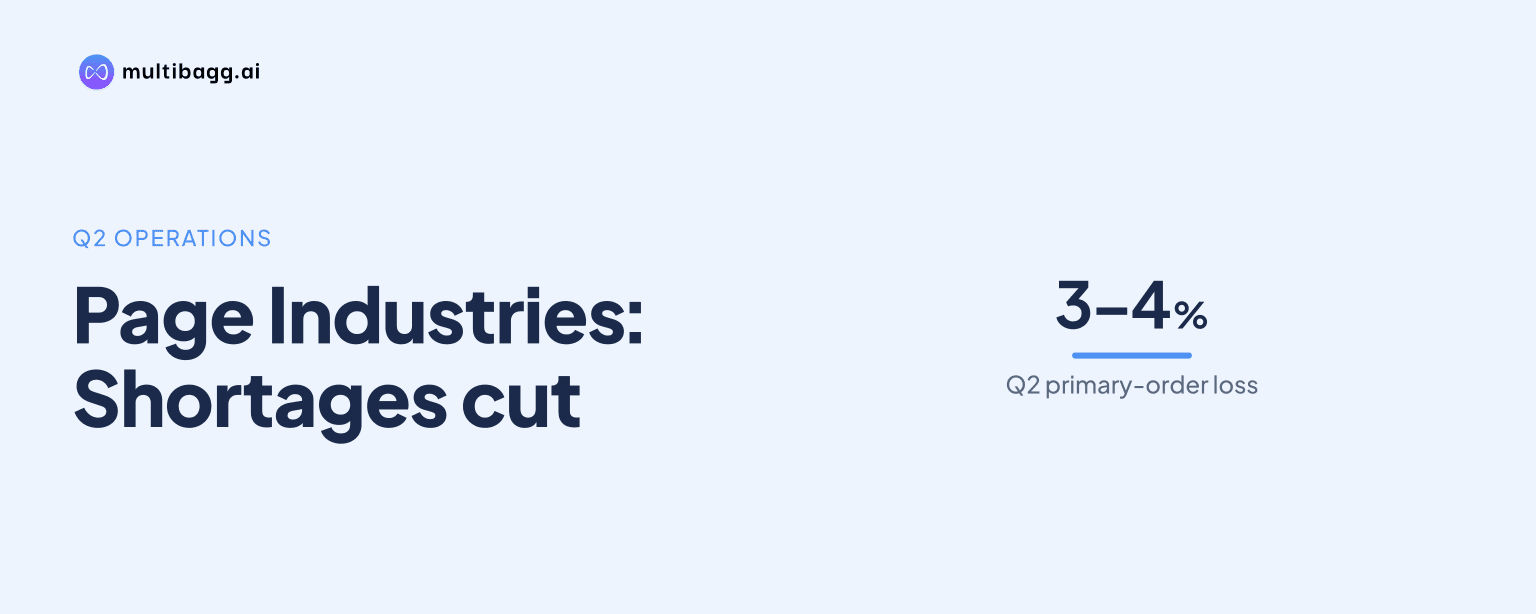
Page Industries Limited said SKU-level shortages reduced primary orders by about 3%-4% in Q2, as fulfilment fell to 96%-97% from its historical 98%-99% range. Management attributed the gap to demand spikes in selected products, imported-input delays and the efficiency ramp-up at its Odisha and K.R. Pete plants, rather than an overall capacity shortage.
Know Page Industries inside out
Results, valuation, peers and who's buying, in one view.
Why did Page Industries lose 3%-4% of primary orders?
Page Industries lost about 3%-4% of primary orders because particular stock-keeping units, or SKUs, were unavailable, chiefly in men's innerwear and women's outerwear. Its primary order-fulfilment rate dropped to about 96%-97% in Q2 from the historical 98%-99% level. Management said this reflected shortages of specific styles rather than an inability to dispatch finished goods to distributors.
The Q2 product-availability constraint differed from the three days of missed billing in Q1. Page Industries described the Q1 disruption as a one-off delivery issue at the distributor point, not an inventory problem, and said the lost billing was recovered in July. In Q2, management said built stock reached distributors without logistics problems, while production and replenishment of selected products constrained order fulfilment.
The company said the lower primary fulfilment affected secondary and tertiary sales to an extent, but did not fully pass through to retail demand. Page Industries cited inventory buffers at three points: retail stores, distributor locations and its own warehouse or production chain. Those buffers supported consumer availability while the company addressed shortages in individual SKUs.
Is Page Industries facing a broad manufacturing-capacity shortage?
Page Industries said it was not facing a broad capacity shortage because demand exceeded forecasts only for certain SKUs. Management said its overall days of inventory remained healthy and that it held buffers across three supply-chain levels. The shortfall therefore related to product mix and replenishment timing, rather than insufficient aggregate inventory or factory capacity.
The company linked part of the issue to its two new plants in Odisha and K.R. Pete, where operating efficiency had not reached planned levels. Both plants were operating at about 40% of the level they can attain, according to management. It called this a ramp-up and execution issue within its control, rather than a structural logistics problem.
Demand spikes also created a raw-material lead-time challenge. Management said the industry normally needs about three months to procure inputs and service higher orders, while Page Industries has worked to reduce its response period to about one month to 1.5 months. It said that agility limited the impact and should allow faster recovery of the lost primary orders.
Imported materials created an additional constraint for some products. Management said geopolitical disruption in the Middle East extended lead times and delayed clearance of containers for SKUs requiring imported inputs. Page Industries said it had increased buffers for affected items and taken corrective actions, but did not quantify delayed containers, affected production or related costs.
Got a follow-up? Ask IRIS
When will Page Industries' Odisha and K.R. Pete plants reach peak utilisation?
Page Industries expects Odisha and K.R. Pete to reach peak capacity utilisation by the end of the next financial year. Management said the complete ramp-up would take another 1.5 years and that both facilities remained on track against plan. It did not disclose individual plant capacities, output volumes or capital expenditure for either unit.
The ramp-up will also raise staffing needs. Page Industries said H1 employee costs reflected an optimised headcount, but headcount would increase as Odisha and K.R. Pete accelerate in H2. Management therefore expects manpower costs to catch up with business activity as the two facilities move beyond their current approximately 40% operating level.
Management said the fulfilment rate had already improved to about 97%-98% when the call was held. That remained below the historical 98%-99% range, leaving scope for roughly 1% to 1.5% further improvement. The company did not set a quarter-specific deadline for restoring its historical fulfilment level.
Can Page Industries meet its H2 volume-growth target despite shortages?
Page Industries retained its double-digit annual volume-growth target despite the Q2 SKU shortfall, saying it needs about 14% volume growth in H2 to achieve that outcome. Management attributed confidence to festive billing moving from September into October and November, marketplace festival activity, and planned Diwali launches in men's innerwear and bras.
The company said July and August primary performance was about twice the rate achieved for the reported quarter, before September primary billing weakened as festive inventory build-up shifted into October. It clarified that recovering Q1's three missed billing days in July was additional to the underlying July-August performance. Tertiary sales kept pace in September versus August, while year-on-year sales across the chain declined because the festival calendar shifted.
Raw-material inflation remained a separate operating variable. Page Industries said input costs were about 6.5%-7% higher year on year, compared with a 2.5% price increase implemented in May. Management said the September cost softening reversed in October, but maintained its expectation that earnings before interest, tax, depreciation and amortisation, or EBITDA, margin would remain in its 19%-21% target range in H2.
Conclusion
Page Industries' 3%-4% primary-order loss was linked to specific SKU shortages, not a broad inventory deficit or a logistics breakdown. Fulfilment fell to 96%-97% in Q2 from the historical 98%-99% range as demand spikes, imported-input delays and less-than-optimal efficiency at new plants constrained selected products. The improvement to 97%-98% indicates that recovery had begun.
The next disclosed milestone is the planned peak utilisation of Odisha and K.R. Pete by the end of the next financial year, from about 40% currently. Management's ability to restore fulfilment toward 98%-99%, expand plant staffing in H2 and deliver the approximately 14% H2 volume growth needed for a double-digit annual result will determine whether the supply response matches demand.