










Page Industries retains volume goal despite 14% H2 ask
Key highlights
- Page Industries reported H1 FY27 volume growth of 5.6% to 121.7 million pieces.
- Management said Page Industries needs about 14% H2 volume growth to achieve double-digit FY27 growth.
- Page Industries estimated a 3%-4% Q2 primary-order loss from product-availability constraints.
- Page Industries reported a 20.6% H1 EBITDA margin, compared with 22.0% a year earlier.
powered by IRIS
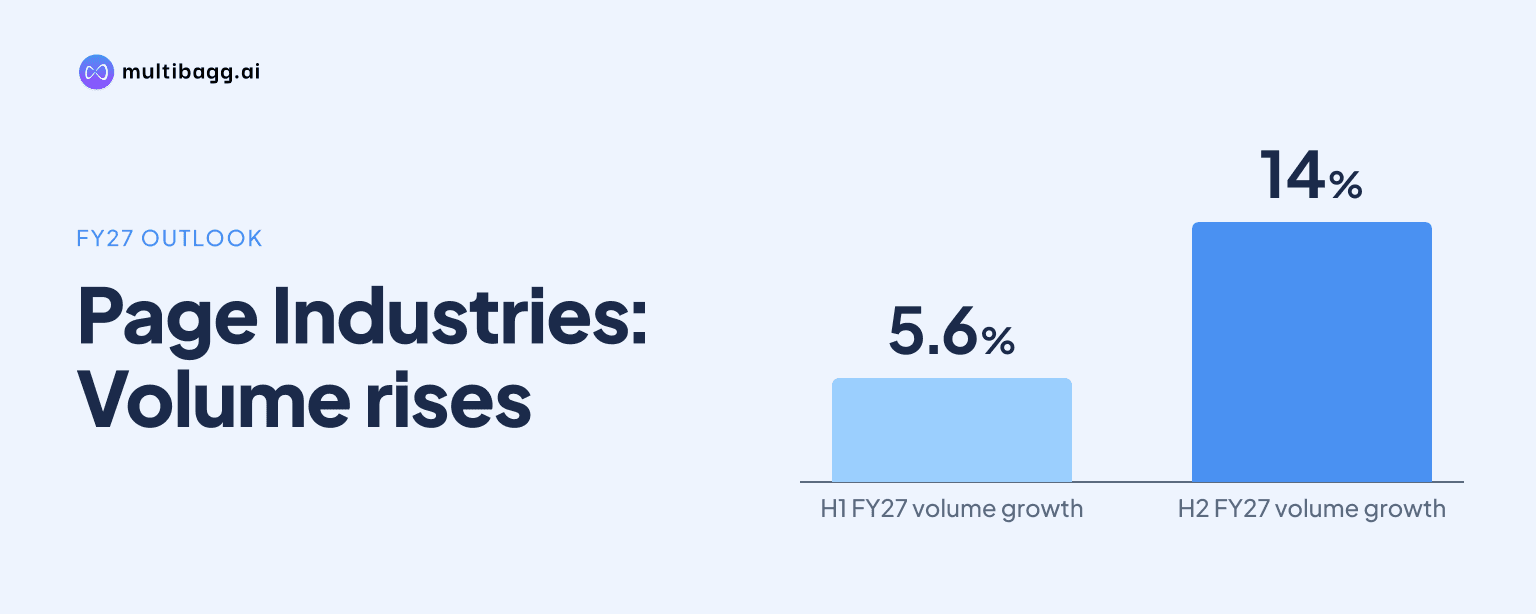
Page Industries Limited retained its double-digit FY27 volume-growth target on November 12, 2026, despite H1 volume rising 5.6% to 121.7 million pieces and management estimating that about 14% H2 growth is needed to achieve it. Management cited a festival-calendar shift, online festive events and Diwali product launches as its recovery drivers.
Know Page Industries inside out
Results, valuation, peers and who's buying, in one view.
Why is Page Industries retaining its double-digit volume-growth target?
Page Industries is retaining its double-digit FY27 volume-growth target because management attributes the H1 gap largely to a shift in festive primary-sales billing, rather than a reduction in its annual demand plan. H1 sales volume increased 5.6% to 121.7 million pieces, while Q2 volume rose 5.5% to 59.8 million pieces.
Chief Executive Officer Karthik Yathindra said the required H2 growth rate is about 14% in volume terms to reach a double-digit full-year outcome. He said management’s annual outlook and internal targets remained unchanged, and that the business was tracking its target-versus-achievement plan as of the November 12 call.
The reported sales-value trend was higher than volume growth, partly reflecting the 2.5% price increase implemented in May 2026 and fully effective in Q2. Q2 sales value increased 11.5% to Rs 1,439.61 crore, compared with 5.5% volume growth, while H1 sales value rose 9.7% to Rs 2,860.06 crore against 5.6% volume growth.
Management did not disclose October or November sales performance because Q3 FY27 had not been completed. It said that the confidence to retain the annual target came from performance against its internal plan, rather than from a revised published volume-growth forecast.
What is expected to drive Page Industries’ H2 volume recovery?
Page Industries expects festival billing moving into October and November, festive marketplace events and new Diwali product launches to support the roughly 14% H2 volume-growth requirement. The company said its published primary-sales figures are materially affected by business-to-business inventory build-up at distributors and retailers.
Management said Pujo billing that occurred in September in the previous year moved to October in FY27, while Diwali moved from October to November. It also cited the build-up for online marketplace events, including Big Billion Days and Great Indian Festival, as an important factor that shifted primary volumes from Q2 into Q3.
The company has planned Diwali introductions in men’s innerwear and bras, backed by marketing campaigns and investment. Management said these launches form part of the H2 building blocks, alongside festive stocking by trade partners and marketplace demand during the October-November selling period.
Page Industries said tertiary sales, meaning consumer-level sales, kept pace in September relative to July and August, even as primary and secondary sales weakened more sharply. Management attributed that difference to deferred inventory build-up at stores and distributors, rather than saying that the calendar shift had no effect on consumer demand.
Management did not quantify sales displaced by the festival calendar. It said July and August performance, excluding the September impact, indicated that quarterly volume growth could have reached about 11%-12%, while the three days of Q1 billing disruption had been recovered in July and were additional to that comparison.
Got a follow-up? Ask IRIS
Did product availability constrain Page Industries’ growth?
Page Industries said product availability reduced Q2 primary orders by about 3%-4%, mainly in men’s innerwear and women’s outerwear. Order-fulfilment rates fell to about 96%-97% in Q2 from the company’s historical range of 98%-99%, according to management.
The fulfilment rate had improved to about 97%-98% by the November 12 call, although it had not returned to the historical 99% level. Management said there remained scope for a further 1%-1.5% improvement as it ramps supply to meet demand in the affected categories.
Management differentiated the Q2 availability issue from the Q1 billing disruption. Three days of billing at the end of June were missed because of a delivery issue at the distributor point of sale, but management called that a one-time event, said it was recovered in July and said Q2 had no logistics issue in delivering build stock to distributors.
The availability pressure was linked to the ramp-up of the Odisha and K.R. Pete facilities, where management said operating efficiencies were not yet optimal. The two plants were operating at about 40% of their expected capacity level, and Page Industries said full ramp-up would take another 1.5 years.
Management expects the Odisha and K.R. Pete plants to reach peak capacity utilisation by the end of the next financial year. It said increased headcount would accompany the ramp-up in H2, meaning employee costs are expected to catch up with business growth as production at the two facilities expands.
How do pricing and input costs affect the H2 plan?
Page Industries said raw-material inflation remained about 6.5%-7% above the prior-year level in Q2, while its 2.5% May 2026 price increase only partly offset the pressure. Management cited both cotton and crude-linked inputs, which softened in September but rose again in October.
Q2 earnings before interest, tax, depreciation and amortisation, or EBITDA, increased 7.4% to Rs 300.14 crore, while the EBITDA margin declined to 20.8% from 21.7% a year earlier. For H1, EBITDA rose 2.6% to Rs 589.14 crore and the margin was 20.6%, compared with 22.0% in the prior-year first half.
Profit after tax rose 4% in Q2 to Rs 202.54 crore, while H1 profit after tax was Rs 395.35 crore and was broadly in line with the prior-year first half. The lower H1 EBITDA margin reflected elevated raw-material costs despite the price increase and operating efficiencies, management said.
Management said Q2 was an indication of the margin environment going forward because the full 2.5% price increase and elevated raw-material costs were both reflected in that quarter. It maintained its 19%-21% EBITDA-margin range for H2, while saying future input costs and additional efficiency measures would determine whether margins change from the Q2 level.
No further price increase had been announced as of November 12. Management said it would assess pricing one month at a time, balancing the 19%-21% EBITDA-margin range with affordability and accessibility for consumers as cotton and crude-linked costs remain elevated.
Conclusion
Page Industries’ unchanged FY27 volume objective depends on management’s view that festive primary billing moved from Q2 into Q3, rather than being lost, and that Diwali launches and marketplace events can help close the gap. The plan still requires about 14% H2 volume growth after 5.6% growth in H1, while improved product availability is needed to recover the estimated 3%-4% primary-order loss.
The next disclosures to watch are Q3 FY27 results, which should capture October-November festive billing and provide an update on fulfilment rates. Management also plans to implement S/4HANA in Q4 FY27, expects Odisha and K.R. Pete to continue ramping toward peak capacity by the end of the next financial year, and targets adding 8,000 to 10,000 outlets by FY27-end.