










Paras Health targets 1,800 beds before 800-bed expansion
Key highlights
- Paras Health had 1,500 operating beds and plans to move closer to 1,800 through 200-250 pending openings in Kanpur and Ranchi.
- Paras Health plans 300 beds in Gurugram and 500 beds in Ludhiana, creating 800 beds across the two projects.
- Srinagar operated at 60.4% occupancy in H1 FY27, after which management said completed empanelments created scope to improve payor mix.
- Paras Health said its average length of stay has historically ranged from 2.8 to 3 days across eight hospitals.
powered by IRIS
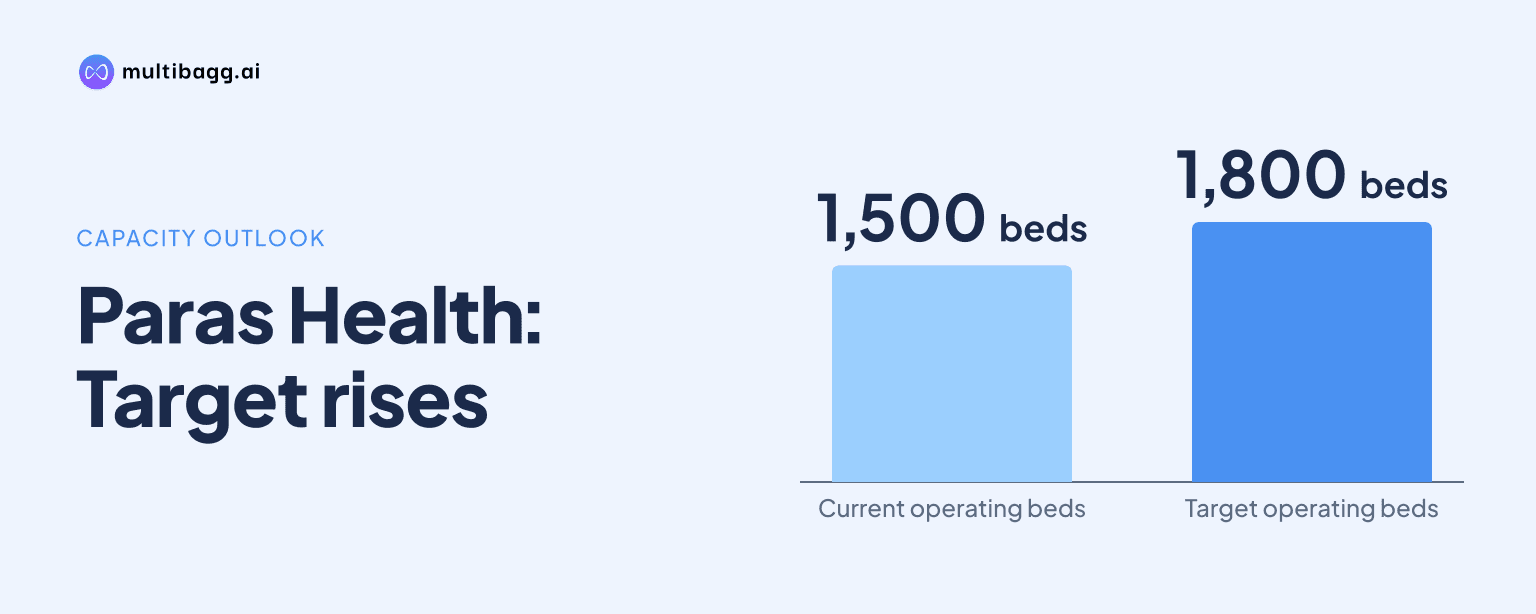
Paras Healthcare Limited plans to raise its operating-bed base from 1,500 toward 1,800 by opening 200 to 250 beds in Kanpur and Ranchi, before adding 800 beds through planned 300-bed Gurugram and 500-bed Ludhiana facilities. Management disclosed the capacity sequence during its H1 FY27 earnings call.
Know Paras Healthcare inside out
Results, valuation, peers and who's buying, in one view.
How many beds will Paras Health activate before larger projects?
Paras Health plans to activate about 200 to 250 beds in Kanpur and Ranchi, taking its 1,500 operating beds closer to 1,800. Dilip Bidani said Kanpur has two wings yet to open, while Ranchi has additional beds awaiting activation within the existing overall capacity.
Management did not provide a bed-by-bed split between Kanpur and Ranchi or a separate commissioning date for either site. The analyst asked about the second half of the year and FY28, but the response described the beds only as yet to be opened, leaving the timing of individual wings undisclosed.
The planned 200 to 250 beds represent a 13% to 17% increase on the current 1,500-bed operating base. Management used the phrase “closer to 1,800,” rather than providing an exact post-opening figure, so the target should be read as an approximate operating-bed level.
Where will Paras Health add its next 800 beds?
Paras Health plans a 300-bed Gurugram 2 facility and a 500-bed Ludhiana facility, creating an 800-bed second phase of expansion. Bidani said the Gurugram and Ludhiana beds were coming up over the next 12 to 18 months, while describing the Ludhiana facility as arriving in the following year.
The Golf Course Extension facility in Gurugram is intended to address limits on further capacity use at the existing Gurugram hospital. Management said Gurugram has less remaining occupancy headroom, whereas Patna has additional opportunity and Panchkula has some scope for higher occupancy.
Management said both upcoming hospitals will retain an asset-light model. Dr. Dharminder Kumar Nagar said Paras Health is open to greenfield, brownfield, mergers and acquisitions, operations and maintenance arrangements, and public-private partnerships over the medium to long term, but the immediate focus is delivery of the Gurugram and Ludhiana projects over the next two years.
Got a follow-up? Ask IRIS
Why is Paras Health expanding when occupancy is high?
Paras Health is adding capacity because available occupancy headroom differs across hospitals. An analyst cited network occupancy of about 76% in Q2 and mature-hospital occupancy of almost 78%, roughly 200 basis points higher year on year, while management identified limited headroom in Gurugram but more room at Patna and Panchkula.
Newer hospitals remain at a different utilisation stage. Srinagar operated at 60.4% occupancy in H1 FY27, and management said its earlier strategy in Srinagar and Kanpur was to fill beds rapidly through insurance and government-scheme empanelments. With those empanelments completed, management said it sees scope to improve the payor mix.
Management is also seeking more patient admissions by improving its CTC consultation funnel through marketing initiatives. It said greater consultation volume can convert into inpatient admissions, but did not give a numerical occupancy target for the 200 to 250 beds in Kanpur and Ranchi or for the 800 planned beds in Gurugram and Ludhiana.
How will Paras Health support use of new capacity?
Paras Health intends to support capacity use through tertiary and quaternary-care programmes, including transplant and robotic surgery services. Management said liver-transplant services began in Gurugram and were subsequently extended to Panchkula and Patna, where it is seeing traction across all three units.
The company also cited kidney transplant, bone marrow transplant and robotic surgical programmes as ways to deepen speciality care. Robotic programmes operate in Gurugram, Patna and Panchkula; Ranchi recently launched one, while Udaipur has an orthopaedic-focused robotic programme.
Management said average length of stay, or ALOS, has historically been about 2.8 to 3 days across its eight hospitals. It attributed that range to the clinical mix of surgical and medical care, day-care procedures, oncology radiation and chemotherapy, and robotic surgery; newly opened hospitals may initially report higher ALOS depending on their case mix.
Paras Health described a maturity model rather than issuing margin guidance. Management said new hospitals begin with negative earnings before interest, tax, depreciation and amortisation, or EBITDA, then move to mid- to high-teen margins before reaching a mature-hospital bucket currently blended in the mid- to high-20% EBITDA range. Bidani said the long-term mid-20% blended EBITDA expectation was a business-model playbook, not formal guidance.
Conclusion
Paras Health has outlined a staged capacity programme: activate 200 to 250 beds at Kanpur and Ranchi to move from 1,500 operating beds toward 1,800, then develop 300 beds in Gurugram and 500 in Ludhiana. The expansion coincides with efforts to raise utilisation in newer hospitals, improve payor mix after empanelments and extend higher-acuity clinical programmes.
The next disclosures to watch are commissioning progress at Kanpur and Ranchi, followed by delivery milestones for the 300-bed Gurugram and 500-bed Ludhiana facilities. Management has not provided network revenue, occupancy or profitability guidance for the expanded capacity, making execution and patient-volume ramp-up the principal unresolved factors.